Expect regular events and activities if you do. Last semester, for instance, they organised a workshop dedicated to building birdhouses meant to be hung around the Belval campus. ROUX attended, which inspired us the question: what would a birdhouse look like if certain famous architects were to design it in their signature style? Enjoy, thus, this little panorama of anticipatory architecture fiction.
Better not look him up in the 30s...
Let us begin with a conceptual analysis. A birdhouse is the encounter of a bird and a house. A house is a machine for living in. But what is a bird? A bird is a biped, and thus only differs from a human because it has feathers. Therefore, a birdhouse is, in essence, a human house, only with less need for isolation. The exactness of this deduction can be proven by the fact that the equation’s terms can be inverted without its truth being altered: a human house is a birdhouse. But that is because I take people to be pigeons.
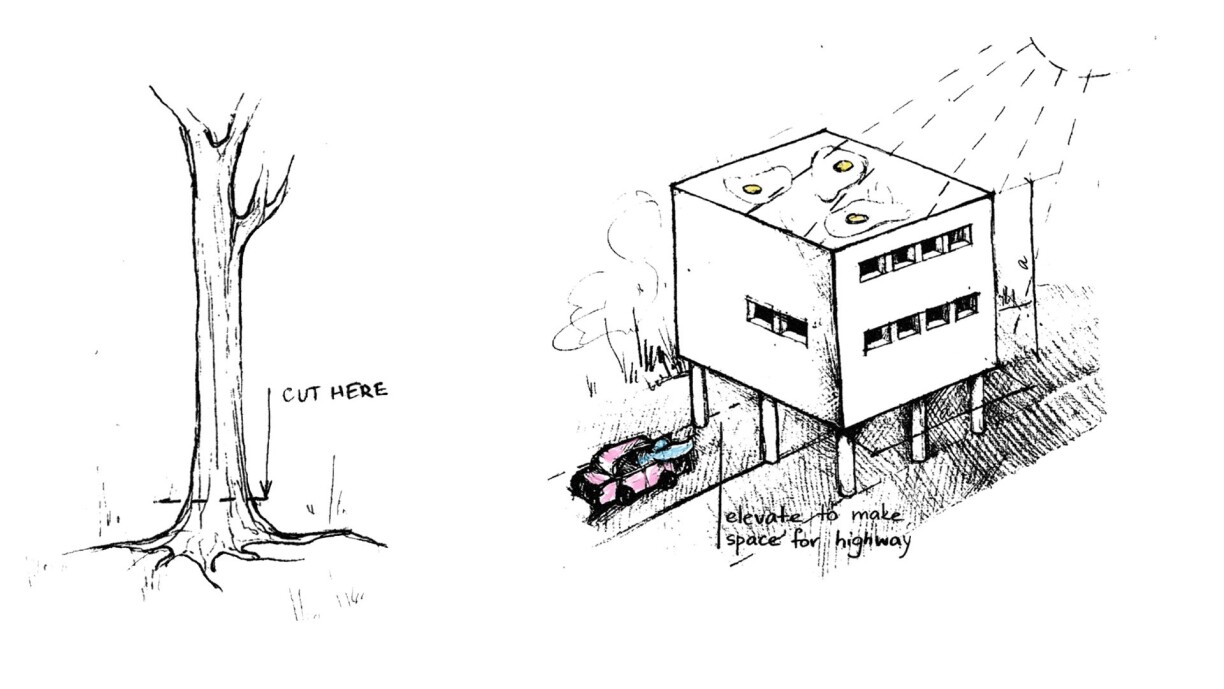
Start by chopping down the tree; it will not be needed. Branches and leaves serve no immediately discernible purpose and hinder access to light. Wood is, furthermore, an outdated material, as is everything reminiscent of nature, including nature itself. Seal the ground on which the tree used to stand with a layer of tar. We shall call this the plan Voiseau.
Build a reinforced concrete cube with a dimension of 8m3. Drill on each of its four lateral sides a number of holes, which will be so many dwellings for bird households. The optimal size for these habitacles was determined by making the inventory of a bird’s basic vital needs, disregarding everything that could not be neatly quantified and multiplying what could by 0,85. There are no small profits! Heat will come from the scorching sun shining directly at the thing non-stop. This will incubate the eggs naturally, leaving both bird parents free to venture outside, maximising their time of activity. Indeed, by swallowing seeds and expelling them, birds play an essential part in the reproduction process of plants. A bird that stays in its roost is unproductive, neglects its duties as a denizen of nature. In truth, these birdhouses would, therefore, be more accurately named bird dormitories, with the caveat that they should not even be comfortable for that either, as they would otherwise encourage sleeping in…
Multifunctional: on particularly hot days, can serve to make fried eggs
Thank or blame him for Paris' iconic look.
Before we begin, a slight adjustment in scope is necessary. The task here is not to build a birdhouse, but to redraw an entire forest.
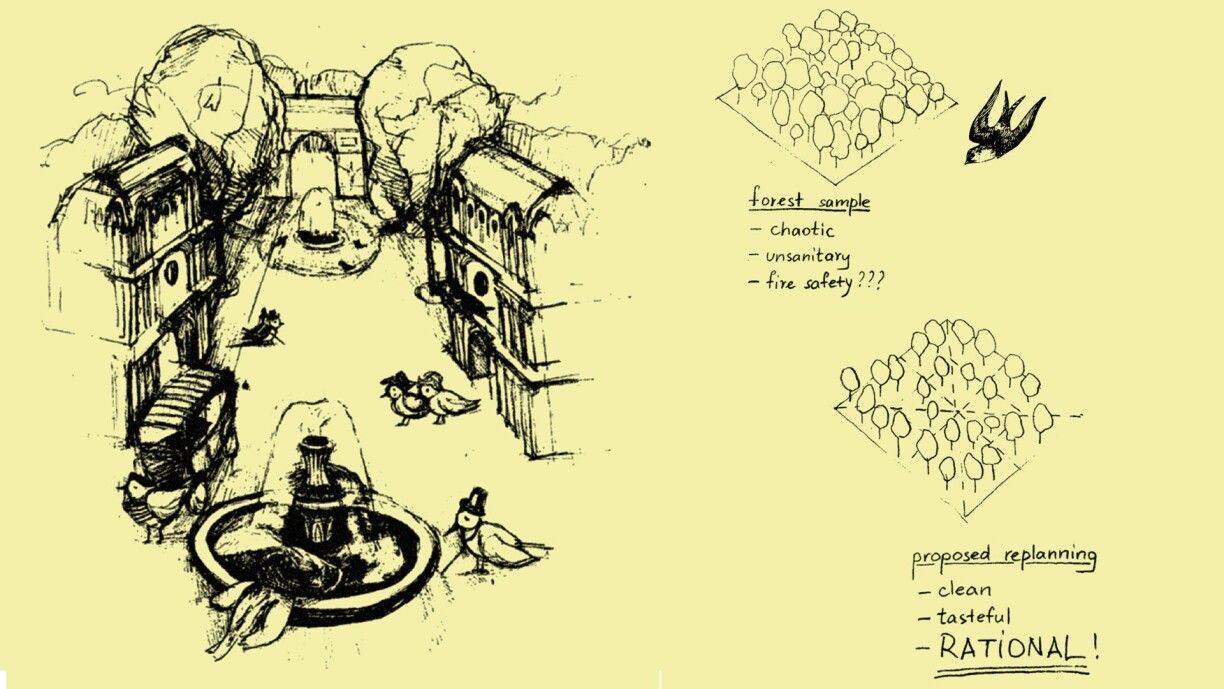
Look at these trees, haphazardly scattered about, standing far too close to one another, competing for light, erm… made out of wood? Fire hazard! Unsanitary! How can such a place not turn into a den of vice and sedition? A dwelling fit only for beasts, I tell you... But the times are medieval no more, so grab a ruler, a chainsaw, and get ready to shine in this mess the holy light of reason.
Begin by drawing, ruler in hand, a few main arteries, long and wide, emanating in a star-like fashion from a single, central point. (They call you the Attila of the straight line.) Connect these boulevards with further ones, narrower but no less straight. (They call you the Titan.) Rinse and repeat until you reach a satisfying degree of meshing. (They call you the Athlete with a robust spine.) As you trace your avenues, make it a point of honour to raze everything in your path to the ground. Let nothing stop you, neither secular oaks nor scruples or river beds, and concede a curve only when absolutely unavoidable. Finally, disregard with sovereign indifference those puny little songbirds that will squeak: “The old Paris is gone (the shape of a city / Changes faster, alas! than the heart of a man)”1. One does not make an omelette without breaking a few eggs. (They call you the Boar.)
When you are done, the forest should be far easier and safer to navigate, at the expense of half of its original appearance. Moreover, your newly created, uncluttered lines of sight will prove themselves perfect for birdwatching… or hunting.
Stylistic homogeneity brings aesthetic harmony. There will be, exactly, one template that will be shared by every birdhouse; but it will be a sumptuous and intelligently designed one (unlike Belval). On each side of your streets, align these multi-storeyed birdhouses. They will have the added benefit of enabling great woodland diversity: on the ground floor, hiving alcoves for crafty bees; the bel étage reserved for fat cuckoos and their bejewelled magpies; and the attic rooms to be occupied by all manner of unassuming or bohemian passer birds.
Providing James Bond villain lairs since 1924.
When the three Wright brothers – Orville, Wilbur and Frank – realised the flying machine they had devised would not be able to carry three people aloft, they resorted to drawing
straws, and Frank had to find himself a new hobby. So he turned to architecture, specifically bird housing. In his mind, this seemed somewhat akin to building hangars for tiny, squishy aeroplanes.
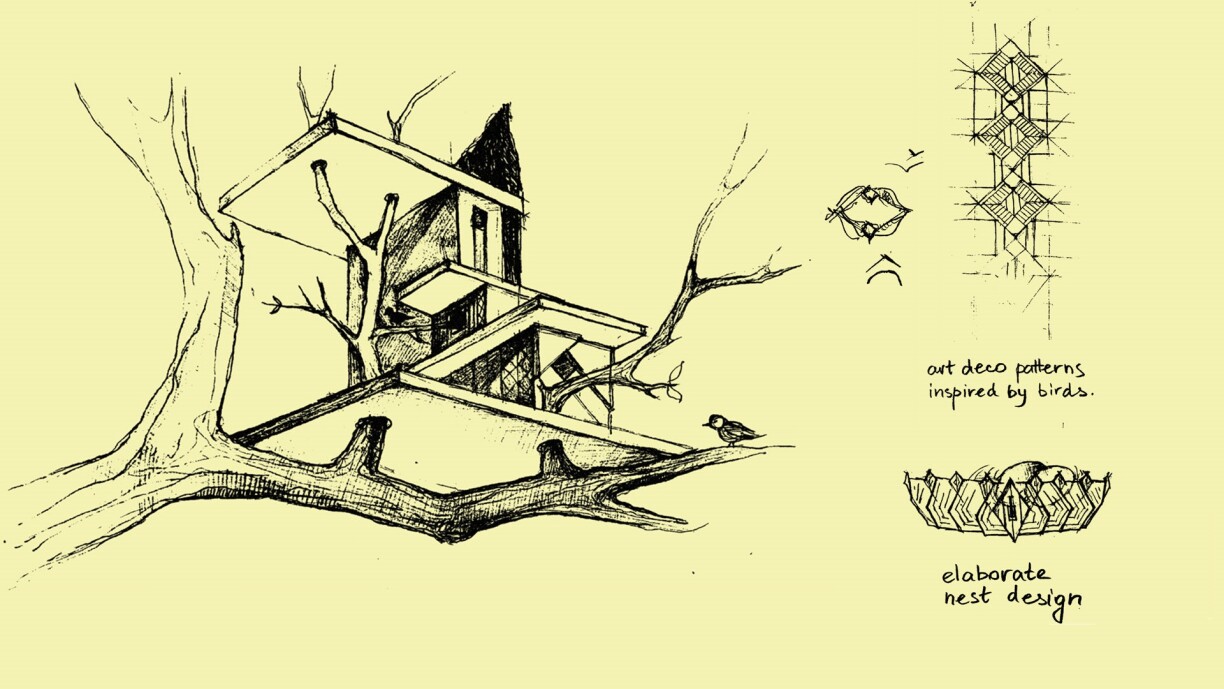
Integration into the local landscape is key. Conceiving the birdhouse as an entity separate from the tree is a flawed way to apprehend it: the birdhouse is the tree, the tree is the birdhouse. However, the man-made element should not achieve harmony with its given surroundings at the expense of its own particular character, i.e. by imitating nature to the point of being indistinguishable from it. Let nature be nature and artifice be artifice. Rather, the forms and textures found in nature and those that necessarily come from human hands should inform one another in a respectful dialogue – a lovely tension, if you will.
Select a mighty tree, endowed with sturdy branches sprouting at a propitious angle. They shall become the foundation of your terrace-style birdhouse. The house will be built in the manner of an open space around a branch – with the branch traversing it through and through –, utilising its ramifications as so many perches for birds to roost as well as a natural way to partially segment its interior into rooms and floors. For the structure, use materials found on location, such as tree bark, leaves and moss, but also, to gently break the monotony, materials coming from the mineral realm.
Leave nothing up to chance: think every detail through, design every element, adorn the walls with avian motives, carve them into the branches… Do not even let the birds come up with their own nest, but design it yourself by hand-crafting each individual twig that will make it up. Do not be lazy, do not rest; nothing is negligible; every nook and cranny, every speck of dust is an art piece worthy of your full, undivided attention. If you could, you would even design the birds. Finally, do find a way to make the tree hatchet-proof, maybe by stacking up sandbags at its base. We have had some unsavoury experiences in the past…
Audacious. Abstract. Inevitable.
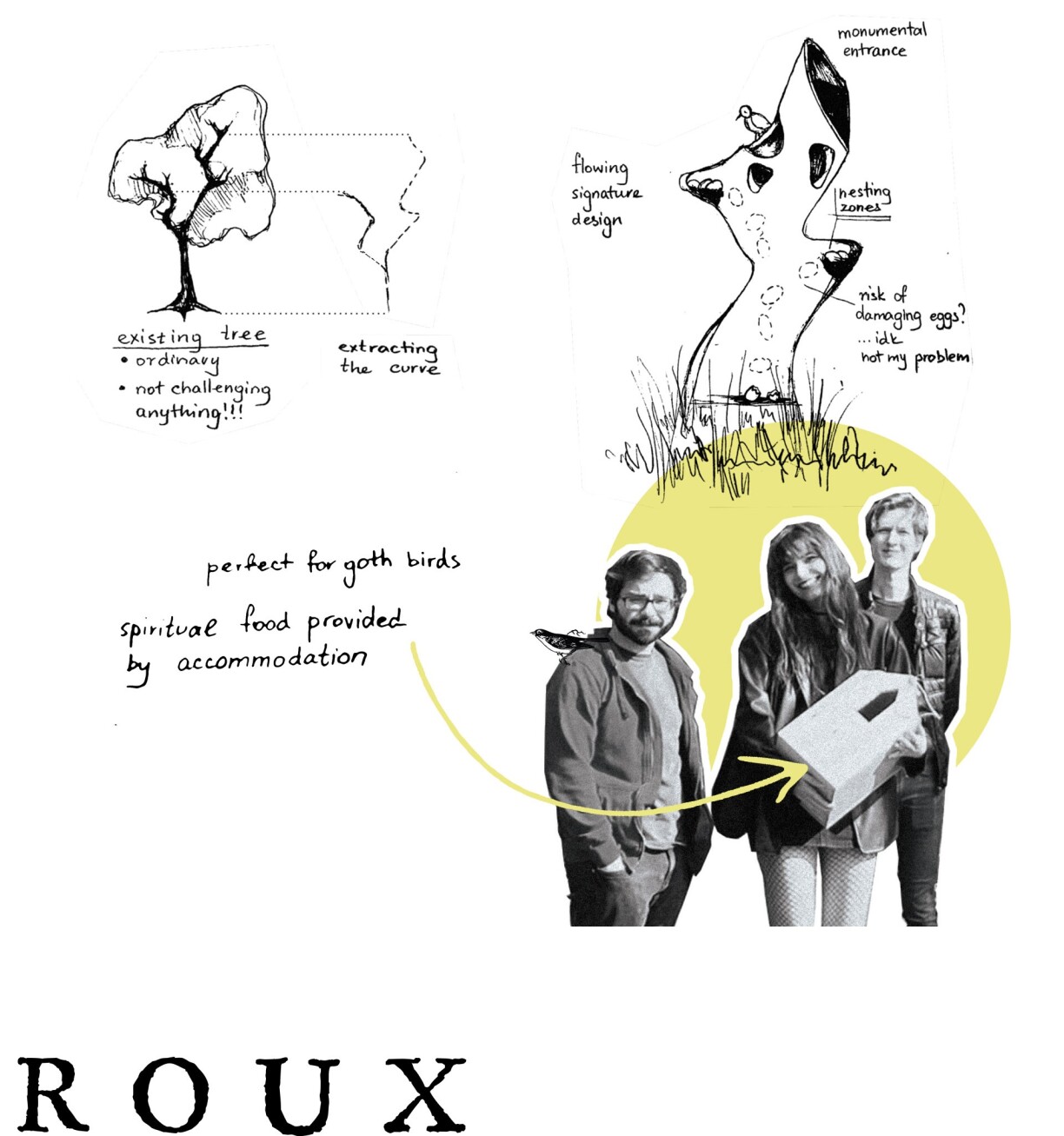
Whose deed? Hadid! This is the motto that should preside at your every design decision; that should, moreover, force itself into the mind of every passer-by glancing at your building. Therefore, even if your design is not bad-looking in itself, you must ensure that it sticks out in the landscape like a monumental sore thumb. Remember that your building is never as beautiful as when it looks like it should sink housing prices in its neighbourhood. (But fret not: if you do it right, you should actually achieve stratospheric gentrification, that is, just high enough for the jet-set to never have to touch the ground.)
Spin the wheel of fancy words to choose the concept behind your birdhouse: fragmentation… and celerity – again! First off, get rid of the tree. Then, create a form, ideally out of glass, espousing the supple strength and upward momentum of the tree you just removed (the tree lives on in the design… – it’s okay if you don’t get it). Concretely, it should look like a flattened spaghetto climbing in a spiralling motion around where the trunk used to be. Salt and pepper your structure with half a dozen mystifying pointy bits at astonishing angles. Put the entrance at the top of the structure to facilitate access for birds: this will allow you to check “functional design” off of your to-do list. An afterthought is a thought; your conscience is clean. Then, make the above-mentioned entrance comically large, because you can. With the interior needlessly exiguous, you can now brag to your colleagues about your designs being inspired by the living (in this case, by the deep-sea fish Eurypharynx pelecanoides, also known as pelican eel and umbrella-mouth gulper).
Due to the birdhouse’s slanted nature, there is a non-null risk of a bird’s egg rolling all the way down the spiral to the ground. But that is quite alright because, as we have seen, practical concerns are for the poor. The rich can afford to be wasteful: that is how they recognise each other… and themselves.
Our initial plan was to make a pirate ship. Halfway through, Kristina said she wanted a Gothic cathedral. We tried to talk her out of it, but she threatened that she would cry. Voilà.
Roux Magazine is made by students at the University of Luxembourg. We love their work, so we decided to team up with them and bring some of their articles to our audience as well. You can find all of their issues on Issuu.





