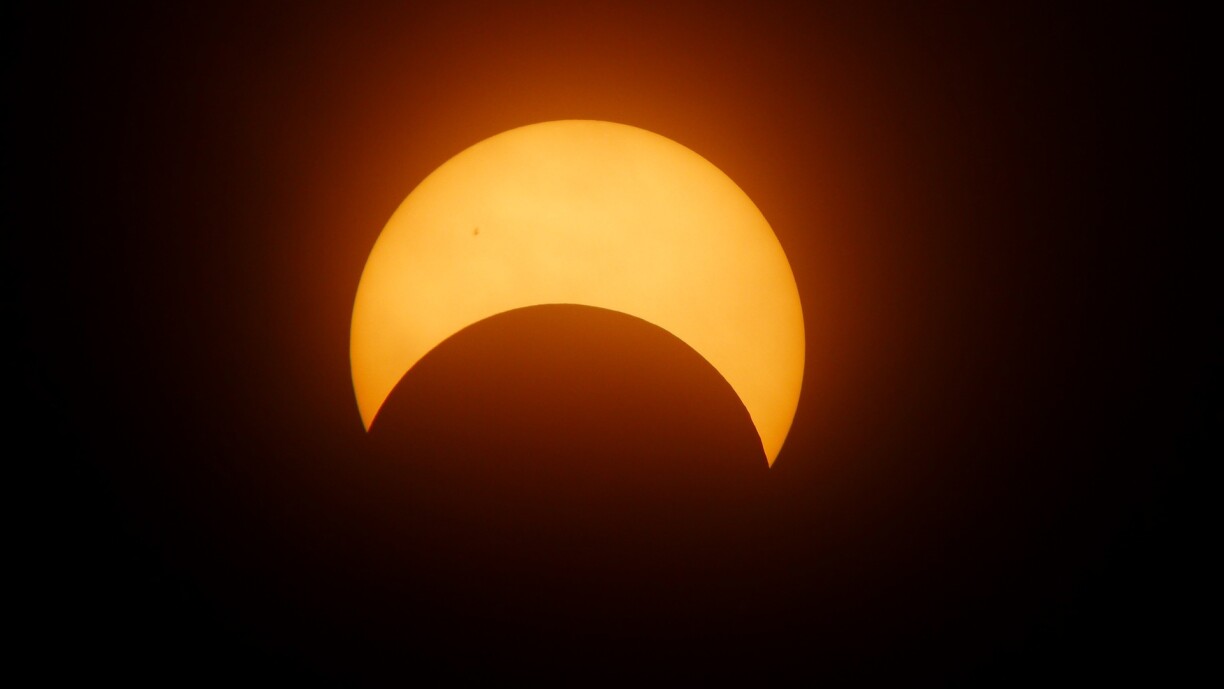
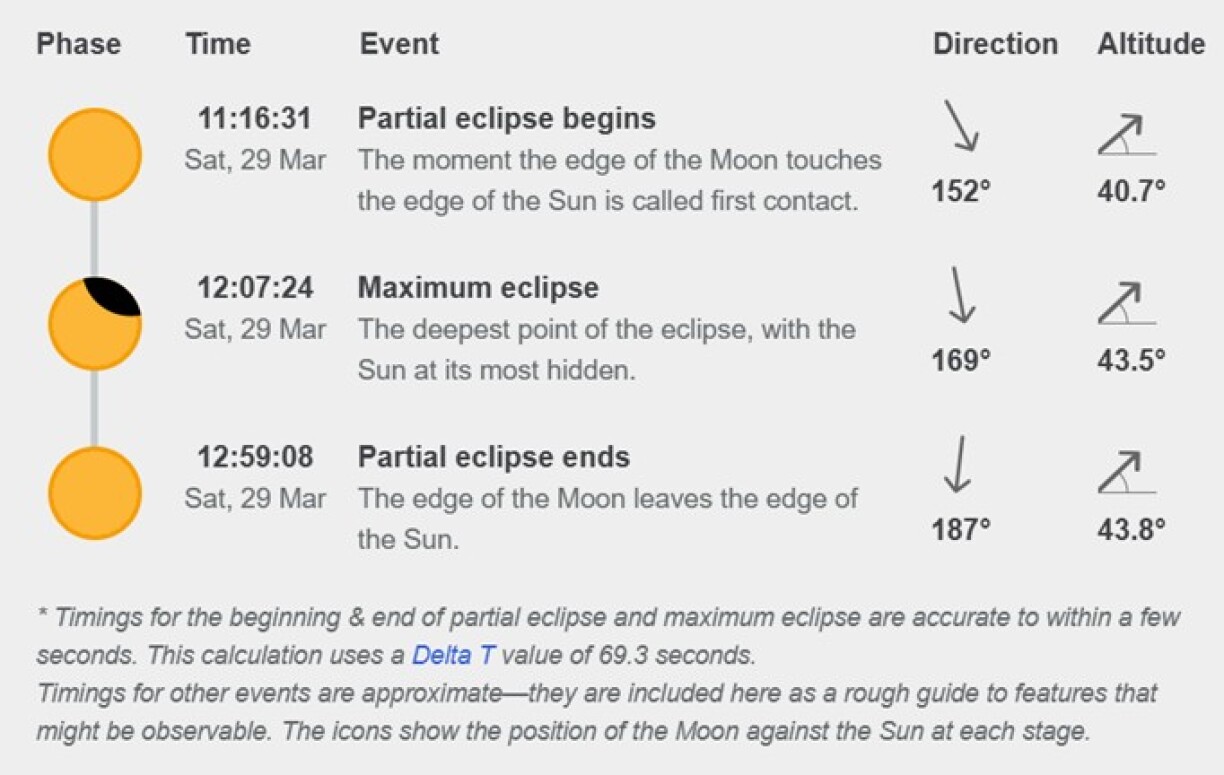
The event will be visible across various regions, including Europe, western Africa, eastern Canada, and the northeastern United States. In Luxembourg, it will begin around 11.16am to reach its peak at around 12.07pm. The majestic spectacle will then gradually fade until 12.59pm. At its highest, approximately 19.6% of the Sun will be covered by the Moon, creating a noticeable celestial event.
The current weather forecast for Saturday midday indicates that the sky will likely be cloudier in the direction of Éislek than in the south, but not overcast – rather, a mix of clouds and sunny spells.
Witnessing a solar eclipse is a scenic event, one that always makes for a remarkable and unforgettable experience. If the weather cooperates, there's no excuse to miss it! However, looking at the Sun is extremely dangerous and some precautions are mandatory. For a safe and enjoyable viewing experience, popular choices are:
Looking directly at the Sun, even for a moment, can cause permanent eye damage, leading to irreversible vision loss. To protect your eyesight, never, under any circumstances, watch the Sun without proper eye protection. Ensure that the solar filter is stable and free of any holes or defects before use.
A solar eclipse occurs when the Moon passes between Earth and the Sun, casting a shadow on our planet. This is possible since the Moon and the Sun appear almost the same size in the sky, a result of an extraordinary cosmic coincidence: the Sun is about 400 times larger than the Moon, but it is also about 400 times farther away from Earth.
This proportionality allows the Moon to perfectly cover the Sun when is at or near perigee (closest to Earth), leading to total solar eclipses. However, since the Moon's orbit is elliptical, its apparent size varies slightly, meaning that when the Moon is near apogee (farthest from Earth), it does not fully cover the Sun, resulting in an annular eclipse instead.
Throughout history, solar eclipses have played a crucial role in scientific discovery. One of the most significant examples is the 1919 total solar eclipse, which provided the first observational proof of Einstein's General Theory of Relativity. During this event, Sir Arthur Eddington led an experiment from Principe Island (off the coast of Africa) and Sobral (Brazil), measuring how the Sun's gravitational field bent the light of distant stars-just as Einstein had predicted.
As Brother Guy Consolmagno, Director of the Vatican Observatory, noted: "The most famous [scientific] use of eclipses was in 1919 when Arthur Eddington observed a star whose light passed close to the sun.... his measurements of how the sun's gravity deflected that light was the first strong indication in favour of Einstein's Theory of General Relativity."
This groundbreaking observation revolutionized our understanding of gravity, cementing eclipses as powerful tools for scientific exploration.
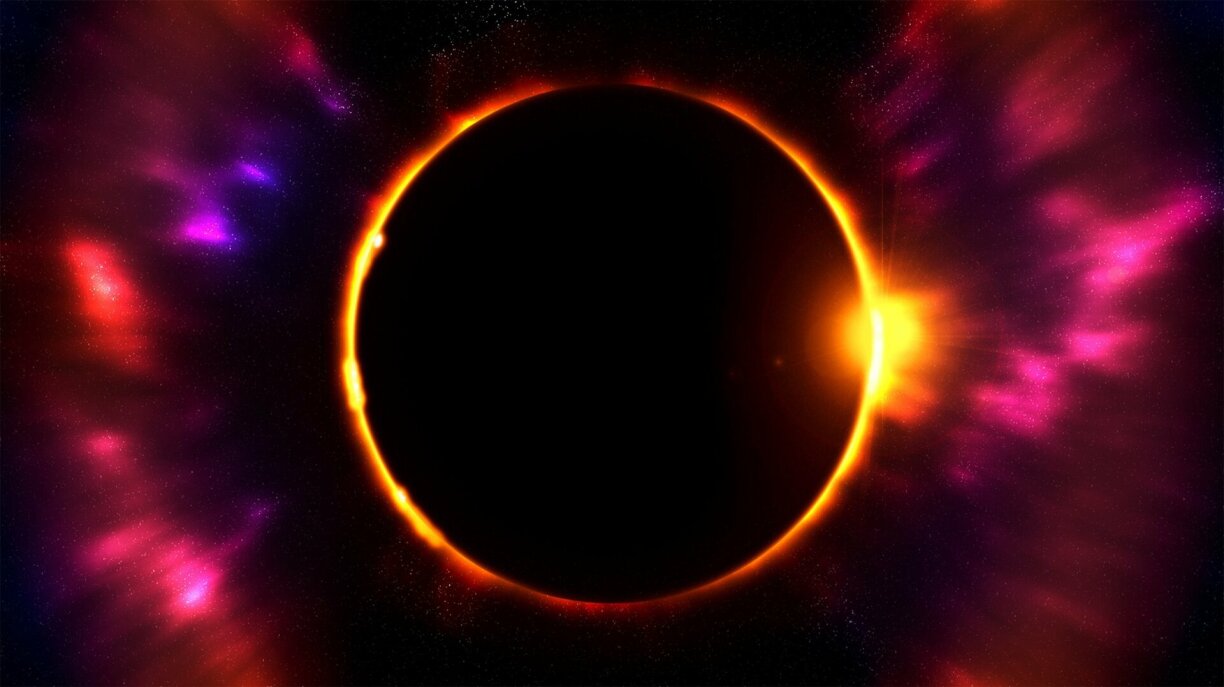
Solar eclipses have also been source of fear and fascination. In some ancient cultures, they were interpreted as supernatural events, often seen as omens.
Today, however, they are understood through the lens of science and celebrated as natural phenomena. The shift in belief was properly highlighted by Cornell University researchers: "Eclipses, once feared as cosmic warnings, are now moments of public engagement and scientific discovery."
The partial solar eclipse on March 29, 2025, is a must-see event for everyone in Luxembourg. Moreover, with the Sun at the peak of its maximum phase, solar activity will be particularly intense, featuring numerous active regions, sunspots, and prominences. This makes the eclipse a perfect opportunity for photography-so get your camera ready!
And the excitement doesn't end there: two even more spectacular events are on the horizon.
The next total solar eclipse visible in Europe will occur on 12 August 2026, with totality observable in the Arctic and parts of Iceland, while in Luxembourg it will be approximately 90% partial, almost a total-like experience.
A year later, on 2 August 2027, another total eclipse will be visible across North Africa and parts of southern Europe, with Luxembourg again experiencing a partial eclipse.
Adriano Anfuso is a photographer and digital creator who is passionate about capturing the awe-inspiring beauty of the cosmos and Earth's wonders. You can check out his work here.





