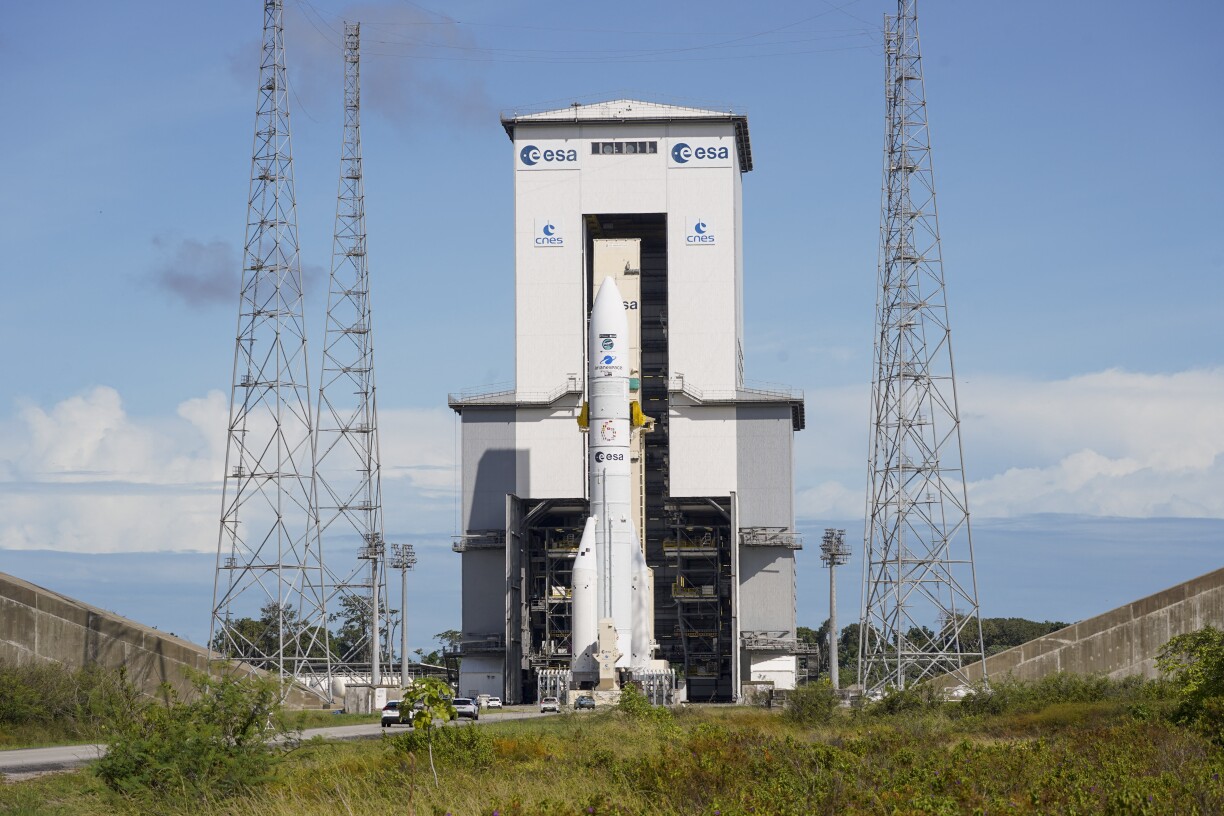
The European Think Tank ESPI, of which the Luxembourg Space Agency is also a member, sees the launch of Ariane 6 as a strategic milestone that will secure European access to space. This at a time when space is playing an increasingly important political, economic and security role.
It is the first launch of the most powerful configuration yet, the Ariane 6-4. In contrast to the basic variant with two additional rockets, four boosters provide extra thrust in the first flight phase. This makes it possible to transport more than twice as much payload into orbit, an important step to remain competitive even on more difficult missions.
"Europe has a clear interest in having rockets that allow us to launch our own missions into orbit", says Ludwig Möller, director of the ESPI. This would not only apply to scientific projects, but also, above all, to security and defense missions. It would therefore be crucial to have reliable and competitive launchers.
"It is important that the reliability that has been demonstrated so far is now also confirmed in this configuration", explains the expert.
According to Möller, in addition to technical success, political factors equally play a role. In Europe, there have been long-running discussions about a European preference, meaning the idea of prioritising European launchers for European missions.
"That is an important step", Ludwig Möller said, "but it is just as important to build up a separate commercial European market".
It may appear paradoxical that Ariane 6 is launching with a major US customer as Amazon is deploying its Kuiper constellation into orbit, a direct competitor to Starlink. But Möller explains: "We are creating a global market today in order to have a sustainable European market tomorrow".
In this context, Luxembourg's satellite operater SES is also playing a role, having relied primarily on US rockets for years, particularly SpaceX. This is operationally logical, the ESPI director said. "For an operator, the priority is to get its systems into orbit quickly and reliably", in part also depending on budgets.
Ariane 6 could therefore become part of a broader launch portfolio for SES, particularly in view of future European programmes such as the EU's IRIS² satellite programme. At the same time, it would be normal for launches to continue taking place in other countries, including the US, Japan and India, the director adds.
In terms of an international comparison, Ariane 6 should be assessed within its intended purpose. "For what it was built for, the rocket is excellent, with high reliability and great precision", Möller said. However, a direct comparison with Falcon 9 is not always fair.
At SpaceX, rocket production, satellites and services come from a single source. "That’s called vertical integration and that’s a key to the success of Starlink", he said. In Europe, these sectors remain largely separate, with launcher manufacturers, satellite producers and operators such as SES and Eutelsat operating independently.
Möller will attend the launch in Kourou. For him, the rocket is only part of what makes the moment special. "It is interesting to see how an American-dominated commercial world and a European launcher come together here", he said.
This comes at a time when discussions about sovereignty in space are more relevant than ever.





