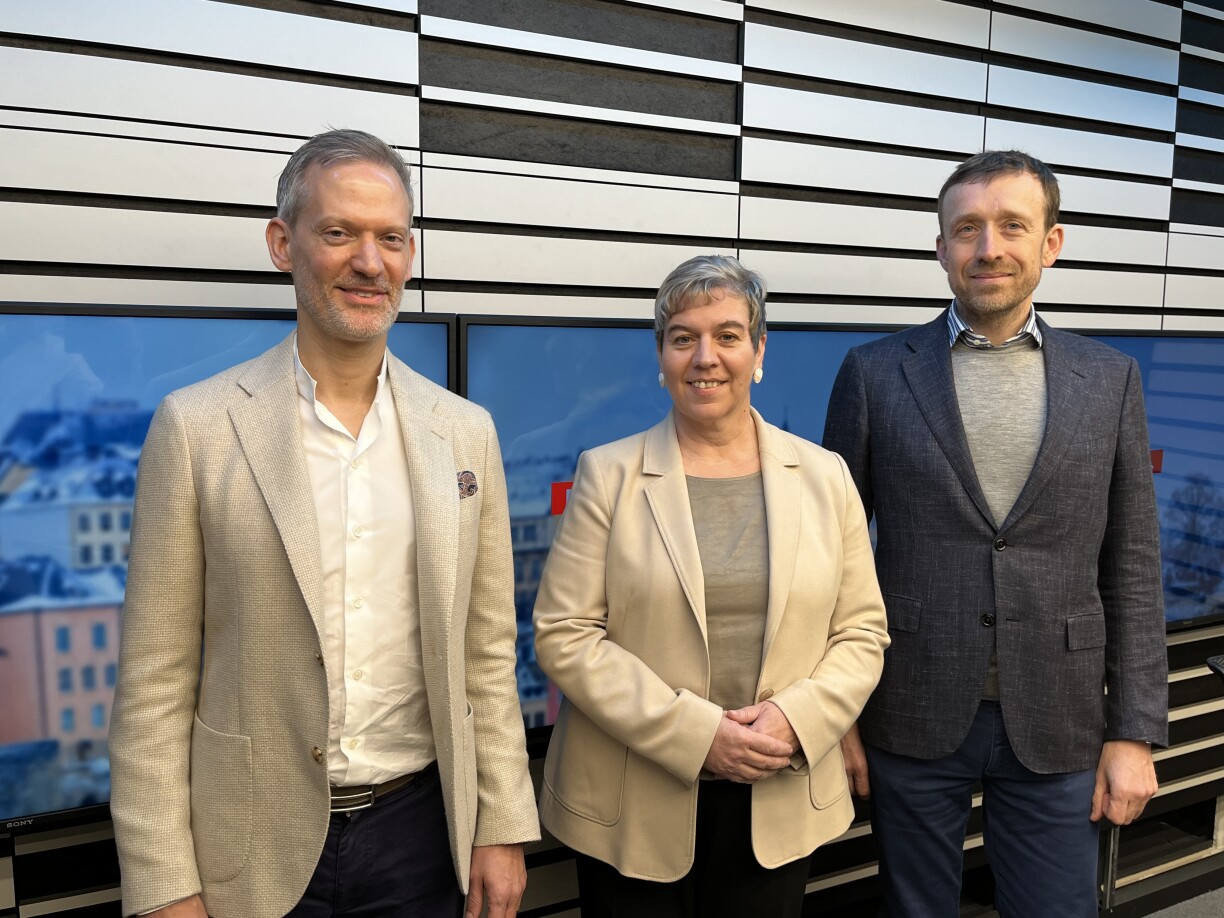
A healthcare roundtable hosted by our colleagues from RTL Radio on Saturday featured key stakeholders discussing the future of medical services in Luxembourg. Participants included Dr Chris Roller, President of the Association of Doctors and Dentists (AMMD), Dr Marc Berna, Director General of the Hôpitaux Robert Schuman, and Minister of Health and Social Security Martine Deprez.
Dr Roller opened by defending the medical profession's recent assertive stance. "One must enter negotiations with maximal demands, which is why the recent letters were appropriate," he stated. Dr Berna suggested, however, that some AMMD demands lacked universal support among doctors, leading to a partial backtrack.
Minister Deprez clarified the government's position by referencing the coalition agreement, which commits to preserving the conventional medical system. Concurrently, she noted, the government is examining which services could be outsourced from hospitals to improve efficiency. "Therefore, one could not say that the government has changed its position in recent weeks," Deprez argued.
A key point of discussion was a draft bill, to be presented before year's end, which would regulate the creation of joint medical practices – a model inspired by existing systems for lawyers. Dr Roller emphasised that the primary goal is cost reduction. "Outpatient facilities simply have less support staff than a hospital, and can therefore operate more cheaply," he explained. He stressed, however, the need for a maintained link with hospitals for patient referrals and information exchange.
A semantic and conceptual debate emerged around terminology and quality. Dr Berna criticised the term "extra-hospitalier" (out-of-hospital), arguing that healthcare is fundamentally divided between "inpatient" and "outpatient" services. He explained that the clinic concept aims for continuity by using the same teams inside and outside hospitals. Dr Roller countered that international standards ensure quality is not exclusive to hospitals, using cataract surgery as a specific example where outpatient care has proven effective.
Minister Deprez welcomed the AMMD's explicit commitment to maintaining a link with hospitals, noting she had not heard this stated so clearly before. On the specific issue of cataract surgeries, she observed that hospital-based doctors sometimes struggle to meet demand. Performing such procedures in smaller outpatient entities, she argued, is entirely feasible, with quality assurance equally rigorous in both settings.
The debate then turned to the practice at Cloche d'Or. Dr Roller alleged that private individuals had been expropriated, after which a hospital group took over the project using funds from the National Health Fund (CNS). Dr Berna firmly contested this characterisation, stressing that one could not speak of expropriation and that the Robert Schuman Hospitals group's financing did not come from the CNS.
Another point of discussion was the role of external investors in medicine. Regarding the planned clinic at Findel, Minister Deprez clarified that it could not be legally designated as a medical practice – a view echoed by Dr Berna, who compared the project to a large medical centre without external backing. However, Dr Berna questioned the logic of such a structure, particularly for dentistry. Dr Roller expressed frustration that the Findel case had led to what he sees as harmful conflations, for which he partly blames media coverage.
The conversation also addressed financial pressures. Dr Roller pointed to the high cost of new technologies, especially in dentistry, as a factor reducing doctors' take-home pay. Dr Berna countered by stressing that hospital doctors do not receive unlimited financial resources. Minister Deprez framed the issue as one of discrepancies rather than injustices, noting these are the outcome of negotiated agreements. She added that changes are being sought to the medical nomenclature – the official list of covered acts and services – to better remunerate general practitioners for procedures currently excluded.
Dr Roller resisted the impression that the AMMD resents hospital nurses' compensation. He argued that the disparity stems from differing negotiation frameworks: hospital staff operate under a collective agreement, while doctors must repeatedly renegotiate terms directly with the National Health Fund (CNS). He criticised recent outcomes, noting that while dentists were offered a zero-percent increase, other doctors received a revaluation of just 1.34%. Dr Berna suggested the AMMD's negotiating "tone" was partly responsible for these results.
Minister Deprez defended the CNS against accusations of a conflict of interest. She clarified that the CNS board includes representatives from the Chamber of Employees, while sectoral collective agreements are negotiated by the relevant representative unions – implying these are separate processes.
Dr Berna, who also serves as President of the Federation of Luxembourg Hospitals (FHL), raised concerns about the AMMD's role in CNS negotiations. He pointed out that the association primarily represents non-hospital doctors and dentists, with relatively few hospital doctors among its members, which he suggested could affect its representativeness in certain talks. However, he was careful to add, "one cannot say that doctors are divided."
In a move signalling potential reconciliation, Dr Roller concluded by announcing that the AMMD intends to initiate contact with the Association of Salaried Hospital Doctors (MSH).





