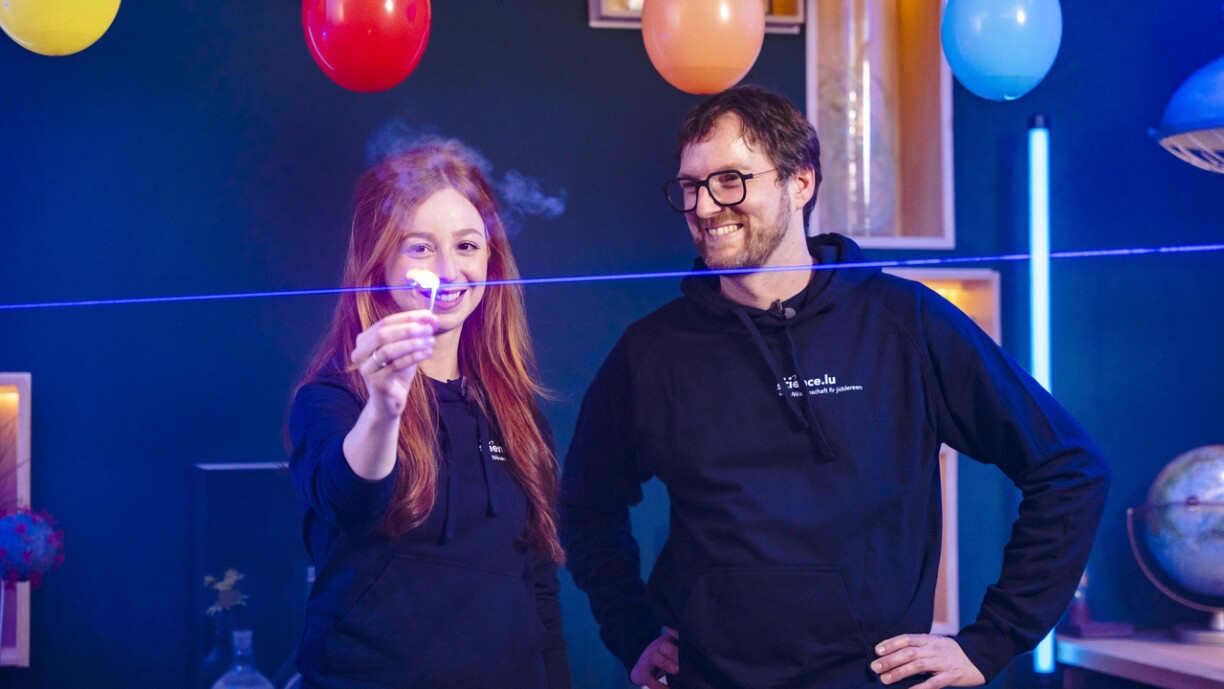
The show "Take Off" is designed with the aim of igniting a passion for science among young people, a cause that Lucie Zeches is deeply enthusiastic about. Over the last year and a half, she has been associated with the National Research Fund (FNR), working to create a connection between the world of sciences and the broader public.
Lucie's fascination with science and nature dates back to her childhood. She recalls: "I remember that I always wanted to bring things from the woods back home. I took plants and put them in my bedroom. I even created a snail farm with my best friend and we wanted to take all the snails back home with us." This childhood passion has endured into her present. She explains: "When I go on walks, I'm that annoying person that has to take out her phone to take pictures of everything. I could even stare at a ladybug minutes on end."
Lucie, a biologist by training, ended up in front of the camera somewhat unexpectedly. While working at the FNR, she started writing articles and about a year and a half into her role as a Science Communicator, she was asked to co-host "Take Off," even though she hadn't had much TV experience before.
"A lot went through my head and I'm so happy that I was given a lot of time to think about this role. I spoke to a lot of people because this was a big unknown for me, and I don't claim to know everything even now."
"It was challenging for me because I'm quite introverted, and I really don't enjoy being in the limelight", says Lucie about her personality. Nevertheless, with a supportive team, Lucie found it to be a wonderful opportunity to express herself in front of the cameras. She collaborates closely with Joseph, also known as Mr. Science : "He is an incredible expert on the subject. I mean, he has been working in front of the cameras for 14 years now, and he is also my best teacher."
The Trailer for the first season of "Take Off":
Watch "Take Off" on RTL Play.
An important aspect of the show is inclusivity. "We weren't only looking for candidates who excelled as top students in school or had won numerous prizes in chemistry or math Olympiads." Although they took part, there was no guarantee that they would progress. The show places greater emphasis on creativity and improvisational skills than on scientific knowledge.
"You have to come up with creative ideas; you have to dare to experiment", explains Lucie.
For her, it was also important to show that girls and boys are equal when it comes to science - girls are just as capable as boys. "We have very talented girls on the show", states Lucie. "We had boys writing on the chalkboard while girls were using microscopes, hammering away, and working with glue guns. Breaking stereotypes is also a positive aspect of the show."


The final product that is shown on TV is only a small part of all the hard work that was put into the show. A lot takes place behind the scenes. The first season of "Take Off" was a collaborative effort with the television team responsible for developing the show concept in their own respective country. However, before being showcased, the presenters themselves must personally conduct and try out the experiments featured on the show.
Lucie tells us about the preparation work: "We like to test the experiments with our colleagues who do not work directly in the science team, for example, the people in the funding program of the FNR. They are our best guinea pigs."
But a big question arises: who finds the best solutions, the younger or older generation? "Often, adults are a bit hesitant because they are afraid of embarrassing themselves. That's not the case with small children or young people because they just love to experiment." However, as soon as you turn it into a competition, it's usually not that easy to win, regardless of age. That is also evident in the show.
Aside from her role in "Take Off," Lucie is also featured in the video series "Ziel mer keng," where current scientific topics are explored. Collaborating with colleagues from Science.lu, she addresses questions with the assistance of experts, tackling subjects like "Is 5G dangerous?" or "Is microplastic a problem?". In this context, Lucie perceives the challenge primarily as having everyone on the same wavelength and fostering shared knowledge among people.
At times, it can be a bit frustrating when discussions in the comment sections under videos on more controversial topics (like electric cars) become heated. However, Lucie views it as an opportunity to open up a space for dialogue and discussion.
"When people comment on Facebook, then we also need to be there. That means that we maybe need to respond to some of those and provide references to other information. Adaptation is key. That is the challenge of the Science Communicator: understanding our target audience."
Very often, the FNR teams learn something new about their own work, especially when engaging in discussions with experts.
"We often have a set idea in our heads, but then we discard it when we realise that there are many myths circulating about those topics on the internet."
Here you can find the episode of "Ziel mer keng" on the CO2 emissions of electric cars:





