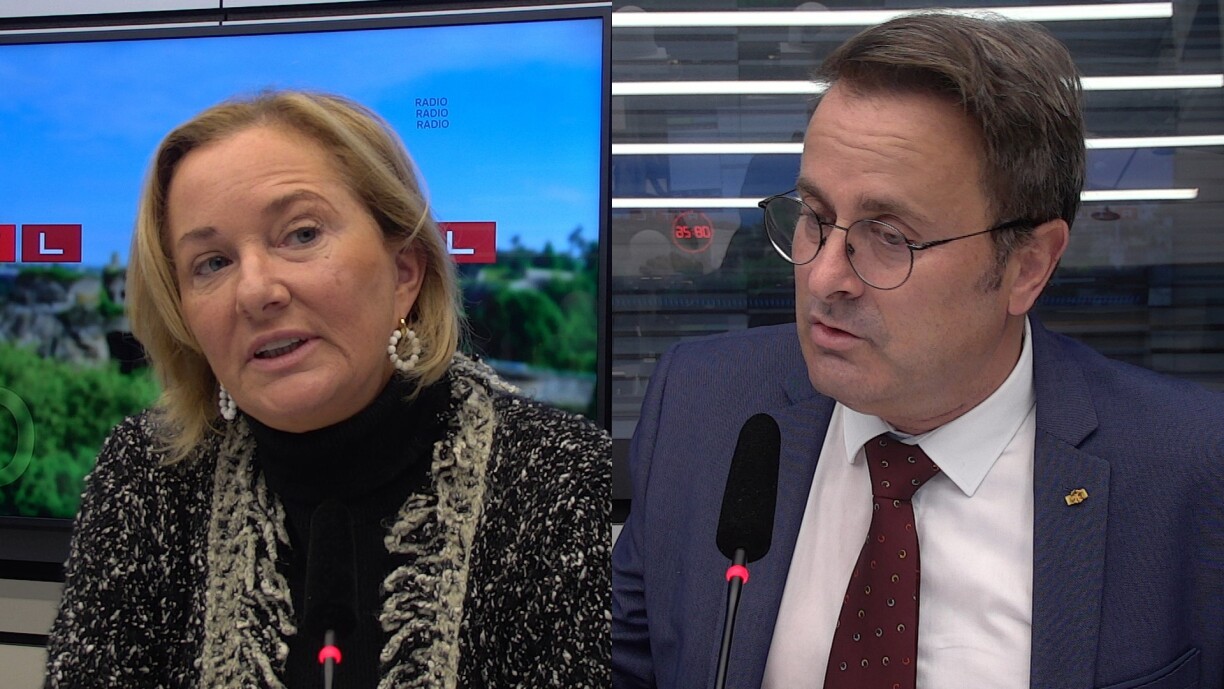
On the agenda were future coalitions, taxes and the reduction of working hours.
Crucially, both candidates avoided committing to a renewal of the DP-LSAP-Green coalition which has ruled Luxembourg for ten years, arguing that the will of the voters must be respected.
Claude Wiseler, co-president of the oppositionCSV, "is not right" when he says that "if the current majority (DP-LSAP-The Greens) were to keep 31 seats, then it will simply continue", Bettel argued.
He noted that each party has its own political programme, and suggested: "the main goal of the CSV - which has politically faded into the background - is to say: 'We want to return to government at all costs.'"
“I am not married to anyone, except my husband,” Bettel said, insisting that “it is the substance” that interests him and “what it will be possible to achieve with a coalition partner, if we emerge stronger from these elections.”
Lenert made the same point, stating: "we are approaching these elections with a posture of openness. What matters is the content."
The LSAP leader said that she would by no means rule out a continuance of the coalition, but said that the make-up of the government would depend on the results of the October 8 elections: “it’s up to the voter to speak and we will have to see what is possible.”
Lenert could become the first female Prime Minister in Luxembourg, but that is not the focus of her campaign.
“Having a woman at the head of the country for the first time would be interesting for the country, but that should not be what is most crucial,” she said. “I am presenting myself with a team, with a program, and what counts most of all is to convince.”
Bettel referred to the referendum of June 2015, when voters comprehensively rejected a ten-year limit on governments. "If 80% of voters say: 'We want to decide how it continues, then nothing prevents me from continuing", he said. "I have the energy, the desire and the motivation."
The prime minister also highlighted the many difficulties his second government has faced, from the pandemic to the energy crisis and rising inflation. "On the 8th, people will say if they still want Bettel or not.”
Bettel's aims are to "continue to be able to strengthen people's purchasing power as far as possible in the middle class", to "give them time" for a better balance between professional and family life, but also to achieve a “historic offensive in housing construction.”
However, the DP lead candidate also warned that competitiveness will be vital for the Grand Duchy: “half of the state budget is spent on social policies and these sums must come in again.”
On this point, the LSAP basically agrees, says Paulette Lenert. But a reduction in working hours must be discussed, in terms of competitiveness, in dialogue with all stakeholders.
The LSAP "made very concrete proposals to provide tax relief for people from the middle class to the upper middle class. People with a monthly gross income of almost 12,000 euros will pay less tax. Someone who earns 4,000 euros gross will pay 173 euros less in taxes. Those who earns 15,000 to 16,000 euros will pay approximately the same amount more,” recalled Paulette Lenert.
“We should not promise something to people that we cannot finance,” Bettel argued.
But in the DP program, "there are no concrete proposals, and for that reason it is very complicated to debate with you", Lenert retorted.
"Individualisation is in our programme. It cannot be that by divorcing or becoming a widow we pay more taxes as is the case today. And the adaptation of the tax scale, as we have done for 2024", replied Bettel.
The country needs to remain competitive and "we need foreign labour," but "what people will look at in the future is, how can I work? What am I being offered? How can I I live in this country? And “working hours are more important for people than in the past”, summarizes Paulette Lenert.
The 38-hour week "is a trend" in the eyes of the socialists, "and we want to commit to imposing it. But in a conciliatory way, by looking at in which sector it works or not".
Just before the elections “the LSAP always makes a turn to the left,” Bettel said. But "working less and earning more doesn't work", especially since "we are in an economic situation which is not stable" and "at the moment we have a concern for competitiveness: companies are leaving Luxembourg."
Entrepreneur who believe it is more attractive “can do it,” said Xavier Bettel, speaking of the 38-hour week. But there is no question for him of imposing it from above. He advocates flexibility in work.





