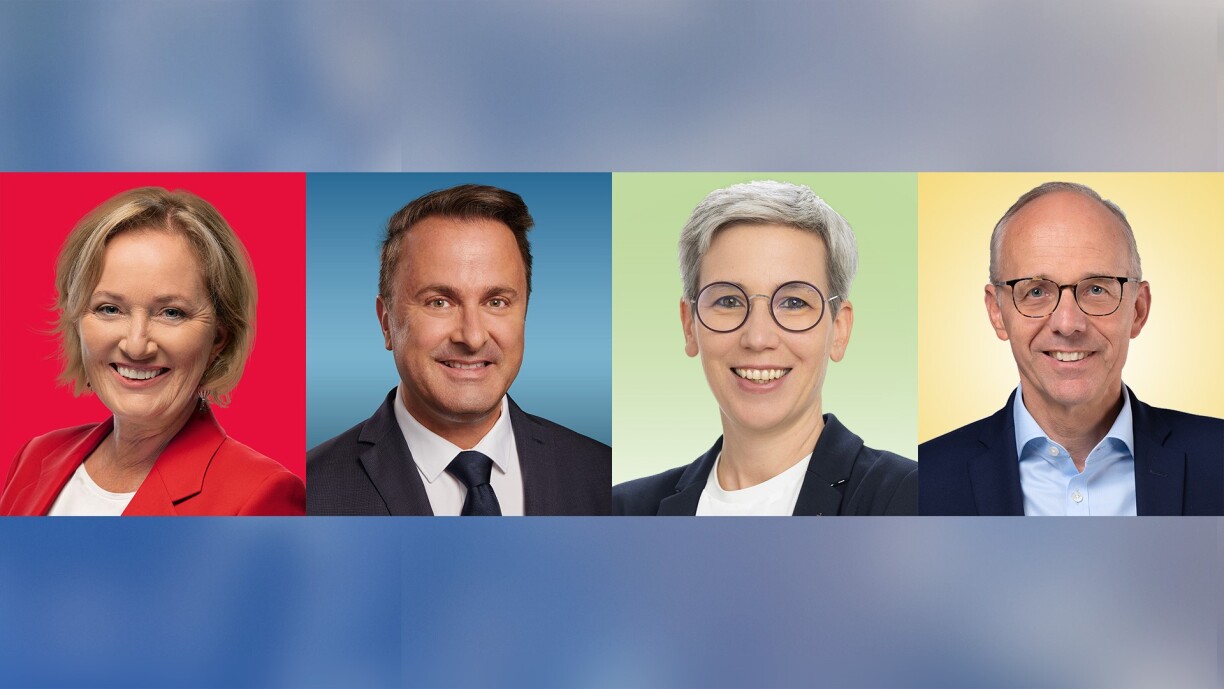
Paulette Lenert is the first female lead candidate of the Luxembourg Socialist Workers' Party (LSAP). At the age of 55, she is the embodiment of the socialist revival and the hope of once again becoming the key party in the formation of the future government.
Five years ago, Lenert was mostly unknown to the general public. However, her political rise since has been meteoric. Following the 2018 legislative elections - in which she did not take part - Lenert was appointed Minister for Cooperation, Humanitarian Action and Consumer Protection.
A lawyer by training, Lenert is no stranger to the inner workings of government ministries, having served as vice-president of the administrative court, first government councillor for the Solidarity Economy (2010 to 2013), and then at the Ministry of the Civil Service where she was general coordinator from 2014 onward.
Her career was poised to change forever in February 2020, even if that was not clear right away. Following the departure of then-Minister Etienne Schneider, Lenert became Minister of Health and became the centre of attention throughout the Covid-19 pandemic.
Although her career took a brief interlude due to illness, the Lenert star reached the pinnacle of popularity by becoming the electorate's favourite political figure in July 2020. In January 2022, she was named Deputy Prime Minister following the departure of then-Minister Dan Kersch, and in April announced on RTL that she was ready to take on the role of Prime Minister.
Xavier Bettel, the incumbent Prime Minister, has quite naturally received the confidence of the Democratic Party (DP) after having held the top job for two administrations (2013-2023). Over the last decade, he led Luxembourg through many crises at national and international level, including the Covid-19 pandemic and the war in Ukraine.
Despite some feathers being ruffled in the plagiarism affair around his final dissertation at Nancy University, 50-year-old Bettel continues to enjoy high popularity ratings. The Sunday poll at the beginning of September placed him as Luxembourgers' favourite candidate for Prime Minister among the candidates of the four largest parties.
His natural joviality and his verve as a lawyer remain some of his strongest assets. His long and uninterrupted political experience – he was already president of the Young Democrats (JDL) at the age of 21 – and his electoral successes, including being elected Member of Parliament at the age of 26 and Mayor of Luxembourg City at the age of 38, speak for themselves.
Bettel likely knows that, having experienced it from the good side up until now, power can wear down and weary voters. He is running in the central constituency alongside Minister of Finance Yuriko Backes. As a former Mayor of Luxembourg City, he is well aware that he has a home advantage in the DP stronghold, as confirmed by the party's results in the municipal elections at the beginning of June.
Sam Tanson was unanimously elected as the national lead candidate of the Green Party (déi Gréng). A fine show of confidence, synonymous with a personal challenge. Until recently, the Green Party was lead by a duo. Her partner in the 2018 legislative election and above all her political mentor, Minister for Mobility François Bausch, announced a long time ago that he would no longer be available for a job in government, but he will be accompanying her in this new challenge.
Though part of the government coalitions for a second time, the Green Party is currently not in the best position, at least not according to the latest 'Sonndesfro' poll. But, at 43, Tanson embodies the second generation of ecologists who dare to adopt Realpolitik, has been in politics for a long time, and is not one to panic.
The Minister for Culture and Minister of Justice has had a long political career, punctuated by ascent and patience. A journalist with RTL and then a lawyer, Tanson was spokeswoman for the Young Greens at the age of 28, then national chairwoman of the party from 2009 to 2014. She gained considerable popularity when she became a senior member of Luxembourg City's municipal executive board (Schäfferot) alongside Lydie Polfer (DP) in 2013 when François Bausch became Minister for Sustainable Development.
Luc Frieden has served as the lead candidate of the Christian Social People's Party (CSV) since winning the unanimous support of his party on 1 February. Ousted from power in 2013 by the three-party DP-LSAP-Green Party coalition, the CSV is looking for a new champion of the stature of Jean-Claude Juncker, their Prime Minister for more than 18 years. For Frieden, a former Minister of Justice, Budget and Defence, it is in fact a political comeback.
Frieden put his promising political career on hold for nearly ten years and was not a candidate in the 2018 national election. However, he is still by far the most experienced candidate in the race. At the age of 60, this lawyer by training can boast an extensive CV of government politics and a deep knowledge of the private sector, having been at the helm of several major institutions.
Frieden was chairman of BIL, Deutsche Bank, the Chamber of Commerce, Saint-Paul, editor of Wort, and more. His new mission is clear: to get the CSV back into government. The party has the highest representation in the Chamber of Deputies with 21 seats, but has been sitting on the opposition benches for a decade now. While his political image is inextricably linked with the Juncker years, Frieden is sharing the constituency poster with Elisabeth Margue, the 33-year-old co-president of the party, to embody a renewal.
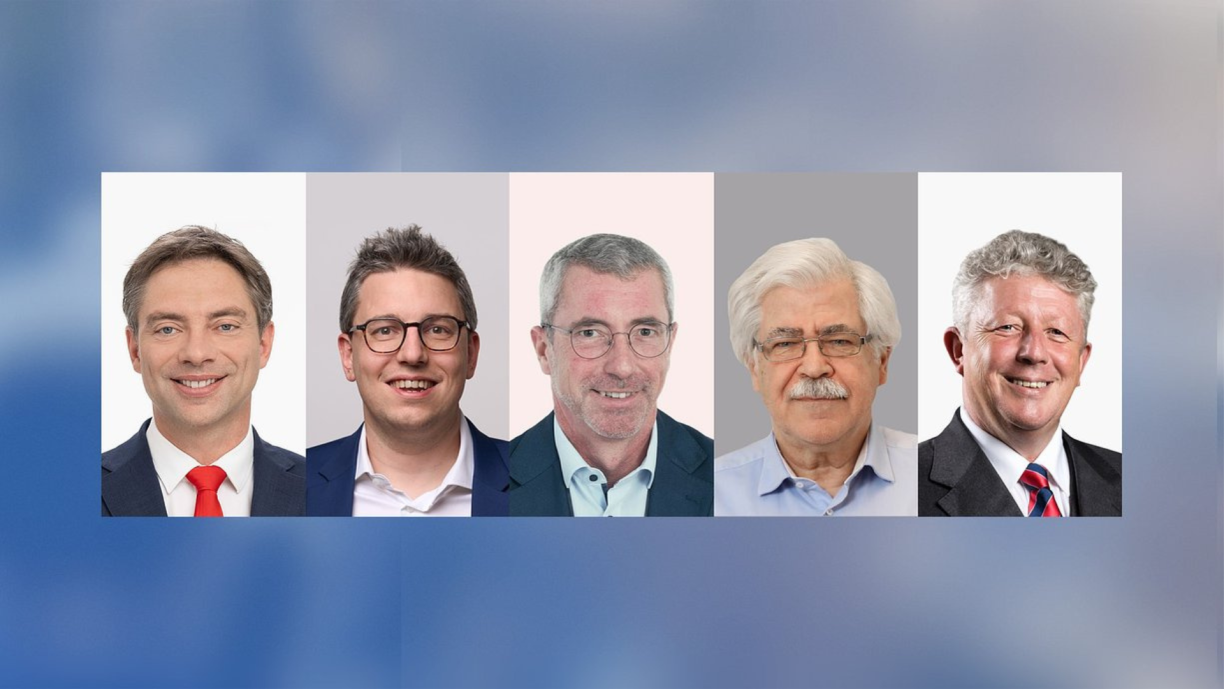
Fred Keup, 43, was unanimously elected lead candidate for the Alternative Democratic Reform Party (adr) in March. This appointment occurred precisely a year after his election as the party's president. What may appear as a rapid ascent in the political arena is, in fact, a result of persistent efforts.
Keup was not elected in the 2018 legislative elections, despite the fact that he garnered over 8,800 votes. It was not until October 2020, following the departure of Gast Gibéryen, that the geography teacher finally entered parliament. Keup's entry into the public sphere dates back to 2015, marked by the memorable referendum that resoundingly rejected the right to vote for non-Luxembourg nationals in legislative elections (78%).
He spearheaded the "Nee2015.lu" platform, championing the "no" camp, which was also embraced by the adr. His new initiative, "Wee2050," paved the way for collaboration with the adr in the most recent legislative elections, where he appeared on their candidate lists. Keup now has one major mission: securing five seats in the Chamber of Deputies for the adr, elevating their status from a 'political affiliation' to a parliamentary group.
Sven Clement, 34, serves as the lead candidate for the Pirate Party, a party he co-founded at the close of 2009 and where he subsequently assumed the role of honorary president. With a warm smile and unwavering dedication, this computer scientist-turned-head of a digital communications consultancy has witnessed a remarkable surge in popularity since entering parliament five years ago.
As a politician from the younger generation, he navigates social networks with ease, as well as commanding attention both in the spotlight and in front of microphones, advocating for increased transparency and a fairer world for all. Clement made headlines as the man behind the "Medicoleak" affair, exposing computer security flaws that allowed access to athletes' medical data. His popularity with voters was evident when he ranked as their 6th favourite politician in July.
His challenge is clear: to establish the Pirate Party as a full-fledged parliamentary group in the Chamber of Deputies. Recent polling has given the Pirate Party a promising projection of five seats. In the June municipal elections (in Pétange, Esch-sur-Alzette, Differdange, etc.), the party enjoyed a significant breakthrough, and five years ago, in October 2018, the young Pirate Party astonished everyone by securing two seats in the Chamber of Deputies.
Frank Engel, 48, naturally assumed the position of lead candidate for Fokus, the young political party he co-founded in February 2022, alongside Marc Ruppert (former secretary general of the DP), Gary Kneip, and Luc Majerus. On 8 October, Fokus will present complete lists in all four constituencies.
With a "pragmatic" approach and "no fixed ideology," Engel, a lawyer by profession, aspires to reshape the landscape of Luxembourgish politics. His vision is not only to rejuvenate his extensive political career, which had hit a sudden halt but also to transform the way politics is conducted in Luxembourg. Engel's political journey includes eight years as the Secretary General of the CSV in the Chamber of Deputies, followed by a role as a Member of the European Parliament (from 2009 to 2019). In 2019, he was propelled to the position of CSV President, a position he left dramatically in March 2021 amidst the Frëndeskrees ("circle of friends") scandal. Despite facing allegations of misusing social assets by some members of his party, he was eventually acquitted by the courts. His primary goal is to secure at least one seat in the Chamber of Deputies.
Ali Ruckert, President of the KPL, represents the Luxembourg Communist Party, a party he joined in 1971. At the age of 69, he stands as the most seasoned among the leading candidates in the race. The man with the iconic grey moustache remains as fervent as ever in championing the interests of workers and their purchasing power.
Serving as the editor-in-chief of the newspaper Zeitung vum Lëtzebuerger Vollek, he has held the role of party chairman since 2000. He was a local councillor in Differdange until June, but he was not re-elected. Ruckert has been trying in vain since 1984 to get a Communist back into the Chamber of Deputies, after the KPL had boasted six MPs in the early 1970s. The KPL has presented lists in the south, centre, and east.
Roy Reding, 58, leads the youngest party in these legislative elections: Liberté-Fräiheet ("Liberty-Freedom"), established in July. This new political party already holds one seat in the Chamber of Deputies. Reding originally represented the adr but parted ways due to what he characterised as a "flagrant breach of confidence."
After serving ten years as the adr's sole outgoing MP in the Chamber of Deputies, they no longer endorsed him to lead the Centre list in the current legislative elections. In response, Reding left the party and explored opportunities with Fokus, but could not secure a place on their lists. Liberté-Freedom swiftly organised lists in each electoral district, despite their recent formation.
Three parties have opted not to field a national lead candidate and are instead embracing regional proximity by presenting multiple or no lead candidates in the electoral districts. These parties are the Left Party (déi Lénk), which currently has two MPs, Volt, a young pan-European political movement founded in Luxembourg in 2018, and The Conservatives, a party established in 2017 and focused on patriotic values.
The Left Party is running in all constituencies, nominating four lead candidates in the south (Marc Baum, Carole Thoma, Gary Diderich, and Line Wies), two in the centre (David Wagner and Ana Correia da Veiga), two in the east (Laurent Fisch and Adela Fuentes), and none in the north.
Volt, on the other hand, is only presenting two lists, covering the south and east of the country, but without a designated lead candidate.
The Conservatives have put forward two lead candidates in each constituency where they are represented. In the south it will be Joé Thein and Roy Holzem, and in the north it will be Serge Closter and Svenja Defays.





