
For the past ten years, Jean-Marc Cloos has been harassed, bullied, and stalked by the same individual. A situation that has not changed even after the perpetrator was convicted as they operate under fake profiles online.
When a platform like Meta's Facebook barely react when he reports posts that could be considered against their community guidelines, it's clear to Cloos that there's a lack of appropriate legislation. With the latest harassment post mentioning the term 'sniper,' it has become too much to bear for Cloos. His appeal to authorities: protect people once and for all.
The insults first started out in letters and were sent throughout the Grand-Duchy to employers, or ministers. Then suddenly came the switch to social media platforms. "Poisoner, drunkard, failure, criminal, murderer..." just a few examples of what you could read regularly on Jean-Marc Cloos' screen, aimed at him.
For ten whole years, this person has been defaming Cloos and his family. Even on the pages of their friends and acquaintances, fake profiles would post lies about Cloos and his family. It has become a permanent nightmarish ordeal and Cloos is unable to defend himself effectively.
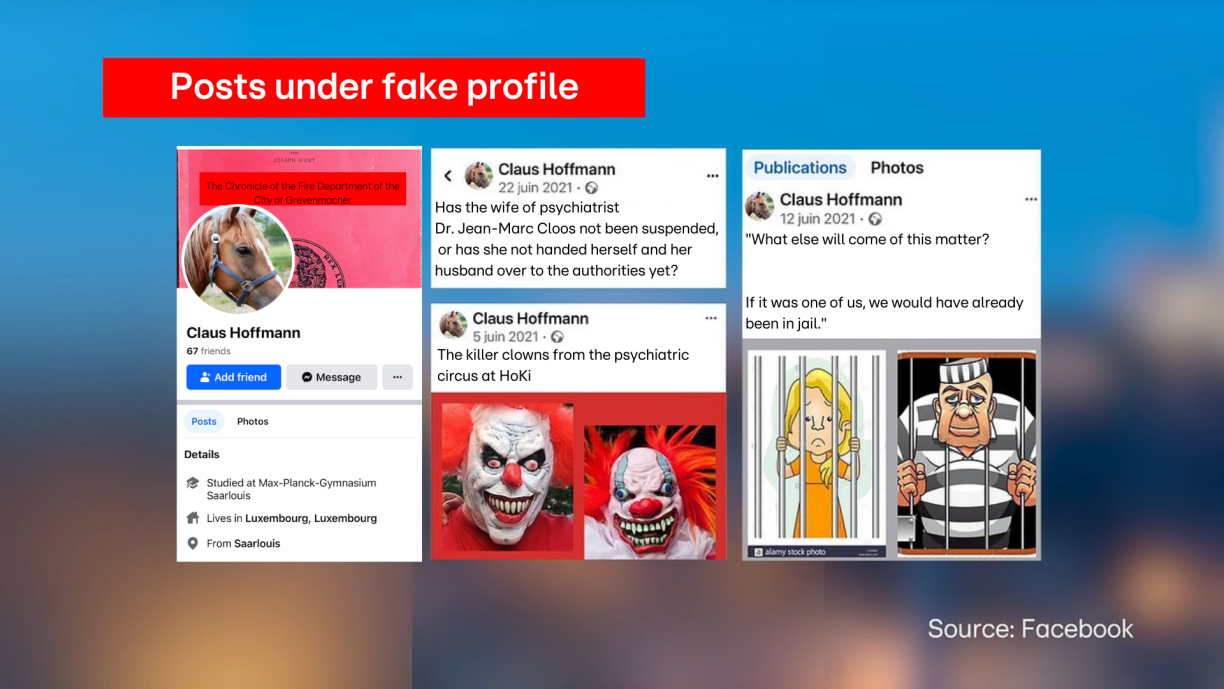
Meta, the technological conglomerate that owns Facebook, Whatsapp, Messenger and Instagram seems to be fully aware of national legislation in the various countries where Meta operates. Despite holding a responsibility to protect their users from abuse and harm, only around 5-10% of Cloos' reported posts were deleted. For instance the latest harassment post calling for Cloos' death was deleted. However, a post comparing Cloos to a Nazi was not deleted. LinkedIn, Cloos notes, has handled his reports more effectively.
The answer is yes, according to the Ministry of Justice. They state that the penal code offers enough jurisprudence on many forms of harassment, whether on or offline, including stalking. The normal course of action is to gather judicial elements, collect evidence, then file a police report. Even our legal expert confirmed that self-defence is possible but with a caveat.
Jean-Philippe Boever, legal expert in RTL's ethics board states that defamation, injury and slander would be the classic articles in the penal code but they are not unconditional. For instance, the plaintiff must prove ill intent. Only upon fulfilling these conditions these articles be used. Then, the judge can determine how real the harassment was, according to Boever.
According to Luxembourg's Minister for Justice Elisabeth Margue, Luxembourg also relies on the EU Commission's "Digital Services Act" for such cases, which has been in force since February. It establishes rules for a safe digital space where the fundamental rights of users are protected. The EU Commission oversees social media platforms, particularly Facebook, and has instructed service providers to remove illegal content and promptly inform law enforcement, states the Justice Minister. In terms of legislation, the ministry believes it is best to stick with what we have for now. New legislation is unnecessary for the time being.
Our legal expert, however, disagrees. Jean-Philippe Boever believes that Luxembourg needs a broadly defined harassment provision in the penal code with a direct procedure attached, so that there is no need to have to use the means of injury, slander, or privacy violation provisions as we do now for such cases.
Jean-Marc Cloos will likely feel dismayed by the response from the Minister, who currently sees no need for new legislation, a position also held by the previous Minister of Justice.
The new EU rules, as far as their implementation goes, also extend to child protection and, for example, target cases of child pornography on social media. Whether these same rules will effectively address Jean-Marc Cloos' case remains to be seen.
Watch the video reports in Luxembourgish:





