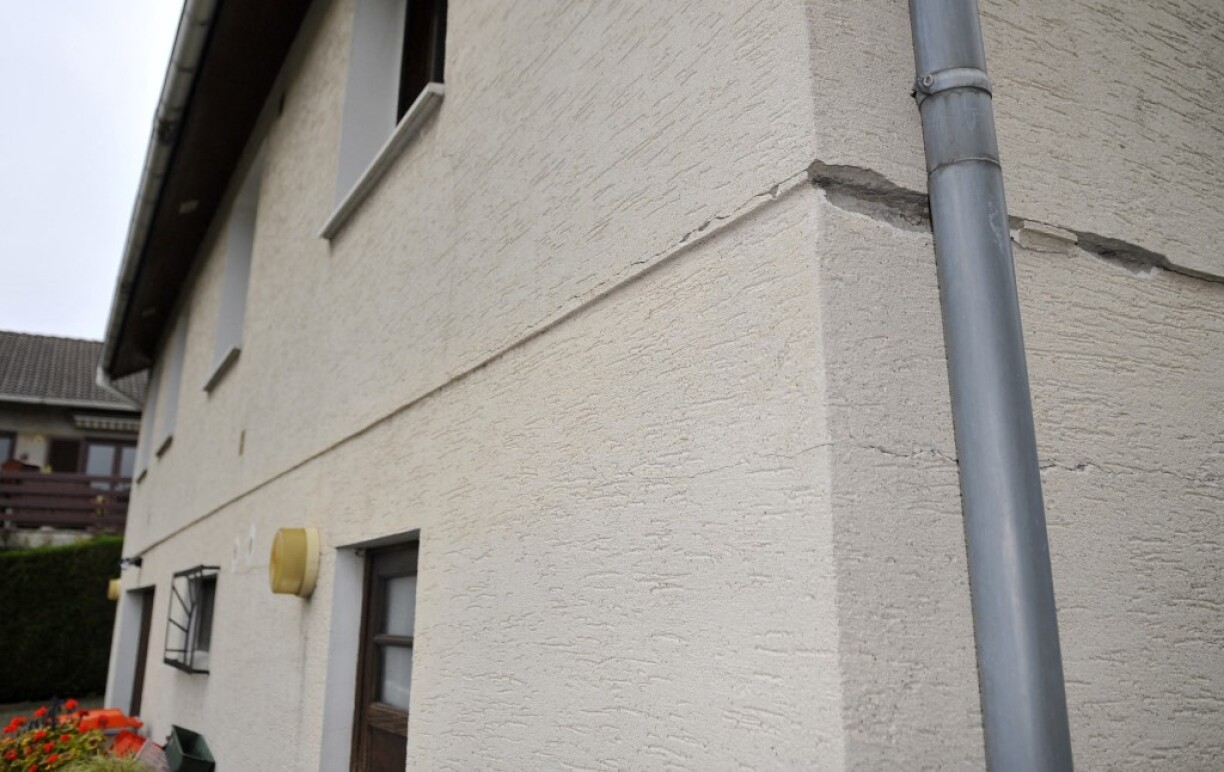
"Whoever breaks it must pay for it." Since the 1980s, Joëlle and Gaston Pirih, retirees from Rosbruck (Moselle) on the German border, have lived in a leaning house which regularly develops new cracks due to the end of mining activity in the region.
Ropes to keep the doors from slamming shut, a living room shutter that won't open, wedges under the furniture to keep them straight; for the past 30 years, the couple's daily life revolves around constantly "patching up" a house with a 3% slope.
At first glance, the village seems pleasant. The Pirih, who lived in public housing in the past, invested "all (their) savings" to build their home in a peaceful area in 1978.
However, "mining backfilling was discontinued in Rosbruck from 1985 onwards" laments the couple. In the months that followed, the couple "felt tremors," and they have felt a thousand more since.
The couple have made it their mission to seek justice. In the dining room, documents are plastered all over the wall: letters from authorities, mining operation plans and newspaper clippings. Joëlle Pirih investigates, keeps records, and continues to call on stakeholders to finally repair the damage.
Notably, the mining operation plans indicate that many homes in Rosbruck have been constructed right above old mines. However, the unfilled mining galleries have caused the ground to sink up to 16 metres.
80 homes in the area have either been demolished or rebuilt. For the rest, residents are living through a nightmare. "We wake up in the morning wondering what will happen to us next," sighs Joëlle Pirih.
The Pirihs are not on their own. About forty families are still engaged in an endless legal process to hold the Charbonnages de France (represented by the Judicial Agent of the State after its liquidation) responsible for the damage to their homes.
"The Judicial Agent of the State wants to make us believe that our homes are not uninhabitable," Mme Pirih says, full of regret. She adds that the state has so far appealed all decisions that were in favour of residents.
In the neighbouring municipality of Cocheren, many families are engaged in the same fight.
Michelle and Gérard Bertrand purchased a home that is almost 300 years old whilst mining galleries were still being backfilled. However, after 300 years, their house is leaning too: all you have to do is place a ping pong ball on the ground and the ball will roll all the way to the wall.
At one point, access to their home was impossible during rain as the ground sank just in front of their home. With the shifting terrain, rainwater flowed from south to north, whereas in 1980, "it was the other way around," emphasises Gérard Bertrand.
The municipality of Rosbruck has also pursued legal action but feels "abandoned" by the state, despite Rosbruck contributing economically through mining for 150 years, according to the mayor of Rosbruck, Bernard Betker, elected in 2020.
"I support our residents," the mayor states, even though there is no end in sight for them, after more than 15 years since their first tribunal hearing in 2007.
After several contentious battles between experts and requests for additional insights by the Court of Appeals of Metz in 2015, a hearing was held in November based on written conclusions, without pleadings.
Final decisions are expected, on a case-by-case basis, starting from the first semester of 2024 spanning the entire year. Although Joëlle Pirih insists that "Not all families have received their expert report yet," and will likely not receive a judicial response this year.
An eternity of this ordeal discourages Michelle Bertrand and prevents the couple from pursuing other building projects. Joëlle Pirih notes bitterly that "we are entirely in the dark, we don't know what will happen. It feels like the opposition wants a solution which sees more people dying."
To make matters worse, some houses have recently been categorised as flood-prone. "Who would want to buy this?" laments Gaston Pirih, who feels like "a prisoner" in his own home.





