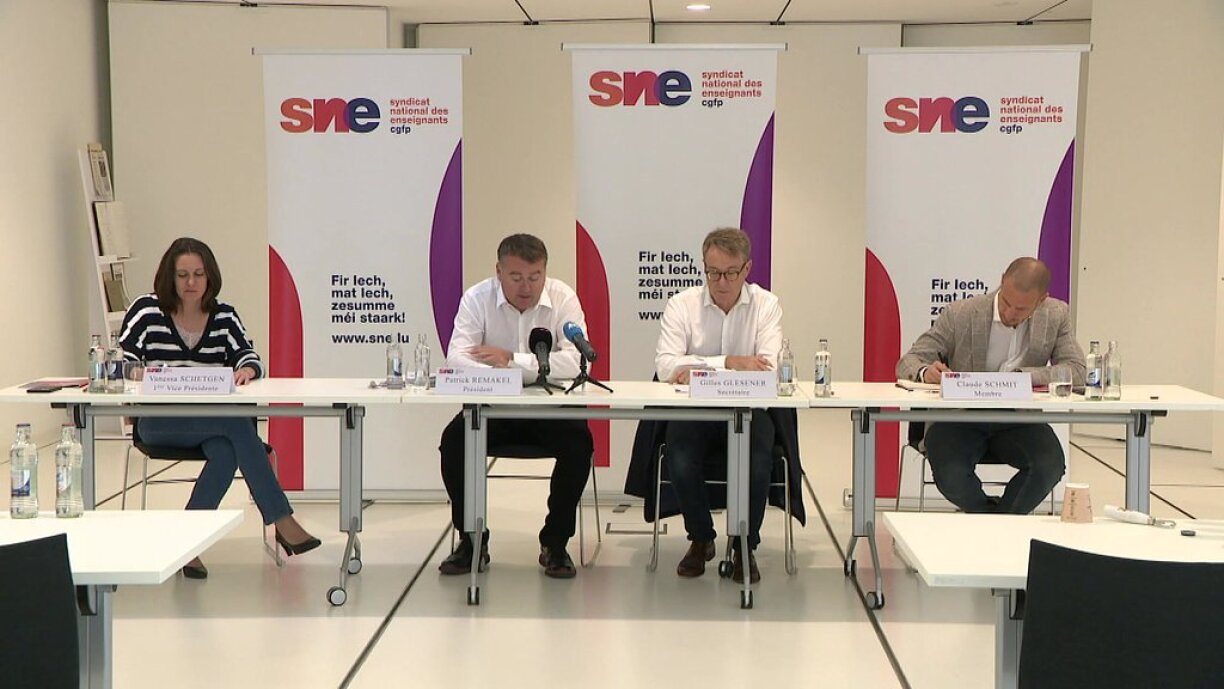
On Wednesday, the National Trade Union of Teachers presented to the press the political parties' responses to a series of questions they had been requested to answer on the future of teaching in Luxembourg. How can the teaching profession become more attractive again? What should initial teacher training look like? What about French literacy programmes? These are just some of the questions that the union's primary eduction section put to the political parties in the run-up to the national election.
During the press briefing, the SNE focused on the responses from the four main parties. As far as training is concerned, the union sees no alternative to a master's degree. Neither the Luxembourg Socialist Workers' Party (LSAP) nor the Christian Social People's Party (CSV) have taken a clear position on the matter. According to SNE president Patrick Remackel, the Democratic Party (DP) is in favour of an alternative model while the Greens have voiced budgetary reservations.
The latter concerns can be attributed to the spike in payments that the government would have to cover if all primary school teachers had a master's degree. The salary difference between A1 and A2 careers in the first year is around €1,400 per month.
Another issue important to the SNE is the establishment of a task force to deal with struggling children. Remakel noted: "We need a prevention and intervention structure in every school, made up of specialists such as educators, social workers, and nurses, to name but a few."
When it comes to this demand, all four major parties seem to be supportive. "So it's clear: after the election, nothing will stand in the way of such a task force, whichever party will hold the Education Ministry", noted Remakel.
Parties appear equally supportive of the SNE's demand for additional resources, which would allow the operation of classes in 'Cycle 1', meaning kindergartens, with one teacher and one educator per class, the same as is being done in a crèche. Remakel showed himself confident that this can be the case as early as next academic year.
As for the French literacy programmes, the four parties believe that the pilot project will have to be evaluated before a general introduction can be considered. Remackel commented: "The SNE is sticking to its position of not closing the door on this project, but draws attention to the fact that many questions remain unanswered. It has to be guaranteed that nothing will be rushed with such an important issue."
The SNE is not making any voting recommendations and remains politically neutral. According to Remackel, the trade union is comfortable to argue, debate and above all cooperate constructively with every party in the race.





