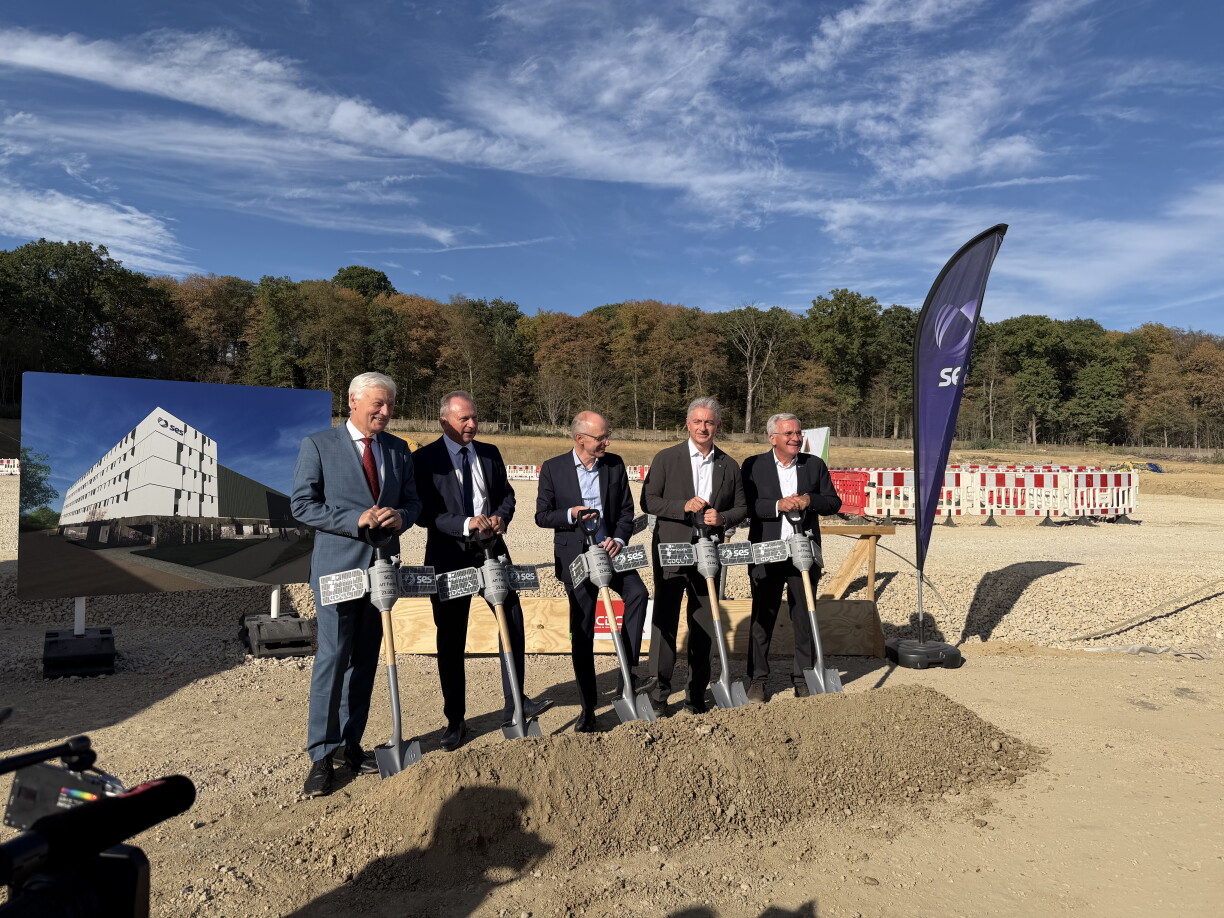
SES, long known as a satellite operator, is now stepping into the role of an industrial manufacturer.
For the first time in its more than 40-year history, the company will design and produce its own satellite technology, not at its Betzdorf Castle headquarters, but in a dedicated facility at Kockelscheuer.
This production hall will also be home to the government-backed Space Campus, a project set to position Luxembourg as a hub of space innovation. Senior government officials joined SES for the official groundbreaking, underlining the project's national significance.
The construction company behind the project has pledged that the facility will be operational by the end of 2027, less than 18 months from now.
The SES factory at Kockelscheuer, on land belonging to the commune of Roeser, will not reinvent the company, but significantly expand its capabilities.
SES CEO Adel Al-Saleh explained that this evolution will take place in several phases. Initially, the focus will be on the technical components already integrated into satellites, but the company plans to gradually manufacture more of these components in-house, depending on demand.
This shift gives SES the flexibility to produce critical satellite elements itself rather than relying on external suppliers.
The facility is expected to employ around 300 staff, including a large number of highly qualified engineers and specialists. SES aims to see its first satellite fully 'Made in Luxembourg' roll off the production line by the end of 2028.


Development and testing are already underway in a provisional laboratory, a point SES was eager to showcase to its guests during the ceremony.
Company leadership stressed that in the highly competitive satellite sector, maintaining momentum is crucial if SES is to remain at the forefront.
For SES, the new facility is about innovation, attracting talent, and strengthening Luxembourg's industrial base. The groundbreaking was described as the start of a new chapter for Luxembourg's space sector, with the company emphasising the broader significance for the country.
While the ability to build satellites in-house provides SES with a clear commercial advantage, it also has important strategic implications for Luxembourg.
The nation will no longer be reliant on external suppliers for its space technology, strengthening its autonomy in an era marked by geopolitical uncertainty.
A government representative highlighted the ambition for Luxembourg to remain a leader in the space sector, noting recent developments in the United States and the need for European, and specifically Luxembourgish, leadership in this field.
Strengthening autonomy was described as a vital goal, particularly in the current challenging context. Reference was made to the recent Space Summit in Paris, where Luxembourg reaffirmed its commitment to the sector.
The representative described how Luxembourg aims to evolve its role: while satellites previously served mainly for television broadcasting, they are now also key to secure communications for defence.
The government supports SES both as the company’s country of origin and as a shareholder, in order to invest in the future of satellite technology across multiple orbits.
The SES facility will be at the heart of the wider Space Campus taking shape at Kockelscheuer. This development brings to life the vision of former Prime Minister Pierre Werner, under whose leadership SES was founded in 1985, and moves Luxembourg’s role in the satellite and space industry into a new era.





