The property market continues to grapple with challenges. Despite an initial price decline at the start of the year, this reduction has not effectively counterbalanced the impact of escalating interest rates. Consequently, borrowing capacity for both households and investors has been significantly curtailed.
According to Eric Dothée, CEO of Eaglestone Luxembourg, transactions still occur in the existing property market due to its greater adaptability in price adjustments. This proves especially pertinent for long-standing property owners.
However, the landscape is considerably more complex for developers, particularly those who acquired land "at the peak of the market," within the last three to four years. These developers are faced with rising construction and financing costs.
"To put it plainly, there is much less scope for adjusting prices," he explains. This is why prices have not fallen at the same rate in the old and new housing markets in recent months.
In addition, the situation is likely to get even more complicated. Dothée claims that numerous developers will soon face financial distress. "Undoubtedly, some will falter, and obviously, there's going to be a clean-up of the market," he said.
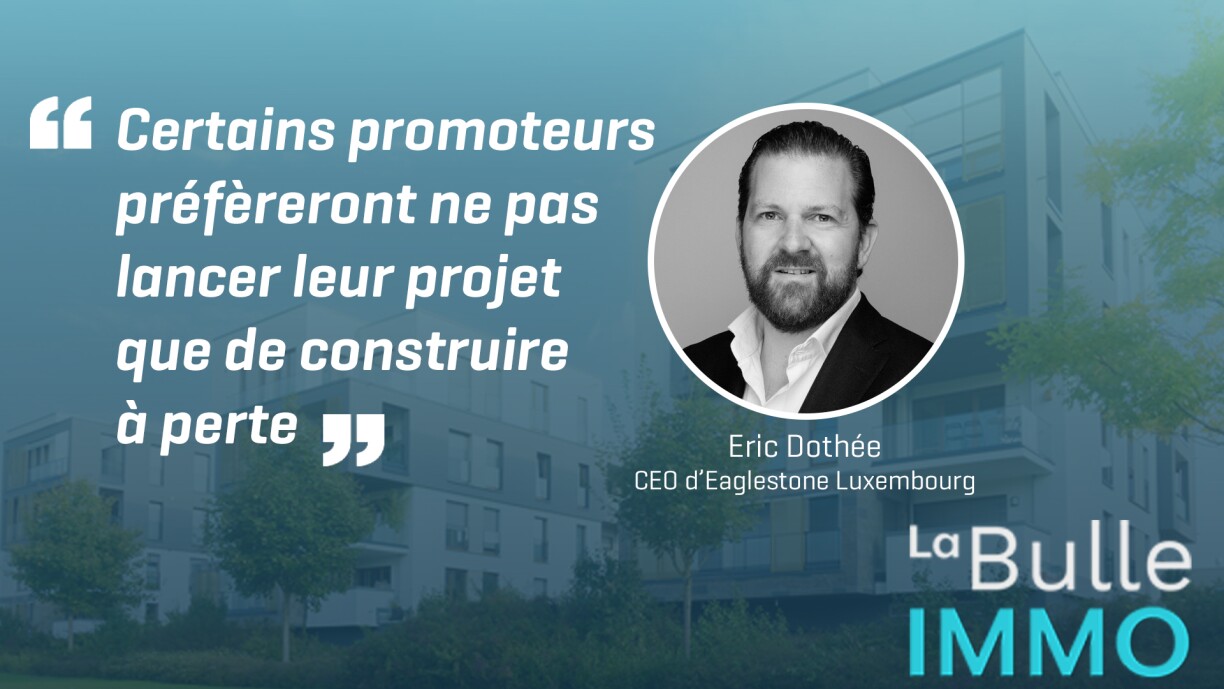
He goes further, saying that "some people would rather not launch their project and not pay the bank than build at a loss." This, he contends, could trigger a domino effect of defaults.
A situation like that would spare no-one, not even well-managed companies, explains the CEO of Eaglestone Luxembourg. "A developer who doesn't pay their contractor, or a contractor defaulting on their subcontractor…" These interconnected challenges could swiftly escalate to global proportions.
When asked if the sector could not have seen this coming and built up a cash position that would have enabled it to get through this crisis, he replies that most developers have reinvested their past gains in land:
"So, there is very little cash flow. We're going to see the difference between small developers who have completed a few good projects in recent years and big groups," he anticipates. Dothée warns that this is not good news for anyone.
-> Housing minister: Affordable housing comes above everything, says Henri Kox
He points out that the property sector is a "major provider of local and sustainable employment" and has been "a major contributor to public finances" in recent years. "The state has every interest in having a thriving housing production sector," he insists.
Dothée's sentiments are underpinned by the belief that without a flourishing private housing production sector, Luxembourg's concerns would be amplified. He is obviously referring to the limited number of homes built by the public sector each year.
As new-build projects face an impasse, Dothée acknowledges that workers employed for excavation work are amongst the first to bear the brunt.
The prevailing housing shortage compounds Luxembourg's worries. In fact, the housing crisis is said to be contributing to "erode" the country's competitiveness. Major companies are finding it increasingly difficult to recruit so-called "talent."
"It's simple: the investors who used to buy a flat in the city to rent to an expat are no longer there," he says. A recent report by the French Ministry of Employment confirms that, despite the rise in unemployment, there are currently shortages in many professions.
As the situation lingers, Dothée advocates the Luxembourg government's intervention via tax incentives for investors and households.
"For the last 15 years, the tax-deductible amount for a home loan has been €2,000 per person. Everyone knows about inflation! It should be adapted, it's easy," he exclaims.
While acknowledging that a recovery might not be instantaneous, Dothée asserts that the capacity to build remains. He emphasises the potential for partnerships between the private sector and the government to address housing needs, advocating for both private and affordable housing initiatives.
"Producing regulated affordable housing is vital for the country's competitiveness," he comments. In this context, he believes that Luxembourg could look to the Singapore model as a source of inspiration to meet the escalating housing demand.





