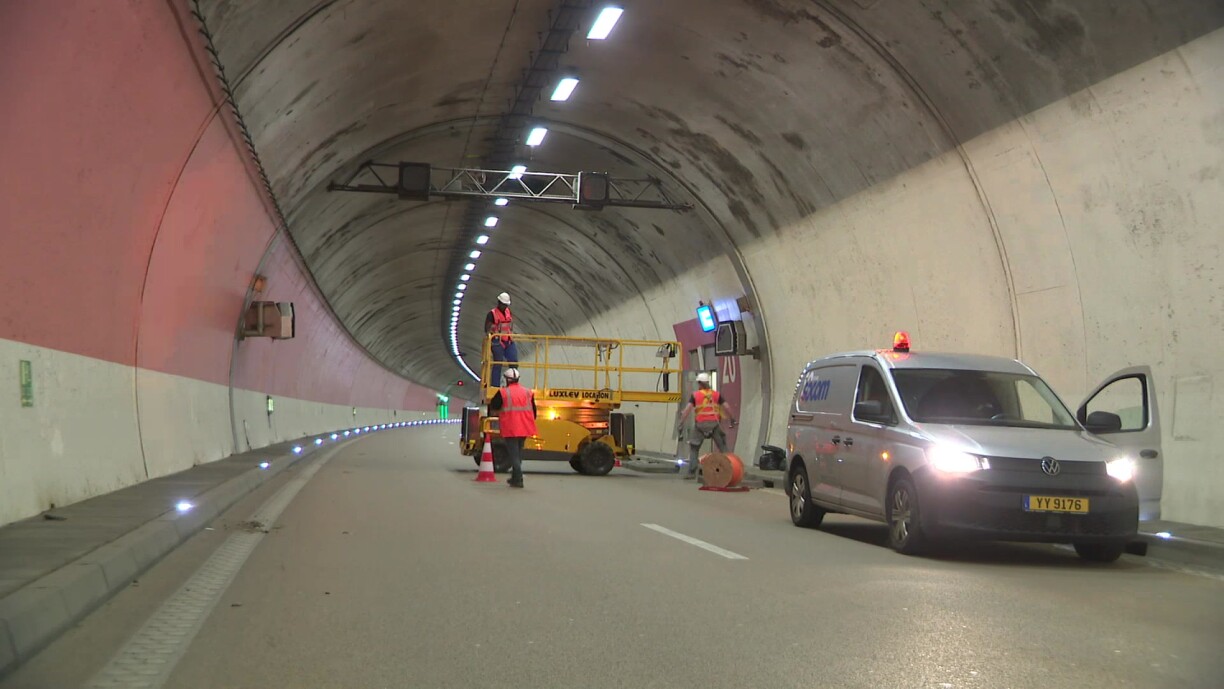
At the moment it is the Gousselerbierg tunnel that is straining the nerves of the drivers. For the past 14 days, the tube in the Lorenzweiler direction has been closed to traffic and will stay so until 13 August. The traffic runs bidirectionally through the other tube, in direction Schoenfels.
In mid-August, once works in the direction of Lorenzweiler are done, the construction site will be revamped and works will start in the other tube. Traffic will then run bidirectionally through the tube towards Lorenzweiler. It is therefore expected that the entire construction will only be completed at the end of summer break in mid-September.
During this period, the speed is limited to 50 kilometers per hour and is also constantly controlled via radar.
The background of the works is that the CITA cameras in the tunnel must be replaced. "We've been using old analogue technology, and are now switching to a more modern solution", says Christian Ewert from National Roads Administration. "But it's not just the cameras that are being exchanged. We have around 100 cameras per tube here and the entire cabling and installations need to be exchanged, too."
He stresses that those works do have a raison d'être. To ensure greater safety for motorists, special cameras are used: "We have detection cameras in the tunnel, which immediately notify the CITA operators when a car slows down, stops or when someone enters the tunnel in oncoming traffic. Even if someone were to lose load or when there are pedestrians in the tunnel... We recognize all of this automatically and then the operators at CITA can react immediately by blocking the tube or a lane, and thus ensuring people's safety."
Regarding the A7, here's a little reminder: since they were put into operation, the radars flashed almost 24,200 times between 15 March and 17 July. Record-breaking was a driver who was caught with 221 kilometers per hour. Around one third of the flashed cars had foreign plates.
Listen to the audio report in Luxembourgish by Jean-Marc Sturm:





