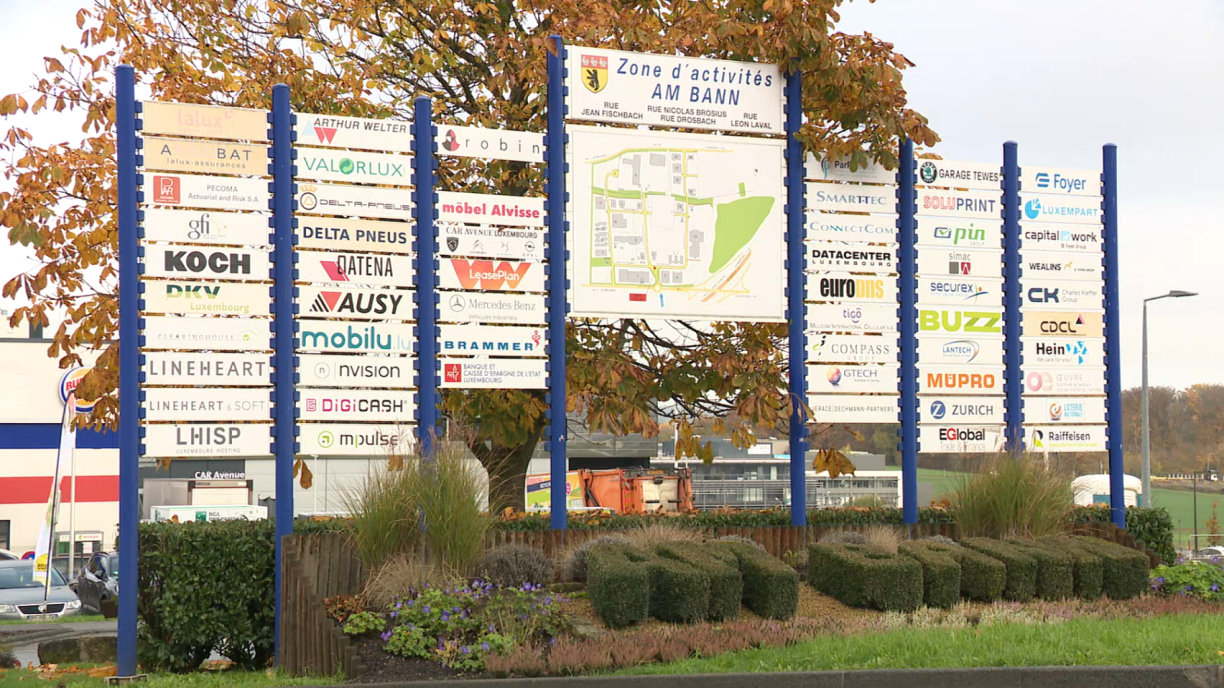
Although the decision to increase the property tax was already taken in September 2021, businesses on the Leudelange territory only learned recently that it has been increased eight-fold.
In conversation with RTL, officials from one business explained that their contribution increased from €15,000 to €120,000. Another company now spends €70,000 instead of €8,000.
Yves Steinhäuser from the latter business noted: "They could have consulted us beforehand or gradually increased taxes. But increase it by eight in one go, the maximum allowed by law, that really is a lot."
Connectcom, a company installed in Leudelange, has noted that leaving the municipality has become a real option following the recent "disaster".
Following the increase of the 'tax multiplier' to 4,000 percent, Leudelange now has the highest property tax in the country, four times as high as the one in Bettembourg, which has the second highest.
Leudelange decided in favour of this radical increase because a 2016 financial law introduced new criteria to evenly distribute municipal tax revenue among the 102 towns in the country.
Mayor Diane Feipel explains: "A 2016 law has changed the distribution of municipal finances. This happened under the supervision of then-Minister for Home Affairs Dan Kersch. It was decided that all towns should receive parts of the revenue from business taxes."
Since Leudelange is considered a small municipality with its 2,800 residents across 13.5 square kilometres of land, but simultaneously has many businesses operating on its territory, the municipality has become the biggest loser of the reform. Before, the town had a revenue of €8 million to €9 million from the business tax, now it is only €1.5 million, says Mayor Feipel. That is barely enough to cover the financing of infrastructure.
The increase of the property tax was thus thought to help make up for losses. To accommodate local businesses, Leudelange decided to decrease the communal business tax (ICC) by 10%, which has allowed the town to pay back €700,000 to companies every year.
However, according to Claude Dupont, spokesperson for the Leudelange-based company Connectcom and municipal councillor in Biwer, Leudelange officials are not able to calculate properly.
ICC revenue depends on the profits of businesses. Dupont's company only saves a maximum of €3,000 through the ICC reduction while the costs of the new property tax increased by close to €60,000. So, the ICC decrease is a long way from compensating the property tax increase.
Dupont explained: "Their financial commission clearly said 'don't do it'! They discussed a factor of six and finally agreed on a factor of three or two, though reluctantly, meaning doubling the property tax. We would not have liked that, but we would have accepted it. Then the Mayor opted for a factor of eight and that was even accepted. Nobody here in the zone can understand that."
Mayor Feipel has ensured that if the municipal financing laws are changed so that Leudelange's business tax revenue amounts to a minimum of €3 million to €4 million, then she might consider lowering the property tax. Furthermore, she apologised that businesses were not informed of the change at an earlier stage, but drew attention to the fact that municipal councils are public and that businesses received an information letter.
Leudelange has long been at odds with the Ministry for Home Affairs. The municipality also has little hopes that a lawsuit will bring about results. Dupont and other local entrepreneurs have also launched legal proceedings in the meantime.
On Tuesday morning, the local opposition issued a press release (GER) in support of the Aldermen Council. Back in 2018, a respective motion (FR), which was not accepted, already proposed to increase the property tax while reducing the business tax.
The statement further notes that local businesses have no extra expenses on average. The government, on the other hand, receives a business tax 2.5 times lower than what it used to be.
Maintenance of the local activity zone is expensive, and without additional revenue, it would be impossible for Leudelange to keep its budget in balance.





