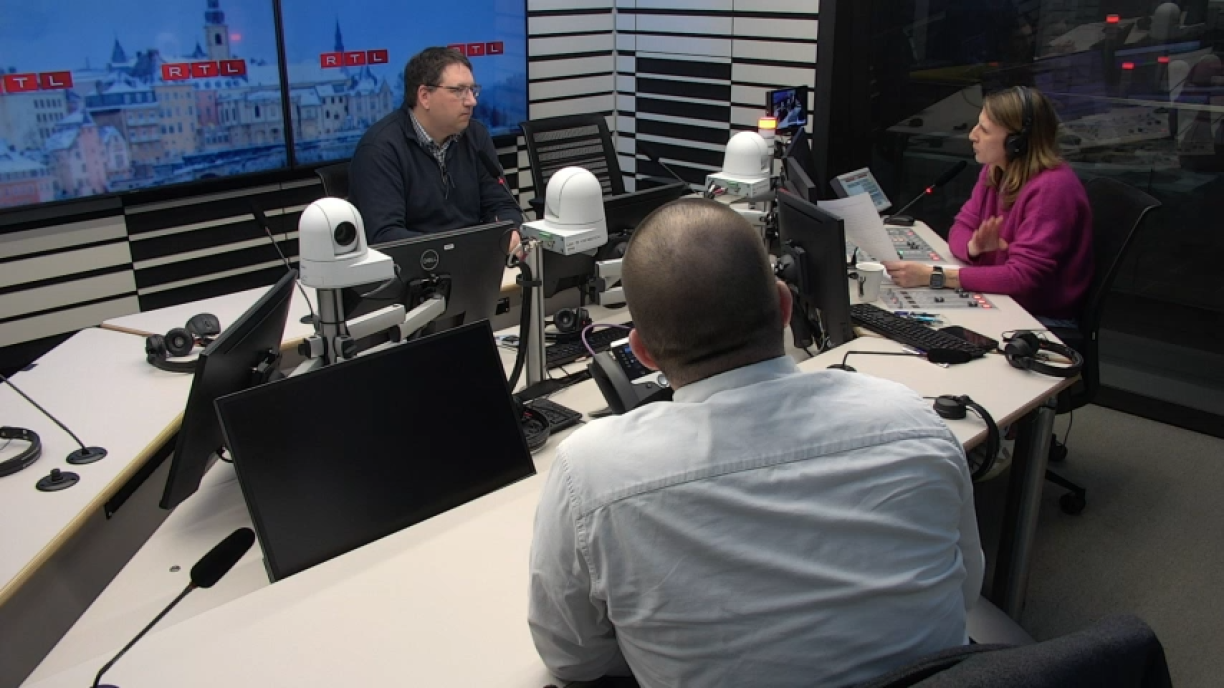
A Monday morning press roundtable on RTL Radio, initially set to discuss the effects of current US foreign policy, began with a heated debate on media responsibility concerning a recent high-profile suspension.
The panel, featuring journalists Christophe Bumb from Reporter and David Marques from Quotidien, quickly addressed the case of the suspended Robert Schuman hospital group (HRS) surgeon. This followed strong criticism of the media by the Association of Doctors and Dentists (AMMD), which had accused the press of conducting a "public execution" and a "media lynching" of their colleague.
David Marques countered this characterisation, identifying a recurring pattern. "Whenever the press does its job, works on critical stories and reveals things, the media gets blamed", he stated. He drew a parallel to the recent case of former minister Georges Mischo, where he argued the focus was misplaced on the press rather than the individual's own mistakes.
Christophe Bumb reinforced the defence of journalistic work. "Don't shoot the messenger", he stressed, adding that "the media doesn't just invent these things." He also challenged the specific accusation directly, noting it was "absurd" to talk of a "media lynching" because the surgeon's name had not been publicly disclosed by the press prior to that Monday morning.
Bumb opened the foreign policy discussion by remarking that while Donald Trump has been in power for only a year, "it definitely feels longer." He suggested that the sheer volume of events has forced a sobering realisation across Western capitals: "the great, trustworthy, and reliable ally is now, at the very latest, gone."
Bumb drew parallels between the recent intervention in Venezuela and the invasion of Iraq, noting a pattern of verbal escalation preceding action. In both cases, he stated, the US legitimised intervention by citing a national security threat – alleged weapons of mass destruction in Iraq and, as David Marques added, the claimed transit of fentanyl in Venezuela.
Marques stressed that such actions are part of a long-standing US interventionist policy, comparing the Venezuela operation to the "Osama Bin Laden" mission. However, Bumb identified a key difference in the current approach: a lack of diplomatic pretense. He described the phenomenon as more "brazen", arguing the US no longer feels compelled to frame its actions within the bounds of international law. While this clarity might have the "advantage" of letting Europe "know where it stands", Bumb warned the greater danger lies in Trump's "uncertainty and unreliability", noting the president "says one thing in the morning and another in the afternoon."
Marques argued that Trump's policy represents a departure from his predecessors. While past administrations also pursued interventionism under the banner of promoting democracy or regime change, he said, Trump has been transparent about different motives. "What is new", Marques assessed, "is that Donald Trump has not hidden the fact that it's not about that regime change, but that it's really for the oil, so really the economic interests." He further noted a tactical difference: "And what is also different in this case is that no regime change has actually occurred."
Regarding the US's interest in Greenland, Bumb advised against fixating on President Trump's statements. He suggested the more substantive takeaway came from Canadian Prime Minister Mark Carney's speech at the World Economic Forum in Davos, which called for Western allies to "no longer back down."
Bumb paraphrased Carney's argument: the post-war world order was conceived and controlled by the US, allowing Europeans to "hide behind" its leadership, even while knowing parts of it "were not entirely right, honest, and legitimate." The core of the message, according to Bumb, was that passive alignment no longer guarantees safety, necessitating a strategic shift. This explains why Canada, while a NATO ally of the EU, is actively pursuing trade agreements with China. Bumb concluded that while he does not view the US as an enemy, it is "definitely unreliable."
Marques contended that the Greenland issue is far from resolved. He noted that despite a temporary diplomatic framework being found, President Trump later posted an AI-generated image of himself with a penguin in an icy landscape. "Knowing full well that there are no penguins in the Arctic", Marques remarked, "There you have it, you just don't know."





