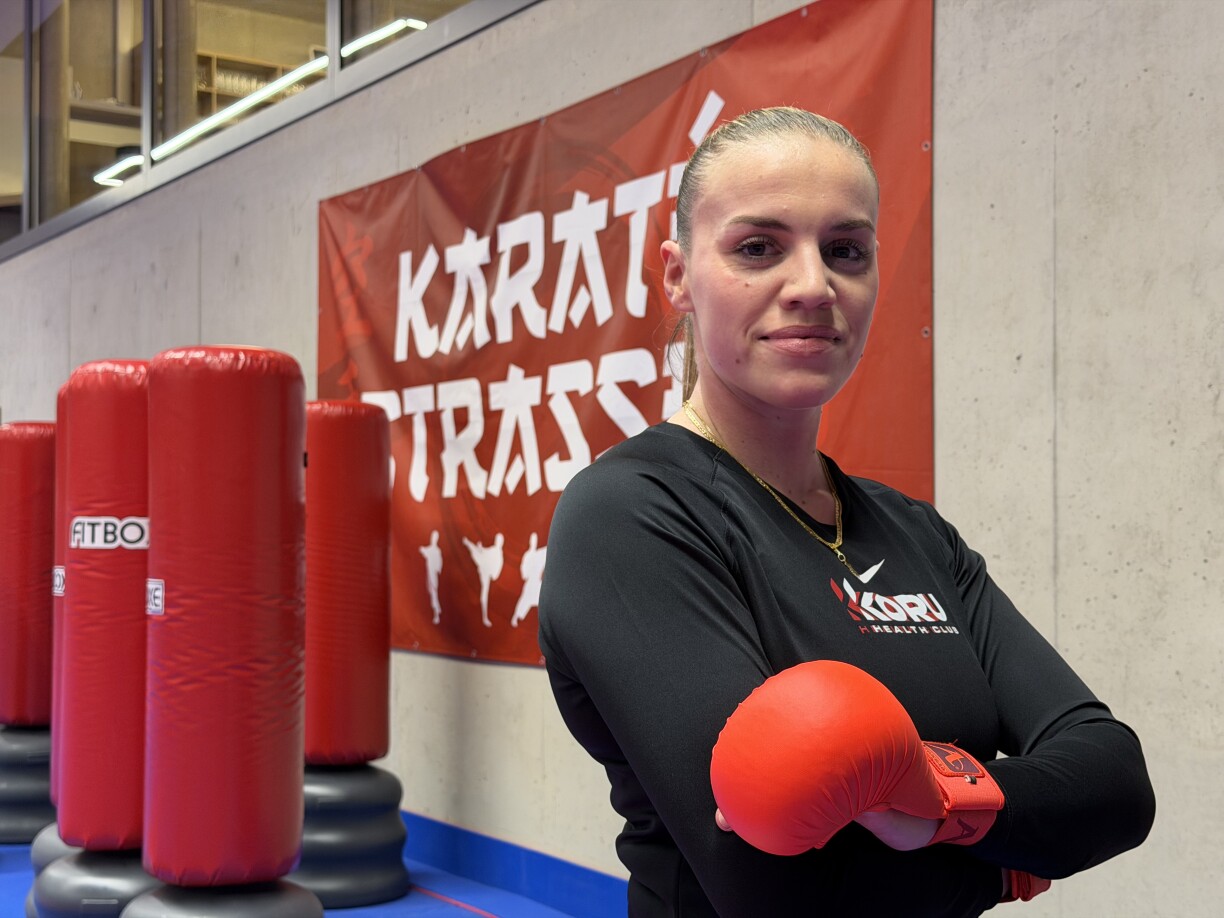
"From a sporting perspective, I'm really nearing the end of my career", Pola Giorgetti began, in a remark that came as something of a surprise.
She explained that combining full-time work with elite sport had become increasingly difficult, which is why she decided to bring her high-performance career to a close. Even so, she still trains once or twice a week.
The 29-year-old studied law and later worked in her family's business. In her spare time, she enjoys walking around town or spending time with her adopted street dogs, whose exact breed she says she couldn't identify.
After tearing the cruciate ligament in her knee, undergoing surgery, hours of stability training, and long rehabilitation sessions, Giorgetti had set herself one very clear objective: competing at the Games of the Small States in Andorra. Following an 18-month recovery, the event became her first major comeback.
She recalled feeling relieved when the doctor finally gave her medical clearance shortly beforehand. It meant everything had fallen into place in time, she said, adding that she had prepared mentally with the help of a performance coach, and on the day itself, she did not dwell on her knee at all.
Giorgetti stated that the mental preparation really paid off, as she went undefeated throughout the competition and came home with the gold medal.
After Andorra, Giorgetti continued competing internationally. But the reality of high-level karate today is unforgiving, especially for athletes who are not full-time professionals.
She noted that the overall standard keeps rising and that most international competitors are fully professional athletes who are paid to train twice a day. In contrast, she said she currently manages only two training sessions a week.
Giorgetti emphasised that keeping up has become increasingly challenging, admitting it can be disheartening to juggle work and sport so intensively, only to arrive at a tournament and feel that things are not going as she had hoped.

Her long injury period also taught her to become calmer and more resilient. The expectations of others, and her own perfectionism, no longer dominate her thinking the way they once did.
Giorgetti said that her priority now lies with her new professional path. Still, karate, her team, the friendships, and the travel form a huge part of who she is, which makes the idea of stepping away entirely emotionally difficult.
Alongside her sporting achievements, Giorgetti has been shaping a professional future that still revolves around sport. Steering back toward the fitness and sports world now, she said, is no coincidence, as it has always been in her nature.
As part of the family venture, she will soon be involved in a premium fitness gym located within GRIDX, the newly built multi-activity centre in Wickrange that forms the latest development of the Giorgetti family enterprise.
"It's genuinely a concept that doesn't exist yet in Luxembourg, a high-end fitness space where comfort is a priority."
One point becomes clear quickly: she does not envisage disappearing from the karate world. Yet the conditions for senior-level training in Luxembourg are not always ideal. She is 29, her national teammate Jenny Warling is of a similar age, and the younger athletes are nearly ten years below them. The training dynamic is therefore not always simple, and the idea of transitioning into a coaching role in the future is very much on her mind.
She said it would be hard to walk away from karate completely, and if she is no longer competing, she would at least want to remain involved as a coach.





