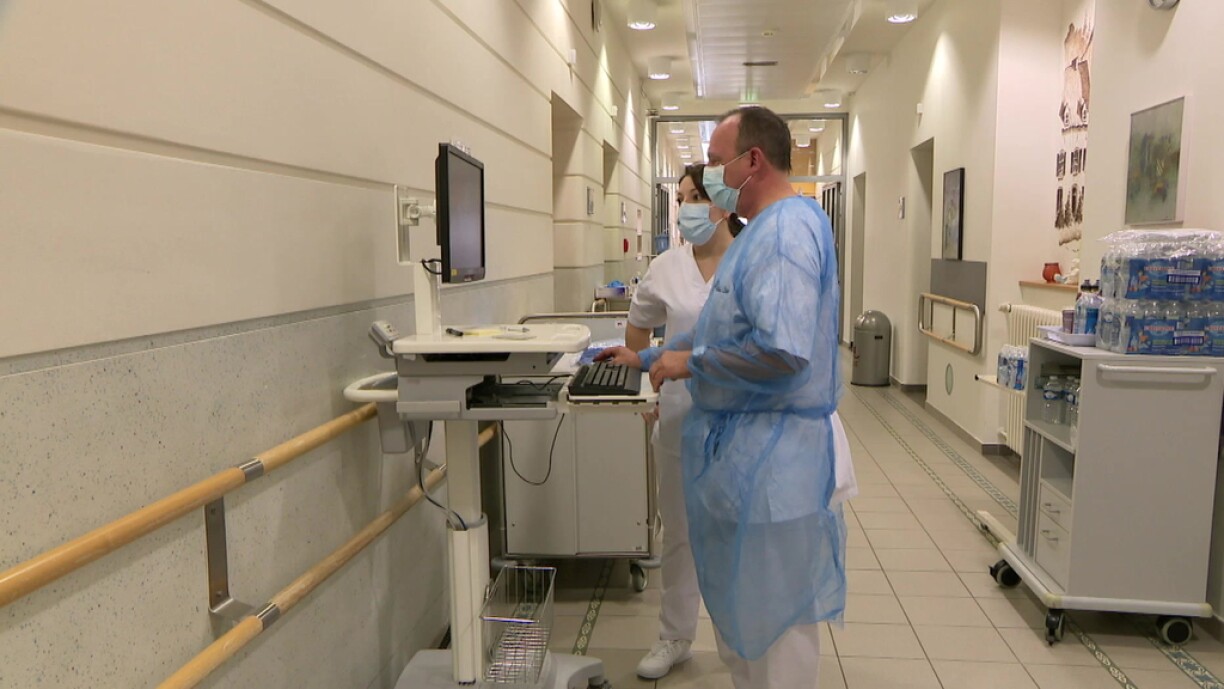
Luxembourg's healthcare is suffering from personnel shortages - most notably, a lack of nurses. In order not to create internal competition between the care sector and hospitals, Copas, the umbrella association for nursing home providers, is calling for a uniform collective agreement for the care and social sector, and Luxembourg's hospital federation (FHL).
The unions have discussed such an agreement before and are prepared to resume negotiations. Marc Fischbach, president of Copas, recently told RTL that the difference between a carer in a nursing home and a nurse working in a hospital is - simply put - 17% in terms of pay. The similar responsibilities, yet different collective agreements already in existence, generally mean that nurses working in the care sector are worse off.
"17% seems a bit much for us now," Pitt Bach of the Independent Luxembourg Trade Union Confederation (OGBL) told RTL. "There are other elements that play a part. Both collective agreements were created in separate negotiations with separate interests."
The OGBL agrees that the current collective agreement for the FHL is generally better. For nurses in particular, a carer would earn more in the early stages of their career under the care and social sector (SAS) agreement, while nurses under the FHL agreement would catch up after a few years. However, by the end of a nurse's career, they would have earned significantly more under the FHL agreement than the SAS plan.
"Annual leave is better under the SAS collective agreement," Bach continued. "But every collective agreement has its individual strengths."
Anne-Marie Hanff of the nurses' association ANIL said it was a difficult situation. "Often people want to change careers. For example, young nurses want to work in a hospital environment, to learn and perfect different techniques. Then later on they develop an interest in out-of-hospital work, or care work. Those who want to switch later on in their career really have to ask themselves if it's the right choice, because it will cost them."
Initial talks took place recently between the OGBL, Copas, SAS and FHL representatives to tentatively discuss a collective agreement. The unions have called for a meeting in the autumn, supported by the care sector employers' associations.
The hospital federation is more reticent. In a statement, the FHL said: "It certainly makes sense to meet and analyse the two different collective agreements, comparing attributions and responsibilities. However, we think the attractiveness of health professions cannot be improved by financial criteria alone."
In 2016, strikes took place in Luxembourg's healthcare sector which eventually led to the new collective agreements struck in 2017. The OGBL has been calling for a common collective agreement in the sector for many years. Bach explains: "At the time there were a number of nursing homes using the FHL collective agreement. These were members of Copas, which all of a sudden introduced the SAS agreement. We have been against the introduction of a second collective agreement from the outset."
The practice of linking both collective agreements, however, has proved troublesome in recent years. Surprisingly, Bach says, Copas has been calling for a common agreement in the media for several months, without talking to the unions.
Fischbach says Copas is calling for one salary level for all nursing staff. "If you don't want to spend more money, it needs to be redistributed."
But the OGBL opposes this philosophy: "This is our main condition. No one in the sector should lose out due to a new agreement. We can't take money from one to give to the other."
The ANIL's Anne-Marie Hanff warns against just considering the financial side of matters. "Often there is just a single nurse per institution on a night shift in the care sector." She says this is a matter of concern. "If you consider that institutions can cover multiple residences, this means a nurse is in charge of several homes at once. This workload is a key reason as to why nurses are departing the profession."
A new agreement should determine staff quotas and the right mix of roles for different institutions. Staff should not merely represent a financial value, she argues. In general, the pay is not a major factor behind nurses leaving the profession at a certain age.
Report in Luxembourgish:





