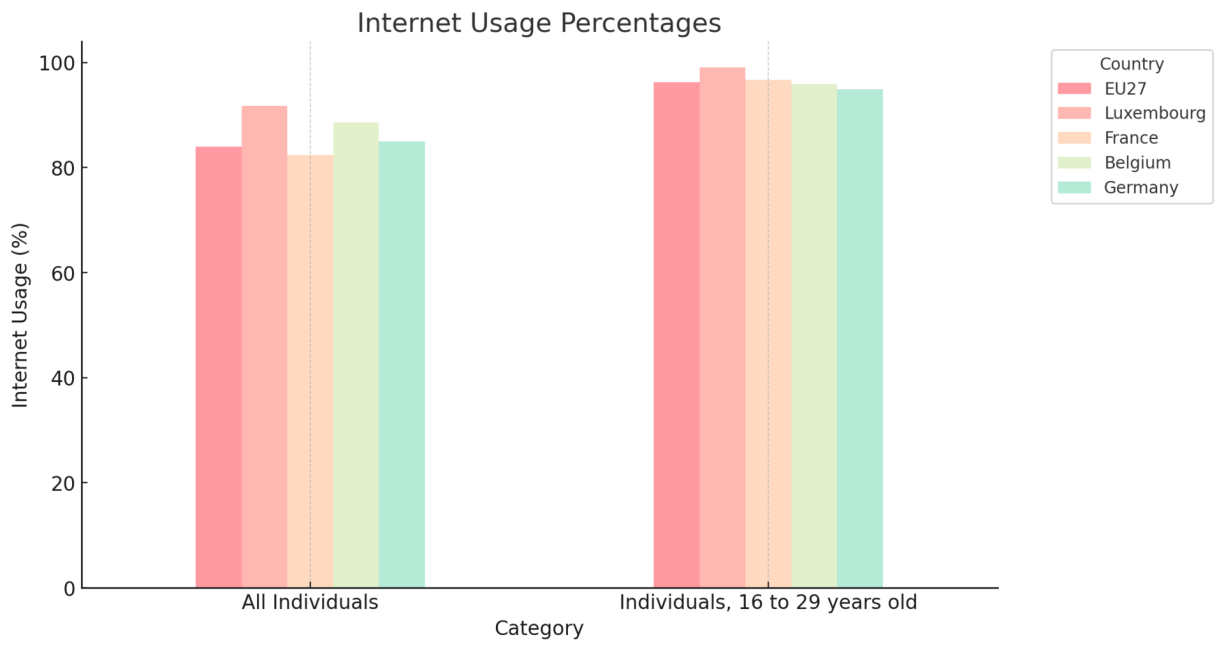
The statistics reveal that a staggering 99.1% of individuals aged 16 to 29 in Luxembourg use the internet daily. This figure is only surpassed by Ireland and Malta.
Across the 27 countries of the European Union, the average daily internet usage for all individuals is 84%. However, when the lens is focused on the 16 to 29 age group, this figure leaps to 96.3%. This significant increase indicates that younger individuals are more likely to use the internet compared to the general population.
In Luxembourg, the daily internet usage for all individuals is 91.7%, a figure that comfortably exceeds the EU average.
The near-universal internet usage among Luxembourg's residents paints a picture of a society that is highly connected, particularly among the younger generation.
However, it also raises concerns over the risks that young people face when using the internet, as highlighted by the Luxembourg government's 'Bee Secure' campaign.
In comparison, France's overall daily internet usage stands at 82.5%, slightly below the EU average. However, for the 16 to 29 age group, the figure rises to 96.7%, aligning with the EU average for this demographic.
Belgium's figures show a similar trend, with overall daily internet usage at 88.7%, above the EU average. For the 16 to 29 age group, the figure is 96.0%, again aligning with the EU average for this age group.
Germany's overall daily internet usage is slightly above the EU average at 85.0%. However, for the 16 to 29 age group, the figure drops to 94.9%, slightly below the EU average for this demographic.
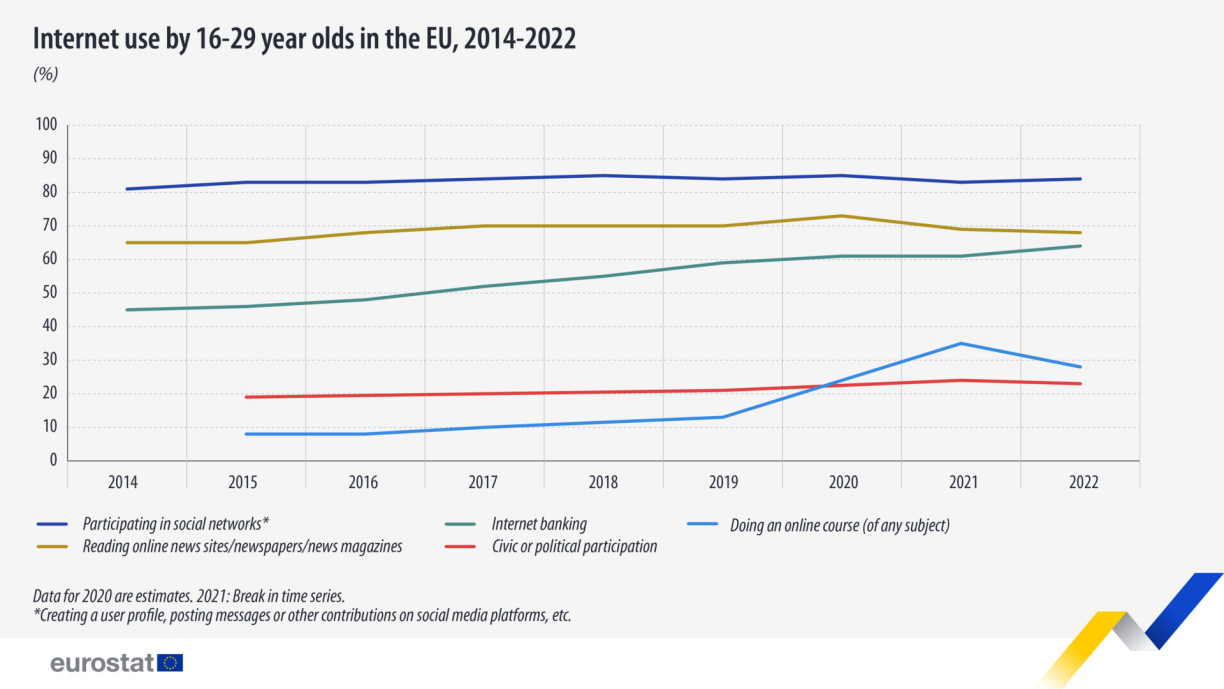
The report also sheds light on the primary uses of the internet among young people in 2022. Social media participation is the most popular activity, with 84% of young people using the internet for this purpose.
Other popular activities include reading news online (68%) and internet banking (64%).
Interestingly, the use of the internet for online courses, which surged from 13% in 2019 to 35% in 2021 due to the COVID-19 pandemic, decreased to 28% in 2022. However, this figure is still significantly higher than the 2019 level.
Overall, the data unveils a disparity in daily internet usage between young people and adults in the EU, with an average difference of 12 percentage points.
In countries such as Luxembourg, the Netherlands, Sweden, Denmark, Finland, Ireland, and Belgium, this gap does not exceed 7 percentage points.
However, in countries like Croatia, Greece, Portugal, Bulgaria, Poland, and Romania, the gap is considerably wider, ranging from 18 to 21 percentage points.





