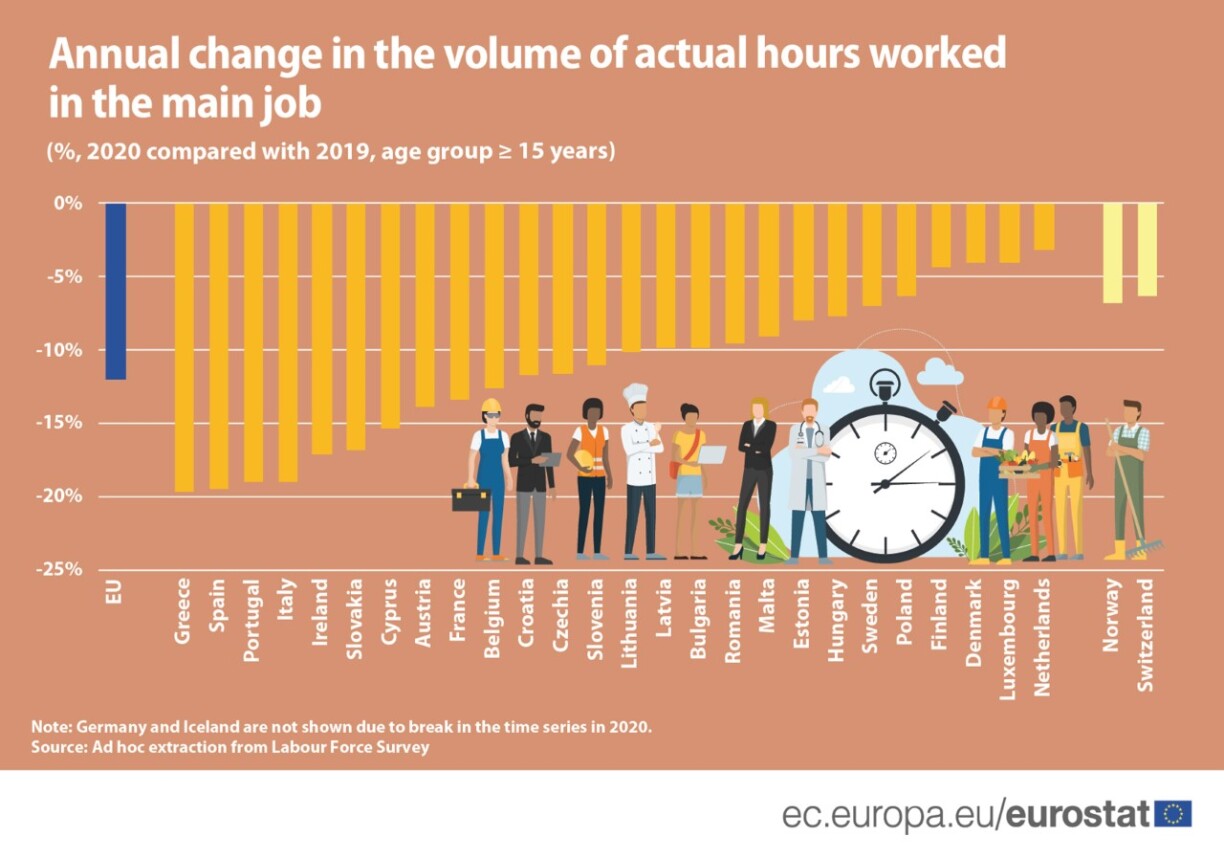
While Greece saw a 19.7% reduction in hours worked - followed by Spain at 19.5% and Portugal and Italy, both at 19% - the reduction in Luxembourg was just 4.1%, placing the Grand Duchy second from the bottom alongside Denmark (also 4.1%), with only the Netherlands seeing a smaller decline (3.2%).
Eurostat note that this reduction can be explained by measures taken in response to Covid-19, which saw many work fewer hours than they usually would, while others were absent.
The statistics agency found that the primary reason for working fewer hours could be found in temporary lay-offs, which increased from 0.5 million in 2019 to 3.9 million in 2020. Also key was what is labelled 'leave for other reasons' and includes parental and special leave as well as training and education. This was up from 4.7 million cases in 2019 to 5.8 million in 2020.
Overtime also saw a decrease, from 7,3 million cases in 2019 to 5.8 million in 2020.





