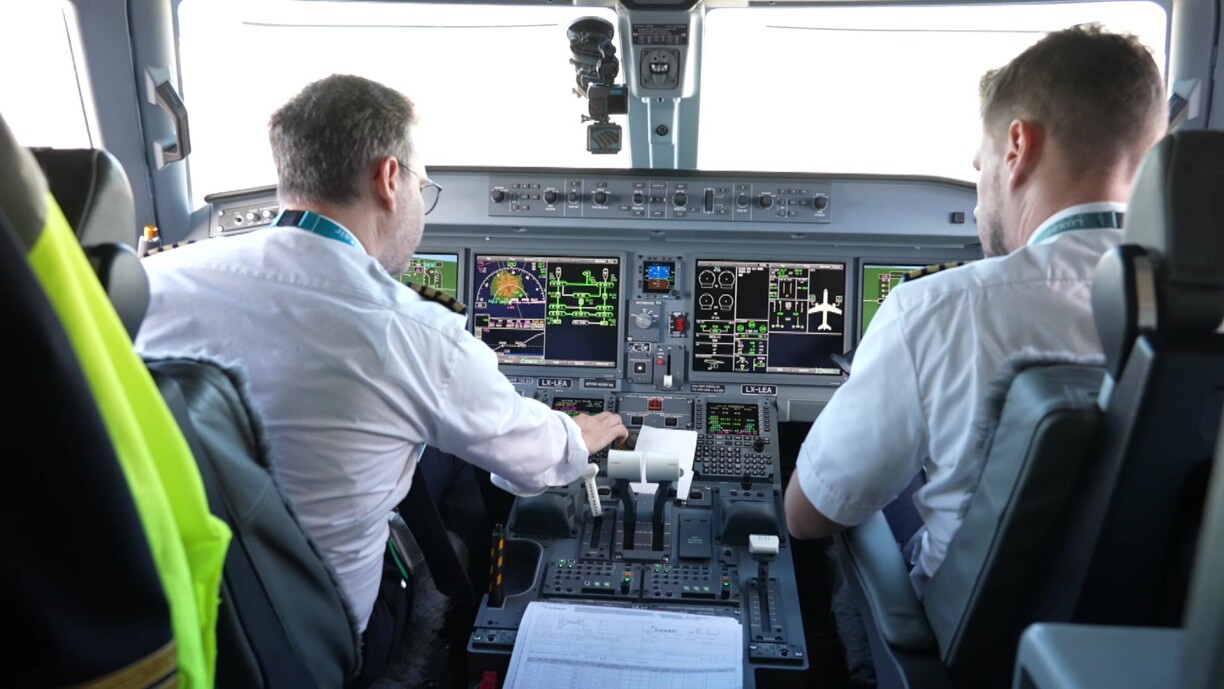
In recent days, several technical incidents in civil aviation have prompted public discussion in Luxembourg.
On Monday evening, Luxair announced that one of its aircraft had to make an unscheduled landing due to a crack in the cockpit windscreen. According to Dirk Becker, a pilot and General Secretary of the Luxembourg Airline Pilots' Association, such incidents should be viewed as coincidental.
“There are no signs that suggest a warning signal – neither for a specific airline nor a specific type of aircraft,” Becker stated.
Becker does not share the subjective impression that technical failures are becoming more frequent. Instead, he attributes heightened awareness to how information spreads in the digital age.
“We live in the age of social media,” he noted, pointing out that air traffic can now be tracked in near real-time. As a result, even minor incidents are quickly reported, commented on, and shared online.
This increased visibility, he explained, does not reflect a decline in safety standards. To pilots, the recently reported issues are part of routine flight operations. Technical faults can occur at any time, Becker said, with periods of quiet followed by clusters of events. “You have to look at it over very long periods,” he emphasised.
The cracked windscreen incident reported by Luxair may sound dramatic to the public, but Becker described it as a known scenario for which pilots are prepared.
“The windscreens are made of several layers and are specially designed. Despite high quality and regular maintenance, a technical failure can still occur,” he explained.
Pilots train regularly for such situations in flight simulators. “These emergency procedures are practised routinely. In case of a cracked windscreen, the flight is aborted and a controlled landing is initiated as a precaution,” Becker noted.
That response may include an unscheduled landing to ensure the safety of passengers and crew.
For Becker, it is essential to emphasise that every decision in the cockpit follows one guiding principle: “When a crew decides to divert or turn back, it is always done in the interest of safety and the passengers.”
Drawing on nearly three decades of flying experience, he notes that such diversions remain exceedingly rare. “In over 17,000 flight hours, I’ve only had to abort a flight once. That shows how uncommon these situations are in a pilot’s day-to-day work,” he stressed.
Becker reiterated that it is not the frequency of technical issues that has risen, but rather the transparency and speed with which information reaches the public. In his view, this increased awareness is ultimately a sign of a safety system that is functioning as it should.





