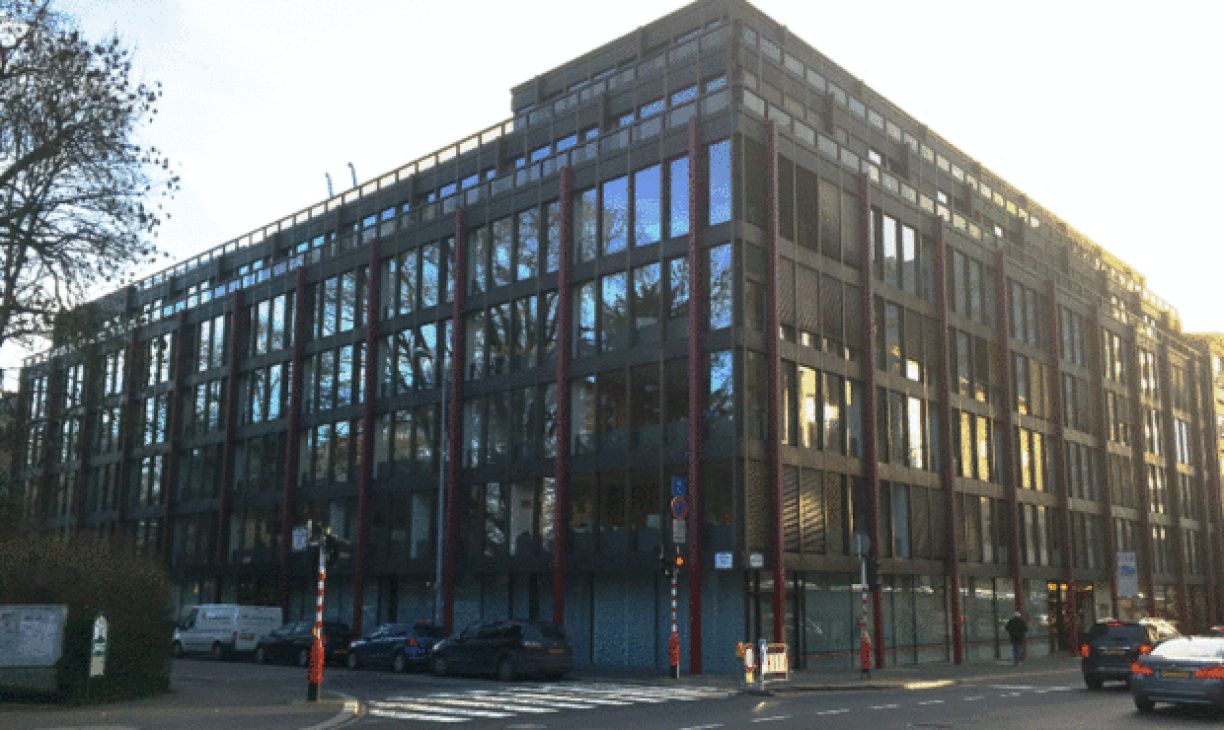
The National Pension Insurance Fund (CNAP) is facing significant challenges in implementing the pension reform measures adopted by the government in late 2025, according to internal documents reviewed by RTL.
The documents, dated October and December 2025, reveal that the fund has identified legal risks and a substantial increase in workload from the reform, largely confirming concerns previously raised by trade unions.
The core of the difficulty lies in the provisions for progressive early retirement at age 60. Previously, workers could retire early with 480 contribution months (40 years). The reform aims to gradually increase this requirement by eight additional months by 2030.
However, internal CNAP analyses conclude that the new law's wording is ambiguous. The legislation refers only to increasing "this period", without explicitly citing the baseline of 480 months or the age of 60. This lack of clarity creates uncertainty over how to apply the new rules to individual cases.
A CNAP presentation illustrates the problem using the example of a person born on 1 January 1970. If they started work at 25 after university, they would accumulate 480 contribution months by 1 January 2028, at age 58. The fund questions whether this individual would then need to work four extra months to retire, eight extra months to retire at 60 in 2030, or be exempt from the increase altogether.
Despite the legal risk of potential lawsuits, the CNAP leadership has determined its operational interpretation: the 480-month threshold will be increased based on the specific year in which a person both reaches 480 contribution months and turns 60 years old.
Beyond the early retirement rules, the CNAP is also grappling with the administrative complexity of the new progressive retirement scheme. This system allows eligible workers to continue employment under specific conditions even after reaching retirement age.
A significant operational challenge involves the payment mechanism. Internal documents show the CNAP is advocating for direct bank transfers to the insured individuals, rather than routing payments through their employers. Regardless of the final method, the scheme will be subject to multiple verification checks.
The fund estimates this new programme will increase its administrative workload by approximately 25%. This surge is not only due to the necessary checks but also because the CNAP must perform detailed calculations for each applicant to issue certificates required to claim associated tax breaks. According to the documents, the fund had to coordinate solutions with the tax administration on this point, a process that appeared partially resolved by December 2025.
Further complications are anticipated from applicants with unconventional education paths. These challenges add another layer of complexity to a pension system that has grown increasingly intricate since the 2012 reform, a change that prompted the then-director of the CNAP to state that pensions could no longer be calculated manually.
In response to enquiries, the CNAP told RTL that a more precise answer would be provided once its analysis of all issues is complete, internal procedures are adapted, and clear instructions for the public are finalised. The fund noted that preliminary information, including an application procedure for the progressive retirement scheme on guichet.lu, is already available online.
In an interview with RTL on 19 December, Minister of Social Security Martine Deprez acknowledged the reform would increase the CNAP's workload, though "not to the extent that some assume". She confirmed that applications for the progressive retirement scheme could be submitted starting in early 2026, with the scheme itself taking effect at the earliest four months later.
To manage the added complexity, Minister Deprez announced an increase to the CNAP's staffing ceiling to facilitate new hires. While she did not specify an exact number, the official regulation references an increase of 100 positions. According to the CNAP's 2024 annual report, the fund employed 242 staff members at that time.
The pension reform followed a period of tense political debate, which included a major public protest in the summer of 2025 that led the government to revise its initial proposals. The final version of the law maintains a key financial measure: a 0.5% contribution increase shared by insured individuals, employers, and the state, which is projected to provide the most significant relief to the pension system's finances.





