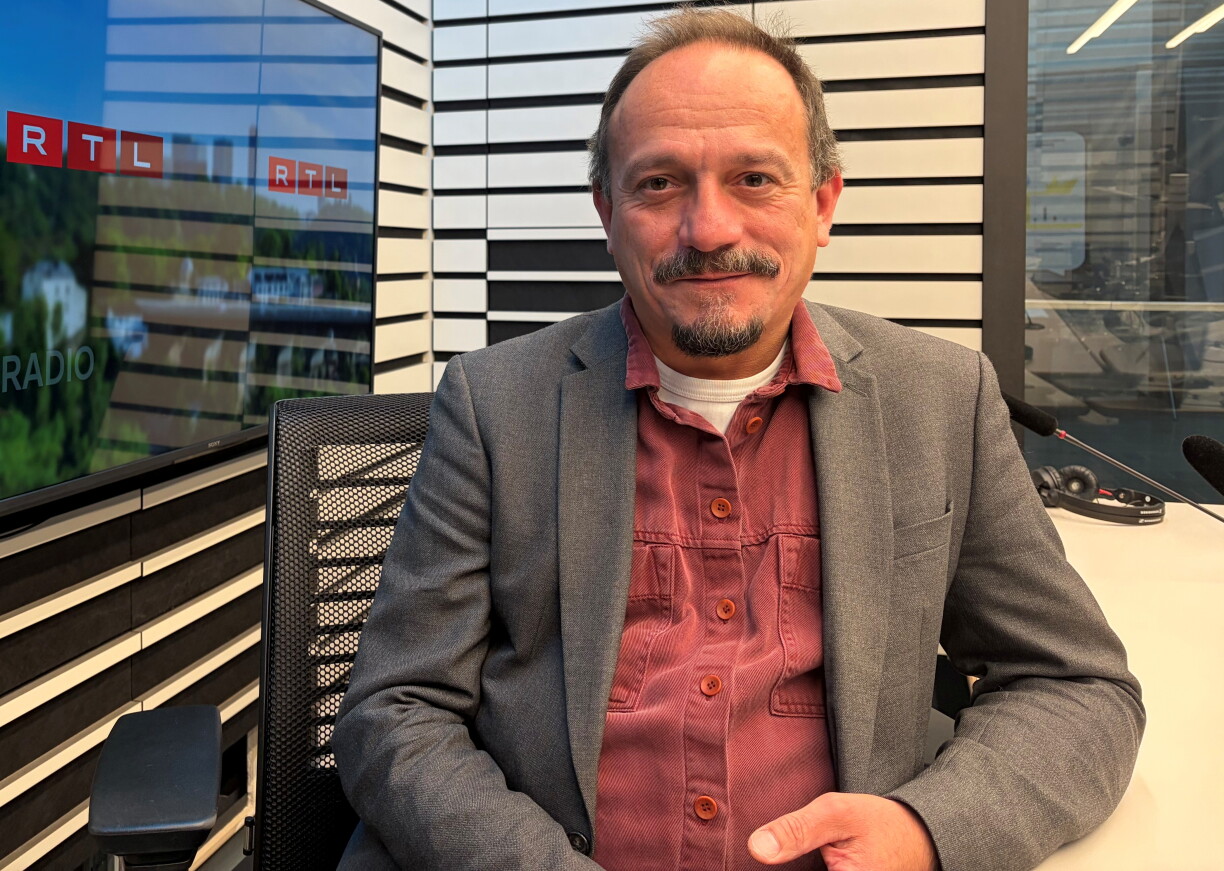
Déi Lénk (Left) MP Marc Baum has raised concerns over the government's management of recent drone sightings near Findel airport. Several incidents over the previous week forced flight disruptions, with authorities providing only limited public information.
Baum said MPs are "just as much in the dark as the public" regarding the incidents, arguing that "the government leaves far too much room for speculation and insecurity".
He argued that the government’s main role in a situation like this should be to "provide reassurance" and offer a transparent account of what is known and what is not.
When pressed about the argument that security concerns prevent officials from disclosing more, Baum acknowledged the dilemma but insisted that even basic information should be shared with parliament, adding that "the government once again gives the impression that it is not in control of the situation".
Baum went further, comparing the handling of the drone incidents to previous cases where he felt the government failed at crisis communication. He referred to the fire in Belgium’s High Fens and last year's major cyberattack on Luxembourg’s postal service. He criticised the government’s crisis communication as "a total catastrophe" in both of those cases.
He warned that the lack of information encourages speculation and public uncertainty, especially in a context where neighbouring states have also reported drone incidents and where concerns about hybrid attacks have heightened speculation about Russian involvement.
Turning to the ongoing dispute between the Luxembourg Association of Doctors and Dentists (AMMD) and the National Health Fund (CNS), Baum also took aim at both sides for their handling of failed negotiations over a new convention.
He emphasised that while doctors do not have to agree with everything, they must always be ready to negotiate, which, according to him, does not seem to be the case at the moment.
Baum said he understood that a draft agreement was on the table and that, in principle, doctors had agreed to it, but they wanted all election campaign promises to be implemented as a precondition for signing anything.
He criticises this approach, stating that one "cannot come with maximum demands, say everything must be fulfilled first, and only then be prepared to even agree to something".
Baum was clear that his party supports maintaining Luxembourg's public healthcare model, which he described as "one of the best health systems in the world in terms of accessibility". International studies, he said, prove this, and the system’s strength comes from involving a strong public actor who sets and enforces the rules.
He criticised the AMMD’s position that doctors should be allowed to set their own prices, calling this "the death of our public health system" and warning it would lead to a two-tier health system.
Asked about AMMD complaints that hospitals are better funded than private practices, Baum defended public funding for hospitals as "the backbone of our health system", though he acknowledged that not every expense is covered by the state there either.
Baum argued that the real question is whether Luxembourg should move further towards a model where more doctors are salaried rather than independent.
He suggests that this debate will become more important in future, since many doctors would prefer a salaried medical model rather than the traditional liberal doctor set-up, where they have to cover all expenses themselves.
Baum also commented on the recent electoral victory of Germany's Die Linke (The Left) in Berlin. He praised their clear, socially-oriented programme and said their focus on affordable housing and investment in public housing were ideas the Left shares for Luxembourg.
Baum said that the party managed to give young people hope and perspective again, adding that the Berlin result sends a signal far beyond the city’s borders.
On whether Luxembourg could adopt Berlin’s proposal of expropriating large real estate companies, Baum said the situations are different because Luxembourg does not have the same concentration in real estate ownership.
However, he noted that in Berlin, a referendum with strong majority support had called for such measures, proving that this approach is not "unrealistic populism".
With Baum rotating out of parliament under the Left's internal system, he said he knew what to expect when he stood for election, acknowledging that "it is always a special situation when you have invested yourself in parliament for three years and then have to switch to an entirely different position for two years, only to possibly stand for election again".
He recognised that while this is a demanding task, it is what he agreed to. Baum confirmed that his party is still debating whether to continue with the same rotation system in the future.





