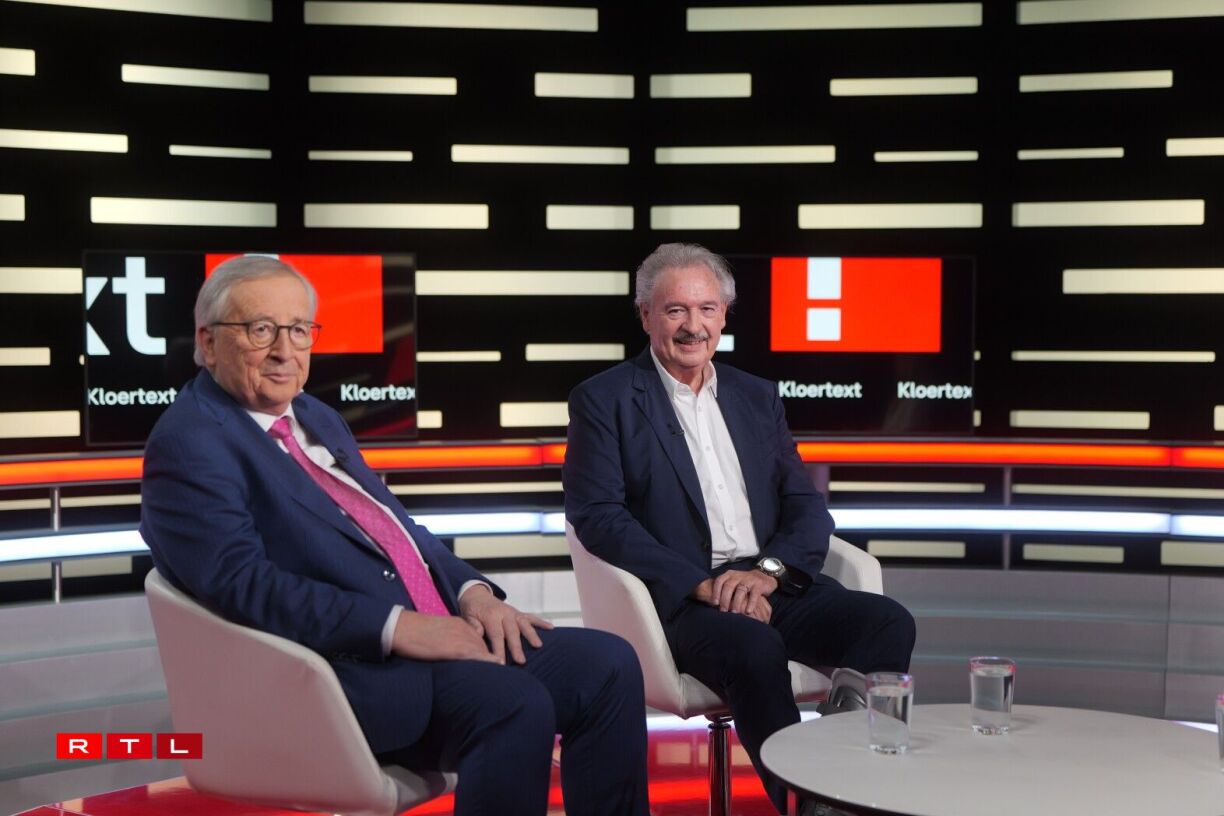
Former prime minister and ex-European Commission president Jean-Claude Juncker and longtime foreign minister Jean Asselborn used RTL's final Kloertext panel of the year to deliver a stark warning about Europe's security and cohesion, urging the EU to respond with unity and a firmer defence of democratic values as Russia intensifies its pressure and the United States under Donald Trump grow openly antagonistic.
Asselborn said Europe is now "between two fires", arguing that the Kremlin's ambitions go beyond Ukraine and that Washington is helping boost far-right forces inside Europe. He also cautioned that a breakdown in Franco-German leadership, especially if France elects a nationalist president in 2027, could weaken the EU's centre of gravity.
Juncker rejected fatalism about Europe's future but said the bloc was losing influence because external powers prefer to deal with individual capitals rather than the EU as a whole. "If Europe stands by itself and stops dividing into little groups that the big powers can play off against each other, then we get out of this", he said.
A central theme was whether the United States remains a partner. Both men portrayed Trump's approach as a direct challenge to Europe's model of governance, including its regulation of digital platforms and its understanding of free speech.
Juncker criticised the tone of the new US security strategy discussed on the programme, calling it overly simplistic and arguing Washington is positioning itself "in clear opposition to the fundamental values of Europeans". He said Europe should be prepared to move early with countermeasures when threatened with tariffs. You have to trigger a counter-move in advance, he said, adding that Europe's past hesitation reduced its leverage.
Asselborn added that the EU must enforce its rules on tech giants and resist intimidation.
Both said Europe cannot quickly replace US military capabilities, particularly intelligence and nuclear deterrence, but they agreed that the transatlantic relationship has already shifted. Juncker said the US "has largely given up the alliance with Europeans mentally", while Asselborn argued Europe must urgently build its own capacity to avoid strategic dependency.
Asselborn said the risk from Russia is broader than the war in Ukraine, describing a Kremlin worldview that targets Europe itself. He warned that Moscow could test NATO resolve, including through hybrid scenarios in the Baltic states, and said European weakness invites pressure.
On whether Europe should use frozen Russian assets to support Ukraine, Juncker expressed sympathy for Belgium's caution because of legal and financial risk. He framed it through a hypothetical: if a country seized assets and then lost in court, taxpayers could face enormous liabilities. Still, he said the geopolitical context argues for using the funds for “a good purpose”, while reiterating his long-held preference for common European borrowing to fund strategic needs.
Ukraine aid deal: EU secures €90 billion after dropping Russian asset plan
Both men also focused on the rise of far-right parties across Europe and questioned whether the traditional "cordon sanitaire", the refusal of mainstream parties to form coalitions or cooperate with extremist parties, is holding, particularly in France and Germany.
Asselborn said the political "firewall" in France has weakened and warned against portraying the far right as normalised or harmless. Juncker argued mainstream parties should not simply blame themselves for extremist advances, saying voters also carry responsibility for the consequences of empowering anti-democratic forces.
Asselborn cast the stakes as generational, saying Europe owes it to its children to defend independent courts, free media, and the separation of powers, and he urged voters to reject parties he said want to dismantle the EU and undermine democracy.


The discussion also returned repeatedly to domestic pressures, including a strained social dialogue, labour market anxiety, and the sustainability of pensions.
Juncker endorsed the appointment of Marc Spautz as labour minister, describing him as someone who is highly functional and holds to party principles, while arguing the role of parliamentary group leader can be as politically significant as that of minister. On social dialogue, Juncker acknowledged that tripartite talks can fail but insisted governments must keep channels open and find alternative formats to restore consensus when negotiations break down.
On job losses, including a large social plan at Amazon, Juncker urged perspective, recalling earlier periods when Luxembourg managed major industrial restructuring. He said rising unemployment is serious but not unprecedented and argued the country has historically found solutions through negotiation and social partnership.
On pensions, Juncker suggested reforms have not gone far enough and said the demographic arithmetic makes inaction harder to defend, warning that growth-driven financing models also generate significant secondary costs for infrastructure and public services.
Coming into effect on 1 January 2026: Lawmakers pass pension reform after marathon Chamber session
On fiscal policy, he cautioned against a sharp rise in public debt and said major tax cuts require discipline elsewhere in the budget. He also warned Luxembourg will face recurring pressure in EU negotiations on excise duties such as tobacco, arguing outcomes depend heavily on negotiation strategy and coalition-building among member states.
Chamber of Deputies: State budget for 2026 adopted with votes of majority parties
In closing exchanges, Asselborn criticised Europe's tougher migration line and the idea of sending asylum seekers to third countries, calling it a betrayal of European principles. He argued the EU failed to create durable solidarity mechanisms after 2015, leaving frontline states to shoulder the burden and encouraging ad hoc responses that erode trust.
YouGov study: Western Europeans perceive immigration as increasingly negative
Juncker linked the debate to broader trends, saying cuts to development aid and the spread of "simple ideas" threaten the values that shaped post-war Europe.
Despite their warnings, both men ended on a call for civic engagement. Juncker said the rule of law is vital for small countries: “The rule of law, the respect for law, the primacy of law over violence, is the greatest protection instrument that exists for small countries." Asselborn urged voters to use their ballots to defend democracy and the European project.





