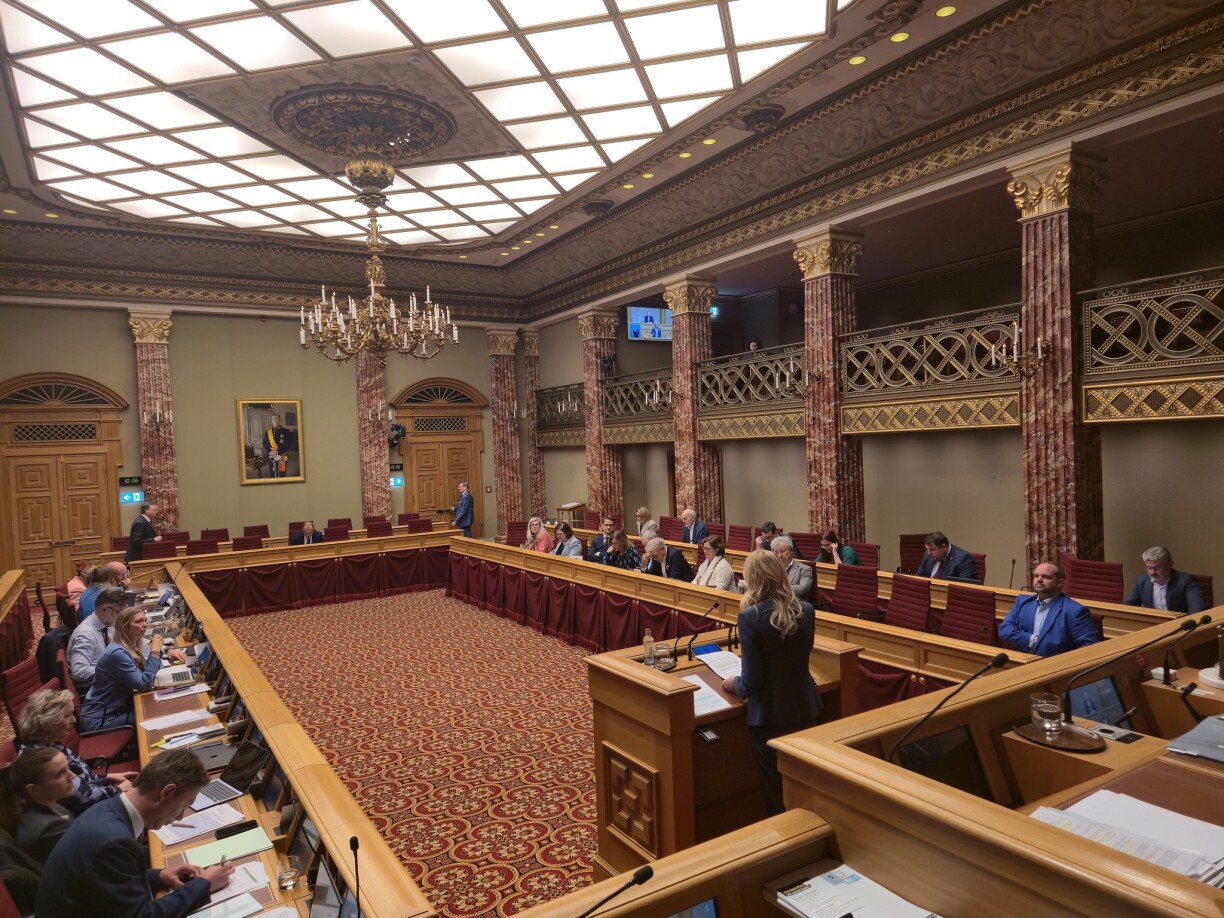
The draft state budget for 2026, presented under the slogan "Growing Together", was debated in the Chamber of Deputies on Wednesday. Finance Minister Gilles Roth described it as a budget of "record investments" aimed at stability, sustainability, and future prospects.
Minister Roth framed the budget against an improving economic backdrop, noting that inflation has stabilised and unemployment is declining slightly. While signs point to economic growth, he argued that sustained investment is necessary to maintain this momentum.
The budget outlines significant allocations across several sectors. Housing receives the largest share of tax expenditure at 42%, with measures including the off-plan (VEFA) purchase programme, rent and interest subsidies, and the tax credit on notarial deeds ("Bëllegen Akt"), which alone is allocated approximately €353 million. Further major expenditures include €150 million for energy relief and €500 million for modernisation investments. Substantial funding is also earmarked for social measures, defence, healthcare, and education.
Roth emphasised that the strategy involves not only increased spending but also further tax relief, with a continued priority to "ensure more net from gross". This includes deductions for individuals working longer and measures to strengthen the financial centre, such as the recent abolition of the subscription tax for actively managed ETFs and more attractive taxation for fund managers.
A planned broader tax reform, whose draft law is not yet tabled, is projected to have a gross impact of around €800 million on the central state by 2028. Corporation tax is also set to be reduced again in 2027.
The minister addressed fiscal sustainability, acknowledging forecast deficits of €1.2 billion for 2025 and €1.49 billion for 2026. However, he noted these figures are significantly lower than earlier predictions and stressed that Luxembourg will continue to comfortably meet the EU's 3% deficit rule.
Increased revenues are anticipated from VAT, wage, and income tax. Roth projected that by 2027, Luxembourg will have the lowest national debt in the Eurozone, estimated at 27% of GDP and well below the 30% threshold, asserting that the ministry has debt under control.
Following Finance Minister Gilles Roth's budget speech, Laurent Zeimet, the new parliamentary group president of the Christian Social People's Party (CSV), responded on behalf of the governing party.
Zeimet stated that the draft budget "takes into account the economic and social situation of the country and its environment" and serves to strengthen social cohesion. He framed the proposal as a responsible investment in the future while maintaining national debt at a reasonable level, particularly at a time when "social inequalities, climate change, energy prices and international crises are increasingly intertwined".
The budget, he said, acts as a "mirror of our responsibility – not only to the citizens of today, but also to the generations that will come after us", and marks a further step in implementing the coalition agreement between the CSV and the Democratic Party (DP).
Zeimet outlined three clear priorities demonstrated by the budget: protecting "the weakest in our society" through targeted social measures, strengthening "the country’s future viability" with high investments in infrastructure, education, the environment, digitalisation, and innovation, and combining "social, economic and ecological responsibility".
The CSV parliamentary group confirmed it will approve the 2026 budget.
DP parliamentary group leader Gilles Baum presented his party's perspective, emphasising the budget's social responsibility. He characterised the 2026 draft as carrying a "social-liberal" signature, with people at its heart.
Baum first highlighted the national anti-poverty plan, unveiled the previous week, which allocates over €1 billion and outlines 106 measures. These include an increase in child benefit slated for 2027 – rising by €45 for younger children and €60 for children over 12. A key priority, he noted, is ensuring aid reaches those who need it and that financial support is distributed more automatically.
On housing, Baum stated the budget "does not skimp", explaining that many policy levers are being activated simultaneously to revitalise the housing market.
Defence also featured prominently in his remarks. Baum described the planned investments as a "paradigm shift," with funding directed across multiple fronts. He concluded by stressing that Europe must now take responsibility and invest in its own defence capabilities.


The 2026 draft budget faced immediate criticism from opposition parties, who challenged its underlying priorities and financing.
The Luxembourg Socialist Workers' Party (LSAP) rejected the government's economic analysis. Parliamentary group leader Taina Bofferding stated her party would set different political priorities, focusing on "social issues, justice, sustainability, and progress."
Bofferding argued the CSV-DP government remains attached to an outdated growth model, what she termed the "mantra of growth." While acknowledging growth is important, she warned it is not the sole compass or a "panacea". She emphasised her party focuses on people, stating that money alone is insufficient and must be used correctly.
A key criticism centered on fiscal planning. Bofferding contended the budget lacks proposals for counter-financing, asking: "Where does the money come from?" She argued the government provides no answers on sourcing new revenues.
Consequently, the LSAP confirmed it would vote against the budget.


The Alternative Democratic Reform Party (ADR) also opposed the budget, with parliamentary group leader Fred Keup arguing it postpones fundamental problems to the next generation.
Keup questioned the budget's sustainability, asking: "Who will pay for all this and where is the CSV's influence?" He criticised the rising debt as uncharacteristic of traditional CSV policy and noted the absence of a clear debt-reduction plan. He labelled the proposal a budget of "instability and extremes", specifically "extreme debt".
For the ADR, the core issue is population growth, which Keup characterised as "turbo-growth". He stressed the imperative to curb Luxembourg's expansion and demanded that social systems be made independent of constant growth, warning against downplaying the associated problems.
In her address, Green Party MP Sam Tanson accused the government of a lack of fiscal transparency. She warned that the current budget and its multi-annual financial plan risk leaving Luxembourg facing significant financial problems within a few years.
Tanson argued that large, foreseeable expenses – including the planned tax reform and increased defence spending – are omitted from the multi-annual plan. She criticised the government for looking only "at the next two to three years", calling this a dishonest projection of the future that fails to strengthen the country long-term. "With this time horizon", she argued, "the government is just saving Luxembourg with this budget until the next election". The Green Party had, therefore, expected "more rigour" from Finance Minister Roth.
Tanson also faulted the government on revenue, accusing the minister of failing to propose the necessary sustainable solutions to secure long-term finances and avoid a structural deficit.
Pirate Party MP Sven Clement continued the opposition's critique, arguing the budget lacks a coherent vision. He warned that spending is not based on realistic forecasts, thereby putting sound public finances at risk.
Clement acknowledged the recent anti-poverty plan but noted that concrete measures to implement it are largely absent from this budget, with most efforts deferred to the next fiscal cycle. He concluded that poverty is not a current priority for the government and called for support services to be made more accessible and effective.
He also expressed concern over the planned increase in the CO2 tax. While supporting climate action, Clement stressed that such measures "must not only hit the socially weak".
MP David Wagner of the Left Party (Déi Lénk) argued the government is using the international situation as a pretext for its decisions. He dismissed the 2026 budget as an achievement, claiming it merely cements the status quo.
Wagner directly challenged the government's assertion that nearly half the budget is allocated to social measures, stating the true figure is "only" 36%. He attributed this discrepancy partly to the classification of expenditures like aid to Ukraine as social spending.
The MP argued that Luxembourg's true potential lies not in the government, but in its population, particularly the 56.8% who are under 30. However, he criticised that these young people struggle in the labour market and face severe difficulties in the housing market, where guarantees have made renting after a first job nearly impossible.
Wagner contended the private market exacerbates these problems. He opposed state support for private developers, advocating instead for the large-scale public purchase of off-plan properties. On other issues, he called for expanded public transport, the creation of public crèches over subsidised private ones, and higher taxes on the wealthy with closed loopholes.
The Left Party announced they would vote against the budget.
The Luxembourg state budget for 2026 was approved by the Chamber of Deputies at the conclusion of Wednesday's debate, passing with 34 votes in favour and 25 against.
The vote took place with the Chamber currently composed of 59 active MPs, as the seat formerly held by Marc Spautz remains unfilled following the departure of former minister Georges Mischo, who is expected to be sworn in by late January.





