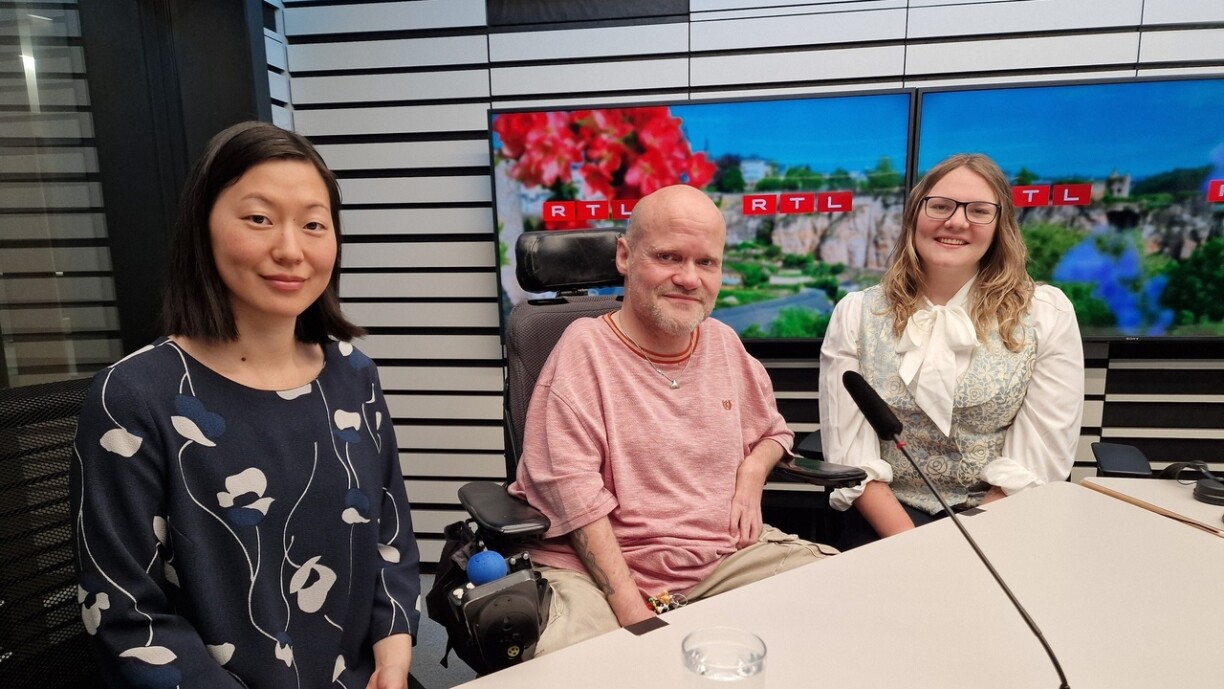
President of the Centre for Equal Treatment, Susanna Van Tonder, acknowledged that while progress is being made, the journey towards inclusion and equality remains arduous. She pointed to the assistance subsidy provided by the Ministry of Family Affairs as a step in the right direction but emphasised the need for greater utilisation of such opportunities.
Joël Delvaux, Central Secretary of the Independent Luxembourg Trade Union Confederation (OGBL), highlighted significant improvements in recent years. Autism coach Joanne Theisen underscored the importance of evaluating inclusion not just in terms of its existence but also its effectiveness for different individuals.
All three participants emphasised the necessity of involving disabled individuals in decision-making processes. Delvaux cited the successful involvement of disabled individuals in the design of public transport systems, such as the tram, as a positive example. However, he criticised the lack of consultation in the reform of On-Demand Transport for Persons with Reduced Mobility (ADAPTO), which led to practical issues and apprehension among users.
According to Delvaux, the ADAPTO reform was carried out "by office workers who had no knowledge of how the whole thing works in practice." Some of the people concerned have even withdrawn because they are afraid to use ADAPTO, he noted. People who face mobility challenges cannot simply be left alone because an ADAPTO driver refuses to accommodate them, Delvaux lamented.
Theisen stressed the importance of consistent and inclusive participation in the development of new initiatives, emphasising the need for thorough examination of any barriers preventing the involvement of affected individuals in decision-making processes.
Reflecting on past experiences, Joël Delvaux recalled a time when the employment landscape for disabled individuals was far more rigid. Personal choice often took a backseat, with options limited to sheltered workshops. However, Delvaux noted a positive shift in recent times, with a growing number of employers showing openness to hiring disabled individuals.
Despite this progress, Susanna Van Tonder highlighted disparities in training opportunities for disabled individuals compared to their able-bodied counterparts. Many face underestimation and limited access to education, with challenges such as transportation hindering their ability to attend traditional institutions. Van Tonder advocated for alternative approaches, such as online distance learning, emphasising the importance of small adjustments to accommodate diverse needs.
"It's not as if we have to turn the world upside down to accommodate people," Van Tonder said. For Joanne Theisen, it is also a shame whenever good initiatives are discontinued. If something is working and the people involved confirm that it is, then it should be maintained, she argued.
For some autistic people, for example, the option to dim lights and reduce ambient noise can be very helpful, Theisen noted. She cited examples like "silent hours" in supermarkets, which cater to autistic individuals by providing a quieter shopping environment. Such adaptations, she stressed, can greatly enhance inclusivity.
Delvaux underscored the value of investing in disabled employees, emphasising the benefits of training and support measures. While initial investments may be required, he noted the long-term advantages of having motivated and grateful employees. Delvaux also highlighted the need for better communication regarding available support services, noting a lack of awareness among employers. Delvaux noted that he had never heard of a case in which an employer refused to employ a disabled person.
Theisen praised initiatives like Duo Day, which facilitate connections between employers and disabled individuals. However, she lamented the relatively poor implementation compared to similar programmes aimed at other groups.
According to Delvaux, the argument that accommodations come at a cost is unacceptable since society will ultimately save money on a disabled person who is given the opportunity to work compared to a person who lives at the expense of the state.
In the view of Joanne Theisen, inclusion is not a luxury.
She emphasised that disabled individuals should be integral members of society, just as much as able-bodied individuals. Drawing parallels to the acceptance of women's facilities in universities, Theisen highlighted the importance of recognising and accommodating diverse needs without question.
It is not enough to say that disabled people belong if they cannot fully participate in all aspects of society. As reiterated by the panellists, achieving inclusion often requires not grand gestures, but rather simple acts of respect and empathy.
For Theisen, a pivotal moment came when a ministry posed a simple question: "What do you need?" Real inclusion can only be achieved through dialogue and respect, all guests agreed. Ultimately, it would be a question of humanity and of promoting a positive development for society as a whole.






