
Widespread attendance at cemeteries on All Saints’ Day, a decline in child baptisms, and a growing interest in faith among adults were among the topics addressed by Vicar General Patrick Muller this morning, on All Souls’ Day.
Muller reflected on recent shifts within the Catholic Church in Luxembourg and highlighted both progress and areas where work remains to be done, particularly in how the Church approaches questions of social inclusion.
For instance, Muller acknowledged that the Church still lags behind when it comes to integrating the LGBTQ+ community and granting women greater responsibility within church institutions.
He stressed, however, that Bishop Jean-Claude Hollerich has made significant efforts to make the Church as open and welcoming as possible.
"Everyone is welcome", and nationality is irrelevant among baptised members of the Church.
Muller, who assisted with blessing graves in his hometown parish of Pétange on All Saints’ Day, observed alongside the local priest that more people attended this year compared to last. He reported similar feedback from other areas.
One likely reason, he suggested, is that All Saints’ Day fell on a Sunday, which enabled more families to attend Mass and visit cemeteries together.
He also pointed to a broader search for stability in uncertain times, with events such as wars and social tensions, alongside young people taking to the streets, prompting many to turn to family, roots, and community for support.
All Saints’ Day is focused on remembering the saints, whereas All Souls’ Day is dedicated to commemorating the deceased.
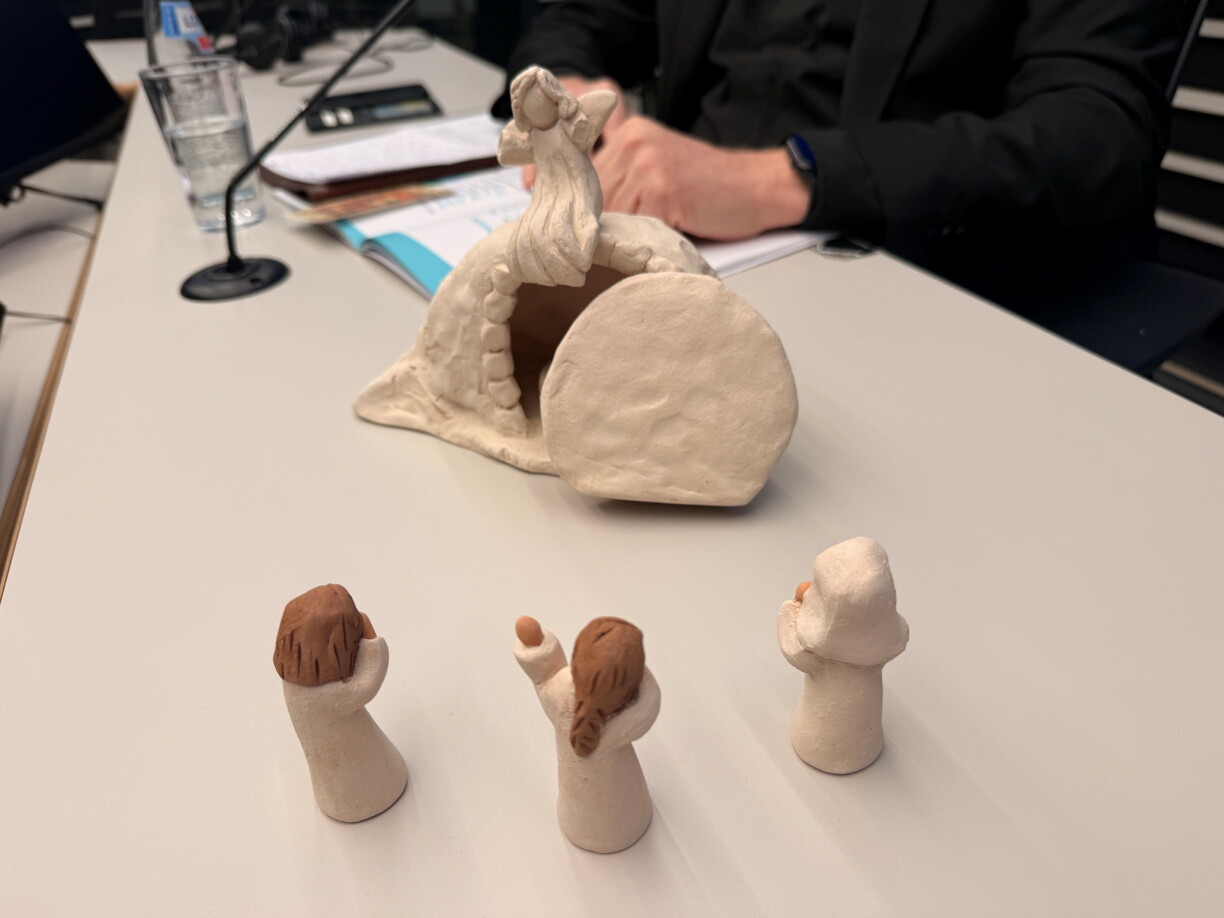
For Muller, this remembrance is closely tied to Christian hope in the resurrection. He explained that, symbolically, Christ’s empty tomb points believers towards hope rather than only mourning.
In Christian belief, the saints are with God, and there is hope that the departed may also reach this final destination.
STATEC figures show that in 2025, there were 4,400 deaths in Luxembourg, with 2,110 funerals conducted with a church ceremony, meaning about half of all funerals in the country remain religious ceremonies.
Muller also noted a growing trend towards cremation: while in 2008 only 48 percent of funerals involved cremation, the number has now increased to almost 66 percent.
However, cremation does not preclude a church ceremony, as urns can be interred in graves or columbaria with a priest present. Even in cases of scattering, a church service may be requested.
When asked about regular church attendance, Muller said numbers vary widely between parishes and communities, but noted that foreign-language communities have become increasingly dynamic.
He pointed out that Italian-, English-, Polish-, and Spanish-speaking congregations play significant roles, with the English-speaking community in particular experiencing growth.
While acknowledging that the Church is evolving, Muller expressed optimism, noting that these communities often attract more families and children than many Luxembourgish-rooted congregations.
He believes that in an increasingly individualistic world, people are seeking opportunities to walk together, to share faith, concerns, and aspects of daily life.
According to the 2025 diocesan report, the number of child baptisms in Luxembourg has fallen by almost 30 percent over the past three years, while figures for first communion and confirmation have increased.
Muller attributes the decline in infant baptisms partly to the fact that many parents are themselves less closely connected to the Church, meaning that baptism has become a more conscious choice rather than an automatic one.
At the same time, more teenagers and adults have been actively seeking baptism on their own initiative.
In the past year, over 50 adults were baptised in Luxembourg, and for the coming year about 60 adults and 30 candidates for confirmation have already registered.
Muller sees this as evidence of a broader trend: even if it does not fully offset the drop in infant baptisms, it shows many people remain on a spiritual search.
Responding to whether these shifts reflect a loss of faith or just declining trust in the institution, Muller observed that there is no single answer.
He underlined that faith and church practice should not be seen as identical, and stressed the importance of the Church providing open communities where people of all ages, backgrounds, and life paths feel welcome.
He emphasised that the journey to faith should happen freely and without compulsion.
The Church’s openness was also questioned in the interview, especially in relation to homosexual people, some of whom have not always felt welcome. Muller described calls for greater openness as understandable, but said he sees positive developments in this area.
On the role of women, Muller acknowledged recent progress: in Luxembourg, three of the five bishop’s delegates are women, who represent the bishop in various domains and assume significant responsibility.
However, he noted that women remain underrepresented at the Vatican. Muller remarked that while the Catholic Church is an institution with a history spanning more than 2,000 years, there has been considerable progress, especially since the Second Vatican Council, and that the Church remains open to further evolution.
He concluded that both Pope Francis and Pope Leo XIV have appointed women to leadership positions in the Vatican, though the path towards full equality is still a work in progress.


