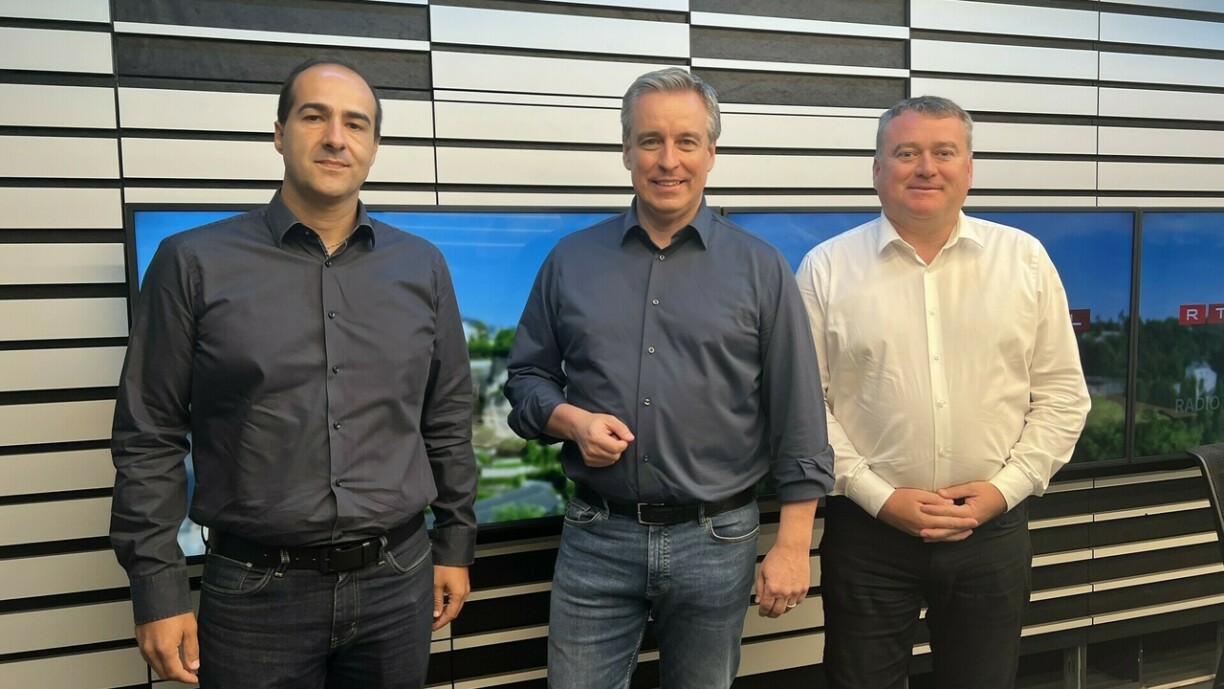
To what extent should inclusion in schools be pursued – and to what extent is it realistically achievable? That was the central question explored in the latest edition of RTL LU's programme: Background am Gespréich. Education Minister Claude Meisch, SNE teachers’ union president Patrick Remakel, and Humberto Rodrigues, a father of a child with special needs, were invited to the studio as guests.
Rodrigues highlighted the confusion many parents experience, noting that from the outside, the school system often appears chaotic, leaving families uncertain about how to proceed or whom to approach. Remakel stressed the need for more staff to be physically present in schools, arguing that it is problematic when specialised educators from ESEB – the special needs support team – are not consistently on-site to assist pupils.
Meisch acknowledged the complexity of the school system, arguing that multifaceted challenges require equally multifaceted solutions. He underlined some efforts over the past eight years: around 1,900 teachers are now working in the field of inclusion, and the number of regional interventions has risen from 700 to 3,400 in the last five years. Still, Meisch insisted that each case must be considered individually.
Remakel noted that teachers are increasingly reporting a rise in pupils with special educational needs. Rodrigues questioned whether simply expanding support structures is enough, pointing out that the real issue often lies in how support is delivered; namely, that children with special needs are frequently supervised in groups by a single educator. Minister Meisch rejected this criticism, arguing that professionals must be trusted in their roles, and noting that regular classroom teachers also manage large groups of pupils.
The Minister does not want to limit himself to simply counting the number of students with special needs; instead, he believes the root of the problem must be addressed.
According to Patrick Remakel, the only reason the system hasn’t collapsed yet is solely due to the dedication of teachers. He pointed out that the resources available in the competence centres are not being fully utilised. Some staff members in these centres tend to see themselves more as coaches for teachers rather than working directly with the children.
"It’s utopian to think that every child can find their place in the regular school system," said Humberto Rodrigues. He added that the existing problems cannot be solved merely by hiring more staff.
“Parents should have the final say in important decisions,” emphasised Claude Meisch. However, he noted that expectations and demands vary greatly from case to case. While some parents want their child to remain in mainstream schooling for as long as possible, others prefer an early move to a specialised structure.
Remakel observed that while it is natural for parents not to be entirely objective, this can often lead to valuable time being lost.
Regarding competence centres, Meisch announced that regional services will be further expanded. Initially, these centres were concentrated around Luxembourg City, which created logistical problems for many families. He also stressed that the potential danger some students pose to teachers should not be overlooked.
“We are questioning how certain competence centres operate”, said Remakel. In his view, the various centres too often play “ping pong” with the students, shifting them back and forth. Rodrigues confirmed having faced a similar situation with his own child – though in his case, it was more an issue between the school and the competence centre. Nonetheless, he welcomed the plan to expand regional services.
A general evaluation of the inclusion measures is not seen as the right approach by either the Minister of Education or the trade unions – such a solution, they argue, would be too simplistic.
Listen to the full discussion in Luxembourgish:
See also:
Inclusion in Luxembourg's primary schools: reality or illusion?





