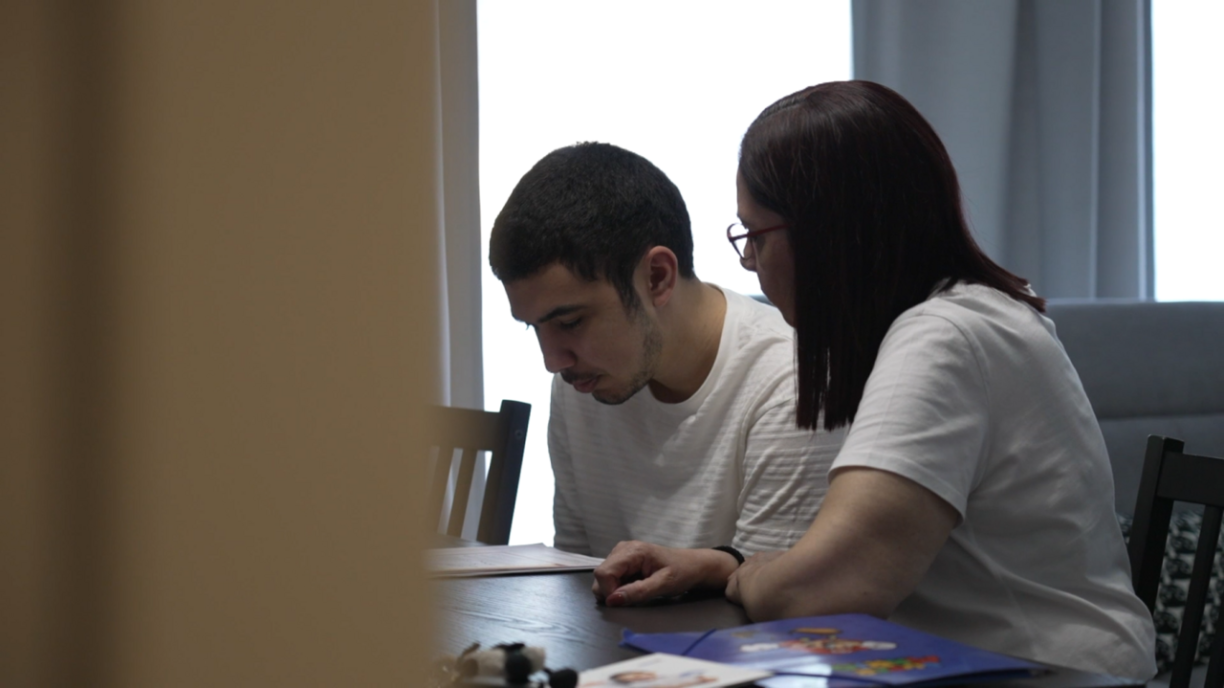
If a child struggles in school – due to a learning difficulty, emotional challenges or a disability – they are considered to have specific educational needs. These children have a right to regular schooling, supported by tailored measures. But in practice, this is not consistently implemented in Luxembourg classrooms.
Some children are placed in the hallway so they do not disturb the class. Others spend the day in a soiled nappy or are hidden behind a screen to avoid distracting their peers. These are just a few examples Eduarda Neves do Rosário has encountered through her voluntary work with ZEFI asbl. She regularly hears from parents whose children face difficulties in school.
"It's not just one, or two, or three cases. There are many children like this", Neves do Rosário says.
These conversations often concern children with special needs who technically qualify for mainstream schooling, but whose needs are not met and who are denied access to high-quality education.
"We have the possibility to do it properly. And it's not about having more money. It’s about directing the money where it needs to go", Neves do Rosário argues. She is the mother of Daniel Quintas, now 18, who attends a vocational class run by the CDI – Luxembourg's Centre for Intellectual Development. He is among the 0.125 percent of students in Luxembourg not enrolled in mainstream education.
When a child struggles in regular lessons, support tailored to their needs should be offered. Since the major reform in 2018, the process begins with the school's own resources. In addition to regular teachers, schools may rely on the I-EBS (specialised teacher for the schooling of pupils with specific educational needs) and the A-EBS (assistants for pupils with specific educational needs), who supports both the I-EBS and students in their daily activities.
If additional support is required, the case is reviewed by the ESEB (Support team for pupils with special or specific educational needs), a support team able to assist pupils either during lessons or through dedicated workshops.
Should school-level support prove insufficient, the next step involves the regional inclusion commission (CI), which draws up an individual support plan.
If this, too, is not enough, the national inclusion commission steps in. This body decides on further diagnosis or care and connects pupils to one of eight competence centres offering specialised support or schooling.
Currently, 0.8 percent of students in Luxembourg are enrolled in specialised education – either partially or fully within the competence centres or in institutions abroad. Daniel Quintas is one of 800 pupils receiving such support.
His education began in early childhood like that of any other child. But unlike others, he did not speak or interact with classmates. At five, he was diagnosed with atypical autism, previously called Asperger's. His parents were advised to enrol him in what was then known as 'differentiated education' (Ediff), now replaced by competence centres.


Initially, Neves do Rosário refused. Parents must consent to any support measures, so Daniel started primary school in a regular class. However, the reality of inclusion fell short.
"He had three hours of classroom assistance. When the assistant wasn't there, he did nothing", she recalls. Break times were particularly difficult – Daniel would hide and cover his ears to block out the noise.
Eventually, Neves do Rosário agreed to transfer him to the former Education différenciée system (differentiated education).
Today, Daniel feels comfortable for the first time in his CDI class, which prepares him for employment. But to his mother, this still is not genuine inclusion. That only happens outside school – in music class, at the gym, or on cinema outings with his cousins.
"The only problem I have is that there's no real inclusion. Because in his class, there are only children who have something. It’s not a regular secondary class."
Daniel's time in school will end in two years. What happens next is unclear. The options, Neves do Rosário says, are limited:
"Anyway, I know that once he took the Ediff path, he wouldn't get a diploma, he would never go to university. I know and accept that. But at least let him do something he enjoys. That's all I want. He's happy now, but I want him to be happy even if I’m no longer here – and neither is his father."
No official figures exist on how many children in Luxembourg have specific needs. Laurent Dura from the National Service for Inclusive Education (SNEI) estimates a prevalence of 10 to 15 percent.
"In a class of 16, that would mean statistically one or two students with specific needs. But one class of 16 is not like another. You don’t have the same distribution in every class."


Joëlle Damé from the SEW teachers' union sees it differently. A teacher in Pétange since 1997, she estimates that around a quarter of pupils in any class have some form of specific need – and that’s a conservative figure. "We've had classes where over half the pupils had an individual support plan."
The number of students supported regionally by the ESEB has more than tripled in five years: from 702 in 2019/2020 to 2,574 in 2024. Growth in pupils supported by competence centres has been far slower. Support offered directly at school – such as that by I-EBS teachers – is not systematically recorded. According to Dura, the number of children with specific needs is rising simply because the overall student population is increasing.
Since 2017/2018, no national data on school inclusion has been published. This was criticised in the 2023 report by the Observatoire national de l'enfance, de la jeunesse et de la qualité scolaire (OEJQS). Dura says the data does exist.
"The reason no data is published anymore is not because it doesn't exist, but because the bodies that used to publish it no longer do."
This has been the case since the 2018 reform, when the competence centres replaced Ediff.
According to Dura, the data could be made public again. Currently, it is only available upon request.
An OEJQS survey also found that 37 percent of teachers had hesitated to refer a child to the inclusion commission, saying the procedures are inefficient and too time-consuming.
When I-EBS and ESEB were introduced in 2009, teachers welcomed them as major improvements. This staff works directly in schools, supporting teams on site. While staffing remains insufficient, their support is valuable. But problems arise when a school’s resources are exhausted.
"People keep coming to discuss, others observe again, paperwork is filled out again – and in the end, you have no more resources than before. You might get advice. But if it's your seventh dyslexia case, you wonder: how helpful is that? You ask if the child can go to a learning workshop – and that’s very difficult. It’s very hard to get specific measures," says Damé.
When asked whether the system is on the right track, Damé answers: "No". The support system is ineffective, and resources do not sufficiently reach the ground.
"When a child enters the same door as the others in the morning but is constantly supervised by someone else – does that person even have time for them? We juggle and patch things together just to get through the day. If the child is progressing, it's because of their own efforts. Otherwise, they wouldn't be in this condition. The classmates suffer, the teachers suffer, the parents suffer – and we pretend we’ve achieved successful inclusion."
A survey conducted by SEW last year confirms this view. Fewer than 5 percent of respondents said they felt inclusion was working well. Fewer than 5 percent agreed that their school had the necessary resources to make inclusion a success.
The Ministry maintains it is on the right path. Its own report, compiled with the University of Luxembourg, supports this view. According to the Ministry, the system will continue to be developed, with more I-EBS and A-EBS staff and decentralised competence centres.





