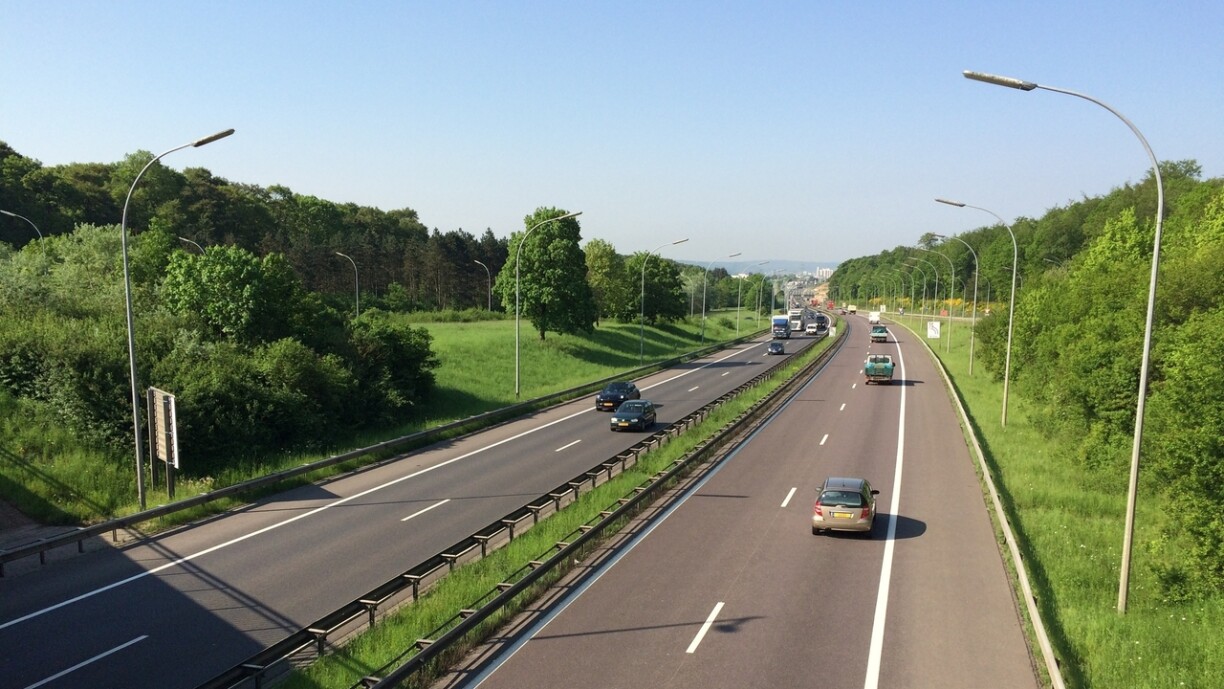
In 2023, an expansion joint on the Munsbach Viaduct failed and was replaced with a temporary element in October. During the summer holidays, the remaining three expansion joints on the viaduct will also be temporarily replaced.
Motorway bridges like the Munsbach Viaduct on the A1 are built to handle heavy traffic. Over time, the constant passage of lorries that traverse these structures daily causes significant wear and tear over time. This viaduct, constructed in 1988, required section replacement in 2023 after an inspection detected a defective joint. In response, the National Roads Administration initiated a project to temporarily repair viaducts across Luxembourg. Roland Fox, director of the National Roads Administration, explained that defective joints result from various factors, including weather conditions and the aging of the structures.
Fox explained that these types of joints need to be inspected every three years. In the case of the Munsbach Viaduct, tests showed that one joint had degraded excessively and sooner than expected. He also noted the challenge of sourcing these custom-made joints, as some manufacturers no longer exist.


To install a new joint, the full width of the bridge is required, necessitating a two-way traffic system with one lane in each direction during the repair work. The speed limit will be reduced to 50 km/h. The entire project is expected to be completed before the end of the summer holidays. When asked about potential traffic congestion, Fritz de Oliveira, Head of the Engineering Structures Division, remarked that "traffic jams are a matter of perspective." On location, Oliveira observed that although traffic was slow, the measures are essential for motorists' safety, ensuring minimal deterioration of the joints until their complete, albeit temporary, replacement.
The National Roads Administration plans to inspect the entire motorway network. According to Fritz de Oliveira, the age of a network significantly influences the frequency of roadworks. Newer networks, such as the Collectrice du Sud, require fewer worksites. Conversely, older infrastructures like the A1 see more frequent maintenance due to their age. Oliveira noted that the widening of the A3 is an opportunity to renovate outdated infrastructure.
Since 1995, Luxembourg's Engineering Works Division has been responsible for inspecting motorway bridges, ensuring that equipment remains intact and addressing any defects. Each bridge undergoes a thorough inspection, and a condition report is issued, indicating whether repairs are needed or if the bridge is in good condition.
Oliveira explained that inspectors are highly trained, do not suffer from vertigo, and are proficient swimmers - a necessary skill as Luxembourg's bridges cross several waterways. The in-house training, provided by the National Roads Administration, lasts around two years. Inspectors also occasionally receive training abroad to learn new techniques, especially with the increasing use of digital technologies like drones in the coming decades.
When a bridge is found to be faulty, decisions must be made about the necessary actions. Minor issues may require quick replacement of specific components. However, in more severe cases, depending on the bridge's age or the extent of deterioration, demolition and reconstruction may be necessary. Effective road traffic management during these processes is crucial. Roland Fox reassures that the extensive work currently underway at the Munsbach Viaduct should remain an exception.





