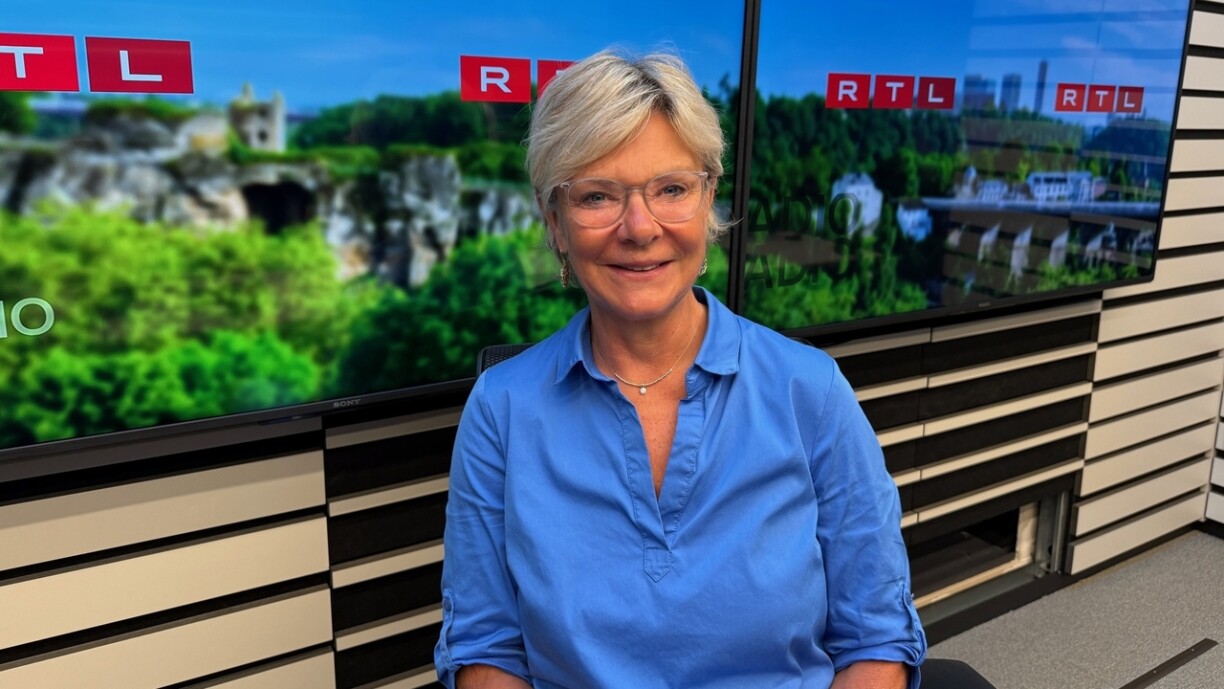
Hansen noted that conditions have been better than expected this year. She explained that grass, hay, and silage reserves are in good shape, and fields remain green thanks to sufficient water in the soil, adding that the grain harvest is largely complete. Regarding wine production, she stated that winegrowers are also hoping for a good vintage. Overall, she expects 2025 to be a fairly normal year in terms of yields.
Looking to the future, Hansen stressed the need to make Luxembourg's agriculture more resilient to extreme weather events. This involves supporting research and trials to develop drought-resistant crop varieties, adopting more water-efficient production methods such as direct sowing and agroforestry, and strengthening farm-level risk management, she explained. Hansen pointed to the state-subsidised multi-hazard insurance scheme, which compensates farmers in cases such as hail or drought damage.
Addressed with the fact that there are only around 1,800 farms left in the country, which employ roughly 4,600 people, Hansen acknowledged that succession is a serious concern, which also affects the wine sector. The Minister warned that within the next decade, half of Luxembourg's farmers will reach retirement age. One-third of farm managers over 55 have a successor lined up, but 45% do not, she stated.
Hansen explained that an action plan is being developed with the sector to make it easier to set up or take over a farm. As an example, she said that workshops with farmers have already begun, with a second session planned for October or November, alongside an EU-level plan expected in September.
Hansen said young people in the sector recognise it as a rewarding profession but are well aware that the much-discussed "work–life balance" is not a given in farming. What they want most, she emphasised, is greater social recognition for their work.
She intends to build on existing initiatives such as the Landwirschaft a Liewen – Agriculture and Life – project, which brings school classes to farms in cooperation with the Education Ministry. She also supports the Chamber of Agriculture’s planned "charm offensive" to promote the profession, the production of short films for social media showing real farm work, and the creation of a central advisory point for young people taking over farms, offering guidance on legal, economic, and inheritance issues.
Hansen also commented on the recent illegal rave party in Heinerscheid held on farmland within a Natura 2000 zone. She condemned it as a "disgrace" that caused real damage, including dangerous litter for livestock. For example, sharp fragments from cans can cause fatal internal bleeding if swallowed, she said. Hansen added that the pasture in question must now be completely renewed, as the forage is no longer usable.
Furthermore, Hansen said she is working with Justice Minister Elisabeth Margue to examine whether the law needs to be amended to better prevent such events. While some material from the party was confiscated and fines will follow, the investigation is ongoing, she said.
On EU policy, Hansen criticised proposed cuts to the Common Agricultural Policy (CAP) budget for 2028–2034, amounting to €90 billion less than before. The CAP budget is now only a reserved share of a larger EU fund, with no dedicated agricultural fund, and is already smaller than the current allocation. While other EU funds could top it up, this is not guaranteed.
She stressed that without subsidies, Luxembourg's farmers cannot compete internationally due to stricter standards than in many non-EU countries. Proposed "capping" of payments based on farm size could affect around 400 farms in Luxembourg, especially young farmers who typically take over larger holdings, on average 120 hectares compared to the national average of 72 hectares.
Finally, Hansen addressed the EU's new anti-deforestation regulation, which Greenpeace argues underestimates the problem. She reiterated that Luxembourg is firmly against deforestation but does not face such issues domestically thanks to national forestry laws requiring replanting after logging.
In fact, forest area in Luxembourg and Austria has been increasing for years, Hansen claimed. Her concern is the heavy administrative burden the regulation would impose even on countries without deforestation problems, such as requiring farmers to register every animal in an EU database to prove their products are not linked to deforested land. She called this "an administrative monster" and urged the European Commission to simplify the rules.





