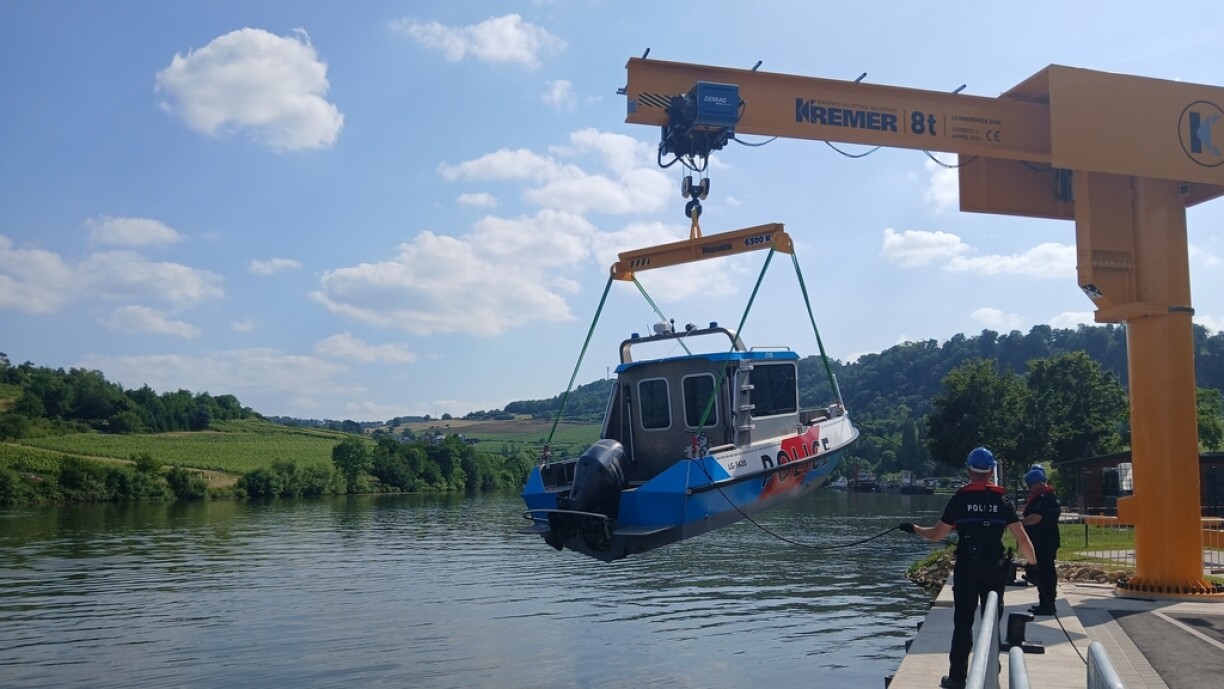
When it comes to animals, Grevenmacher is usually associated with its famous Butterfly Garden. But recently, two 'giraffes' have captured the town's attention. At least giraffes is the nickname locals have given to the two towering yellow cranes at the new dock on the outskirts of the city near Mertert.
This quay will serve as the new base for the boats of the police and the Grand Ducal Fire and Rescue Corps (CGDIS), marking the culmination of a long-awaited project that has finally brought great satisfaction to local authorities.
Just a few hundred metres from the Grevenmacher police station, the police boat, unveiled about a year ago, has now found its permanent home. Yet, the idea of establishing a dock here dates back two decades.
Anne-Lyse Dick, director of the Central-East Region of the police, said that the police had already had a boat in 2005 and that the necessary connections had been installed beneath the station at the time. However, the dock's original location – directly across from the station – had proven impractical because it was too close to the lock.
According to her, large boats entering the lock would have left too little space for a dock at that spot, which is why it was eventually built at its current location near the Deysermühle.
Of the two striking yellow cranes, one is dedicated to the police boat, while the other serves to launch the CGDIS boat into the Moselle. Paul Wirtz, head of the CGDIS's Eastern Zone, highlights the operational improvements this new infrastructure brings, noting that delays used to occur mainly during the lock process and when launching a boat.
Speaking to RTL, he said the new dock was the final piece that allowed them to get a boat into the water before the Grevenmacher lock. According to Wirtz, there is now a boat permanently stationed at the Mertert harbour, another deployed in summer before the Briedemesser lock in Remich, and two more stationed in the port at Schwebsingen.
Thanks to the cranes, two people can launch a boat within ten minutes. Having two cranes is essential because police and CGDIS are sometimes called out together, allowing both boats to be prepared simultaneously.
Home Affairs Minister Léon Gloden said that while serious emergencies are fortunately rare, the need for such facilities is evident. He explained that the area falls under joint jurisdiction, with police patrolling the Moselle – particularly to monitor shipping – in cooperation with the German police. He noted that real emergency deployments happen perhaps once a year, but added that they are glad when the boats do not need to be used frequently.
Investment in rescue equipment will continue, with the CGDIS set to receive a new boat similar to the police's current vessel. In the medium term, a larger boat is planned under an Interreg programme.
The new dock itself is 74 meters long, featuring not only the two cranes but also a ramp for launching boats. Construction took approximately a year and a half, with a total cost of around €3.5 million.





