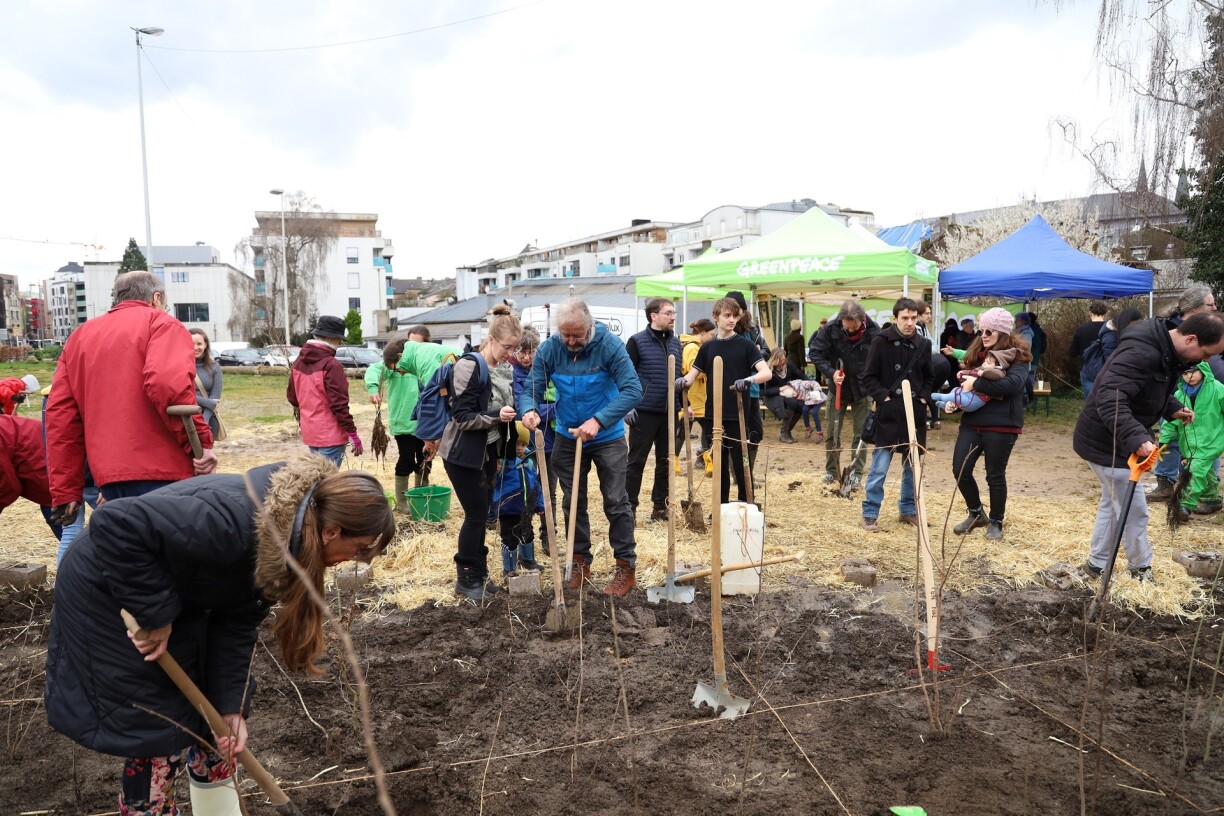
Around 600 trees were planted on a 200m2 space in Esch-sur-Alzette previously used as a parking lot. The campaign managed to gather numerous families with the hope that the planted trees will eventually grow into a lush microforest.
Using the Miyawaki method, named after the Japanese botanist Dr Akira Miyawaki, the microforest is designed with a density of three trees per square metre, aiming to establish a compact forest allowing as much growth as possible in an urban setting. Greenpeace explained that "this small haven of biodiversity will contain fifteen separate species of native trees including the sessile oak, the warty birch, the hornbeam, the rowan, the blackthorn, and the elderberry."
The Miyawaki method has been tried and tested across many larger European cities. However, this is only the second time that Greenpeace Luxembourg has undertaken such a campaign, with the first microforest being planted a year ago in Mertzig.
The Director of Greenpeace Luxembourg, Raymond Aendekerk explained that "Greenpeace is proud to have planted new trees for future generations to enjoy in this fertile ground that used to be an old Terres Rouges mining lot, which not only facilitated the development of our organisation but also numerous other local campaigns."






