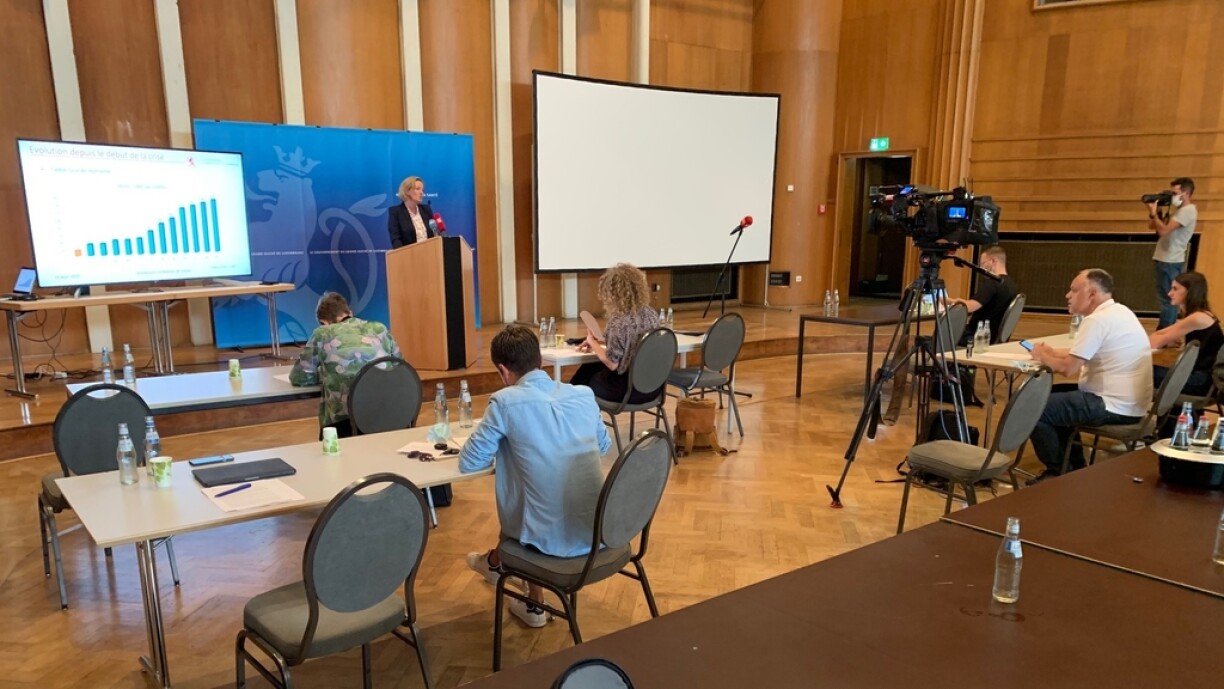
The minister started by looking back at the past months, and praised the low mortality rate, the effective reorganisation of the health care system, the access to protective equipment, and the fast isolation of infected people. On the other hand, the minister pointed to in part heavy restrictions to personal freedoms, many people being forced to postpone or even miss medical procedures, the closure of schools, and the impact on the economy as negative consequences of the crisis.
Lenert stressed that there were still significant efforts being made to inform people as best as possible while also reminding them of the importance to keep respecting social distancing. She added that early detection, i.e. a testing strategy which identifies as many asymptomatic people as possible, still played a key role. Lenert stated that the testing strategy was very flexible and could easily be adapted to potential clusters, which have been observed to emerge locally.
The minister announced that the entire health care sector will again be tested on a large scale, while the Horesca and construction sector will be tested on the basis of smaller samples. However, this time people will be invited through their employers in the hopes that this will lead to more people deciding to get tested.
Lenert also discussed tracing, stating that the Ministry continued to regard it as another key element of its strategy. The main goal was to break up infection chains as soon as they start to appear. The minister pointed out that calling people personally by phone had proven to be very effective in this regard. 80 people are currently part of this task force, working seven days a week. The task force also has a team working on the ground. Lenert announced that the latter will be reinforced for the upcoming autumn season.





