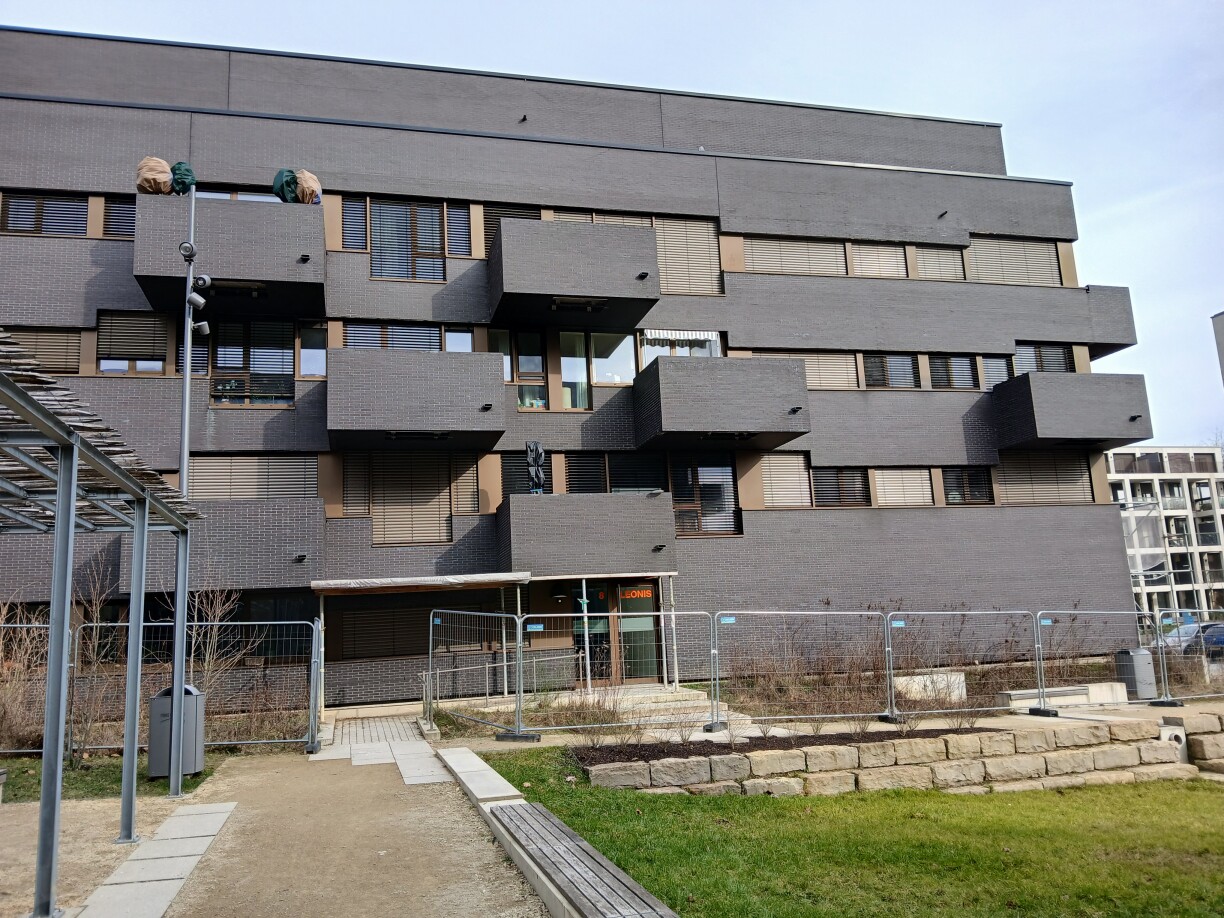
For the past two and a half years, residents of three SNHBM housing blocks in Kirchberg have been living with the risk that pieces could fall from the balconies and cause injury. Talks between the National Affordable Housing Company (SNHBM) and the construction firm are now said to be entering their final phase.
Almost exactly a year ago, attention was drawn to the case of the three residences, Clava, Leonis, and Meïssa, which were built on behalf of the SNHBM. In September 2023, fragments from one balcony fell into a garden below. Residents were subsequently advised not to use their terraces or balconies. More than two years later, little appears to have changed at first glance.
Safety barriers still surround the buildings, and the entrances are covered by protective structures due to the ongoing risk of falling debris. The works were not carried out directly by the SNHBM, but by a foreign subcontractor commissioned by the Luxembourg-based company C.L.E.
After the defects came to light, a court-appointed expert was instructed to carry out an assessment. According to the SNHBM, court proceedings were not the preferred route, as this would have prolonged the matter further. However, involving a judicial expert was seen as a way to apply pressure and ensure that the technical findings could not later be challenged.
The expert report has now been completed, albeit after significant delays, said SNHBM director Guy Entringer. He acknowledged that when elements fall from a balcony, it is clear that something has gone wrong.
The aim, Entringer said, has been to learn from the situation together with the constructor. He stressed that a solution is being found under which residents will not have to pay anything, with costs shared between the SNHBM and the construction company. He added that "the most important thing for residents is that they have balconies they can use again safely and that the building is completed without any risk".


Entringer described cooperation with the construction firm as positive at this stage. He explained that technical plans are currently being drawn up and will be reviewed by independent control bodies. Once approved, a test balcony that Entringer called a "mock-up" will be built to validate the solution.
Following this "solution", the co-ownership association will then need to give its consent, Entringer said, adding that if all approvals are obtained, the works will be implemented as quickly as possible.
Although only one balcony has actually shed debris, the technical solution will be applied to around 90 balconies in total. According to Entringer, a verbal agreement has been reached, but formal signatures are still pending. For that reason, he declined to provide a precise timetable.
Asked whether the construction company might face consequences in future public tenders, Entringer noted that the SNHBM must comply with public procurement law. He said that the existence of problems in a particular case does not automatically constitute grounds for excluding a firm from future contracts.
While Entringer declined to further comment on the legislation itself, he made it clear that the current legal framework does not make matters any easier.
It is also worth noting that adjacent SNHBM residences, whose balconies are currently wrapped in protective sheeting as part of separate remedial works, were built by the same construction company. While residents there can still use their terraces, other defects have reportedly been identified.
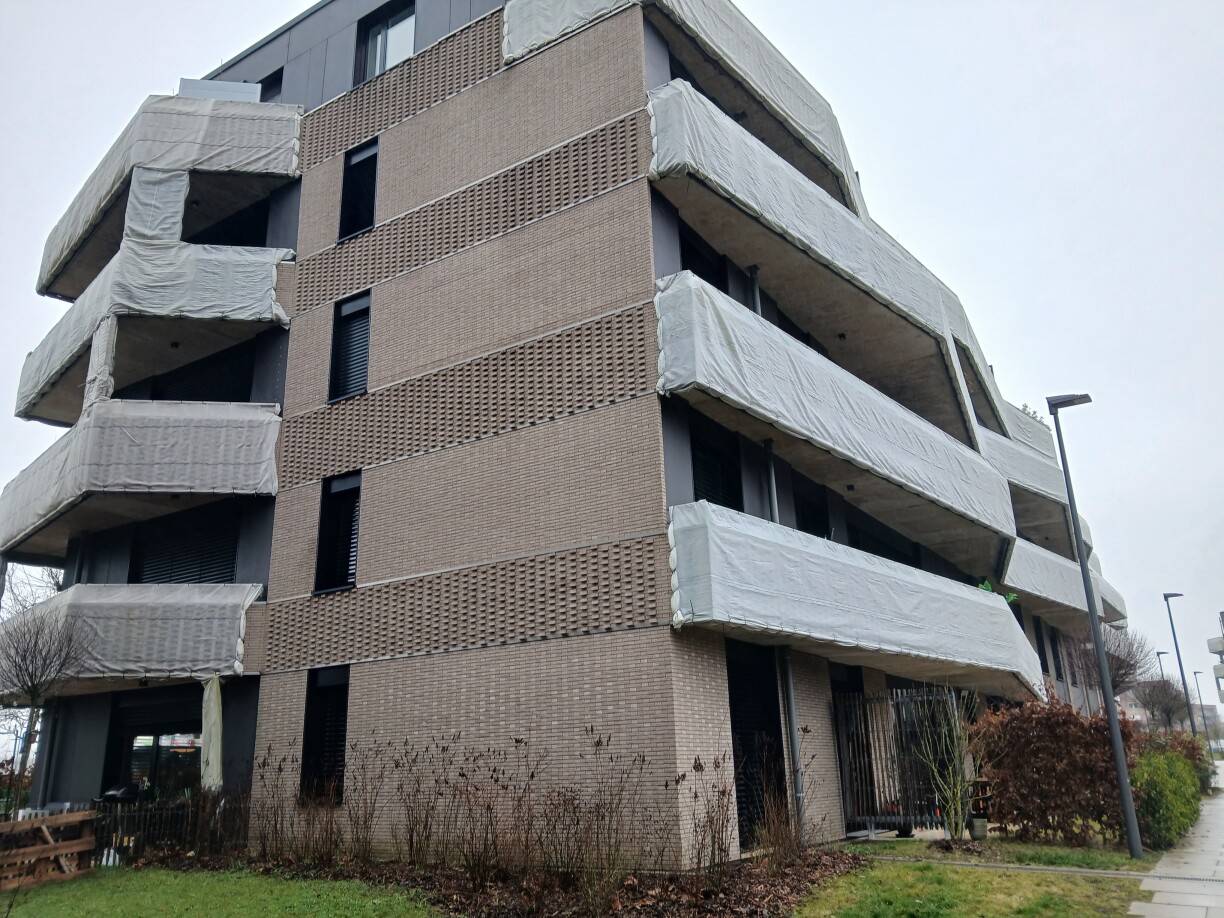
Frustration among residents of the affected buildings continues to grow. Roberto, who lives in one of the blocks, said that from their perspective little has changed: gardens and balconies remain unusable due to safety concerns, and no clear timeline has been communicated.
Although regular communication between the SNHBM and residents has now been established with monthly updates, Roberto suggested that this only happened after sustained pressure from residents and their co-ownership association, and not as a proactive initiative by the developer.





