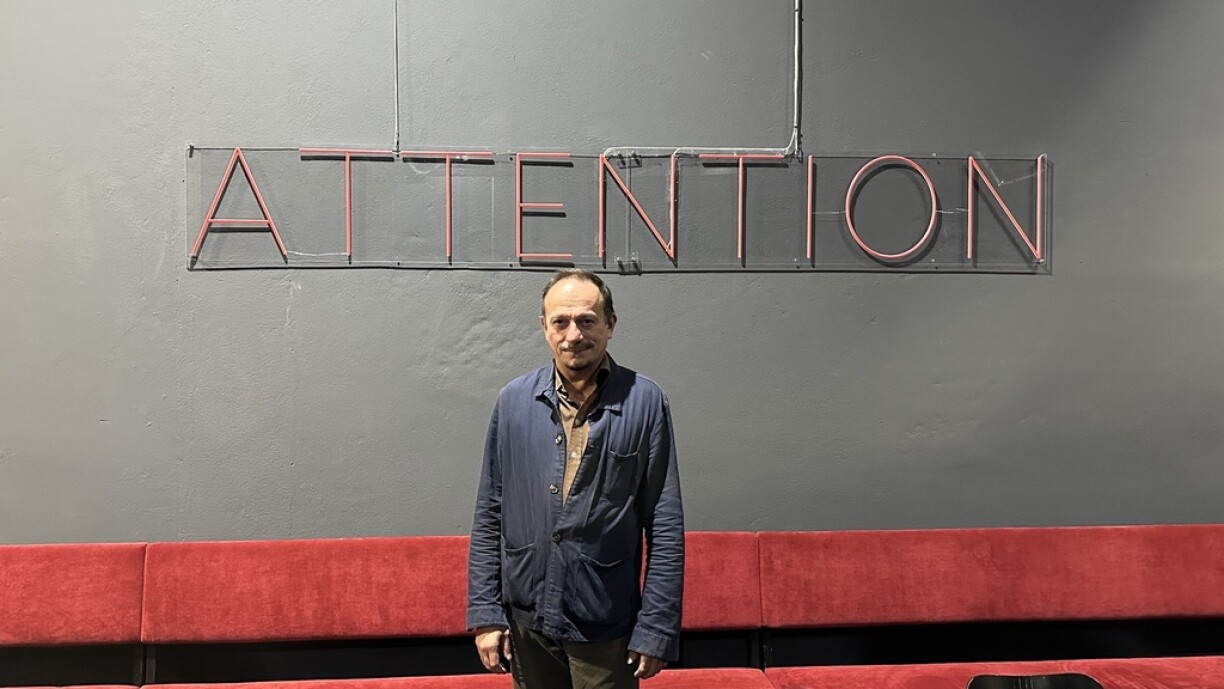
Marc Baum is both a seasoned actor and an experienced politician. His career began on the stage, where he took part in the inaugural production of the National Theatre on Route de Longwy when it first opened over two decades ago – a formative experience he recalls with fondness.
Despite his transition into politics, he still sees theatre as a defining part of his professional life. "There are obvious similarities", he explained. To him, the parliamentary floor is a kind of stage that requires more than just speaking – one needs to command attention and get one's message across effectively.
But while both acting and politics involve public performance, Baum emphasises a key distinction: In theatre, you play a character who may be nothing like you. In politics, you have to stay true to yourself. Authenticity is key.


Baum's entry into politics was anything but conventional. In 1999, at just 21 years old, he was among the founding members of The Left (Déi Lénk) – a new political movement that sought to offer a genuine left-wing alternative in Luxembourg's political landscape. At the time, he felt that existing parties, particularly the Luxembourg Socialist Workers' Party (LSAPL and The Greens (Déi Gréng), had drifted toward the political centre, embracing neoliberal economic policies and moving away from their more progressive roots.
His first official mandate came in 2008 when he was elected to the municipal council of Esch-sur-Alzette for Déi Lénk. Baum describes local politics as being especially valuable because of how closely connected it is to the everyday concerns of the public.
It is all about concrete issues that directly affect people, he noted: "That's what makes it so valuable: you're constantly in dialogue with residents, and you see the impact of political decisions up close."
Today, he credits that period in local government as formative for his role in national politics. In a large municipality like Esch, many of the issues already carry national weight.
"Esch is the second-biggest city in the country, which means you're already working on complex policy questions", he explained. "Take something like water cost calculations or the coverage of essential services – those are clearly national topics but they play out in very concrete ways in your own city, with your neighbours."
Among Baum's responsibilities in the current legislative session is his work on the Caritas affair, where €60 million went missing from the social charity's accounts. He recounts the exact moment he found out, via a news alert while sitting in a café in Esch.
"At first I couldn't believe it", he recalls.
As more information emerged, Baum was struck by how widespread the institutional failures were. "It wasn't just a single breach – it was a collapse across all safety nets: within Caritas, and across the banking system." He added that it felt almost surreal – like something you would expect to see dramatised on Netflix.
Baum laments the current government's approach to reform – not just in content but also in procedure. One of the central dossiers where this criticism has taken shape is the government's pension reform effort. Baum points out that Prime Minister Luc Frieden, for the first time in his State of the Nation address, clearly indicated that extending working lives is part of the government's long-term strategy.
This stance, however, stands in direct opposition to Déi Lénk's position, which calls for greater redistribution, an increase in employer contributions, and the elimination of the contribution ceiling.
What frustrated Baum most was the way the government handled public consultation. A year ago, they promised a participatory process, he recalled. There were online platforms, public feedback loops, surveys – and thousands of people contributed ideas.
And after all that, the government picked the path people rejected most. For Baum, this is emblematic of what he calls an authoritarian style of governance: "If they knew what they wanted to do all along, why go through that tedious process?"
He sees a similar pattern in the government's approach to housing. While the issue is widely recognised as a national crisis, Baum argues that the policies implemented have largely benefitted property developers rather than tenants or first-time buyers. "Instead of actually building affordable housing, they've focused on restoring profit margins for developers", he said.
And yet, Baum points out that while sale prices did dip over the last two years, rising interest rates meant that access to credit worsened – leaving many unable to obtain loans even as nominal prices declined. Now, as interest rates begin to fall again, prices are already starting to rise, making it no easier for potential buyers. And in the meantime, rents have surged, he further warned.
And with roughly 3,000 fewer workers employed in construction than before the crisis, Baum is doubtful that the sector can meet housing demand anytime soon.
The pension debate and housing crisis are among the most pressing issues in Luxembourg today – accompanied by a noticeable rise in age-related poverty and the broader risk of falling into poverty. Across the EU, nearly 95 million people are now affected by this risk.
These are traditionally topics that fall within the domain of left-wing parties. Yet the current political landscape is increasingly shaped by a strong right-wing presence – including populist and far-right movements. The question then arises as to whether the political left is in a crisis.
Baum believes the current situation facing the left is, in part, self-inflicted. Many parties that once stood firmly on the left, he argues, have abandoned that position.
"It's a crisis of the political left", he said, "but it also has to do with the fact that many parties that were historically left-leaning moved toward the centre during the height of neoliberalism from the 1980s into the 2000s. That didn't just shift the discourse to the middle, it shifted the entire political spectrum to the right."
For Baum, the way forward lies in reclaiming political representation and reconnecting with people's real concerns. "Politics has to be done with the people", he said.
It is not about being populist but about clearly naming the problems, he added, citing housing as a prime example. On one side, there are young people and renters struggling to find a place to live; on the other, a small minority benefits from land ownership and speculation.
"It's not populism to point out that a limited number of people profit from the crisis, that's just the truth. And if you want to solve the crisis, you have to be willing to name it."
Despite the setbacks, Baum sees reason to remain hopeful. He notes that resistance to right-wing extremism is growing, and that many – especially young people – are dissatisfied with the current situation. He notes that more people are listening and that more are coming up to him to have a conversation.





