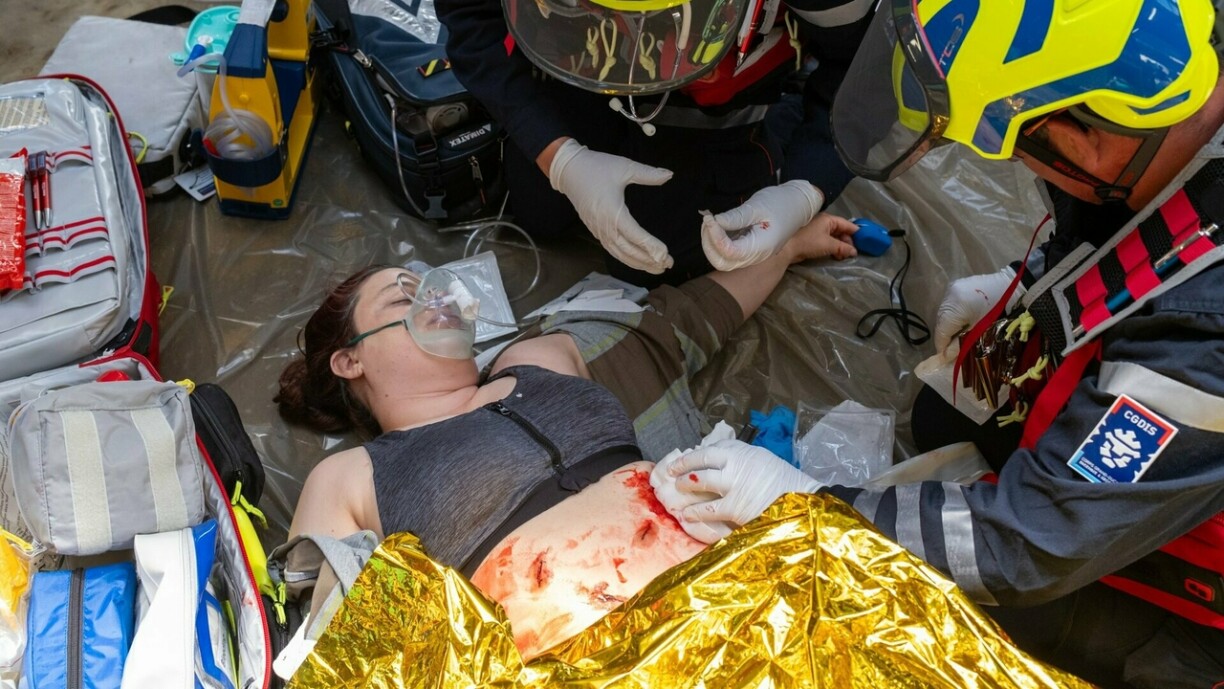
The National Trauma and Rescue Challenge is more than just a competition – it's about ensuring that Luxembourg's rescue teams are ready when real emergencies strike. One possible scenario that teams in the contest have to face: two cars have just collided, one person is seriously injured and trapped in the wreckage, while another, in shock, stands nearby.
Both need help – but one more urgently than the other. So, what is the appropriate first move?
Before attempting any rescue, emergency teams are trained to first assess a scene like that for hidden dangers. That could mean stabilising a second vehicle perched on top of the wreckage or removing a gas cylinder from the boot.
After all, saving lives starts with ensuring the safety of both rescuers and victims.
That principle was at the heart of last weekend’s National Trauma and Rescue Challenge, held at the Grevenmacher-Mertert Fire and Rescue Centre. The event brought together trained firefighters – both professional and volunteer – as well as first responders with certified medical training.
Andreia da Silva, one of the participants, described the pressure of working in lifelike conditions: "The hardest part was getting the victim out – the roof had collapsed and there was barely any space left", she said. "We had to use a jack to lift it, but even then it was tight. I stayed in the car with the victim the whole time. It was incredibly hot, but I'm proud we finished in under 25 minutes."
Each team tackled scenarios that were designed to feel as close to reality as possible. Behind the scenes, that realism is orchestrated by volunteers like Yves Streff, a trained firefighter who now specialises in creating realistic injury simulations.
"I used to see fake wounds drawn on with pen – we knew we could do better", he explained in conversation with RTL. "So I started researching special effects and built up from there."
Using prosthetics, artificial blood, paint, and even animal bones to mimic compound fractures, Streff's work adds a layer of authenticity that helps train teams under real pressure.
The challenge is also tailored to reflect real environments. This year's theme was based on a camping scenario – a nod to the nearby campsite in Mertert.
"Last year, we designed vineyard crash scenes in Grevenmacher", said Yves Marx, who is in charge of set design. "This year, we went for a campsite setting to reflect the local area."
While the winning team will go on to represent Luxembourg at the World Rescue Challenge in Karlovac, Croatia, this September, competition is not the ultimate goal.
"The focus is on learning", explained Joel Biwer, President of the Luxembourg Rescue Organisation. "Teams receive detailed feedback after each scenario – the idea is to learn from mistakes here so they don't happen in the field."





