In times of economic uncertainty and rising prices, discussions about the index flare up over and over again. In 1982, following years of inflation - triggered by two oil crises - Luxembourg experienced a general strike after the then-government expressed a desire to abolish the wage indexation.
The mechanism which counteracts the drop in value of salaries, and thus re-balancing purchasing power, has been present in Luxembourg since 1921 in its most rudimentary form. Initially aimed at civil servants and railway staff, the index has since been repeatedly adjusted in a number of stages and extended to the general public.
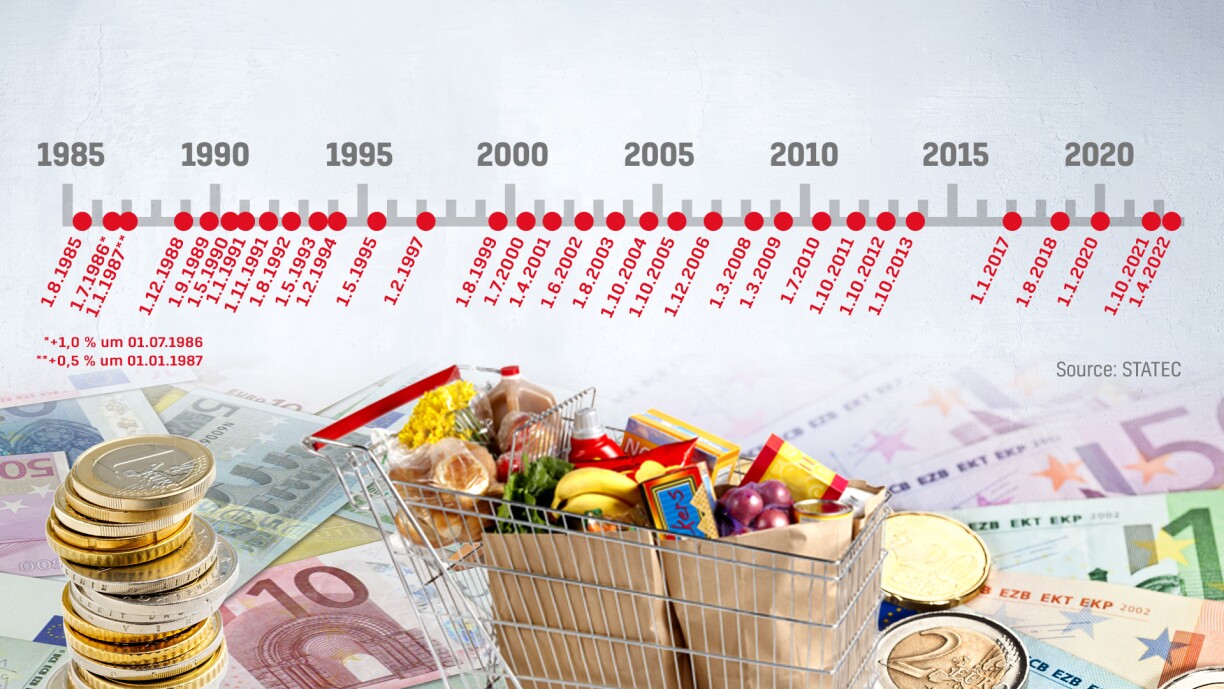
Today in 2022, following two years of a global pandemic and rising energy prices as a result of the Ukraine war, the topic is once again on the agenda. Salaries in Luxembourg were adjusted upwards in October 2021 and again in April 2022, increasing by 2.5% each time. However, the third index tranche, which was due to occur in August 2022, has been pushed back to April 2023, causing uproar in some sectors.
The principle is simple: if the cumulative inflation rate since the last index tranche rises above the value of 2.5%, a new index tranche will be triggered. At the same time, salaries will also increase by 2.5%. The salary is adjusted in proportion to the cost price law to counteract a loss of purchasing power. Since 1985, there have been 32 index tranches, with some stable periods between 1995 and 2000 and between 2013 and 2018.
STATEC, the national statistics agency, monitors the rise in prices and publishes the evolution of consumer prices on a monthly basis. With the help of an average "shopping cart" of products and services, consisting of over 66,000 different prices, STATEC researchers can compare prices month by month and signal whether a new index is required.
The average shopping basket method looks at 12 main categories, including food, rent, energy prices, transport costs, crafts and building work, and leisure activities. It does not include real estate prices.
The method is regularly adjusted and weighted according to actual consumer behaviour in the Grand Duchy. For example, over the last two years, Luxembourg residents have spent less money on travel due to the pandemic. The weighting of these positions has been adjusted downwards in the price index accordingly for this period as well, STATEC's Marc Ferring explained to RTL Radio.
What would happen if STATEC identified decreasing prices in the shopping cart exercise? Could this lead to deflation or a negative indexation, in which salaries would drop 2.5%?
In short - yes. The index is linked to Article L. 223-1 of the Labour Code and is based on Article 11 of the 1963 law regulating civil servant salaries. The law states that the increase or decrease of the cost of living, by 2.5 points over the period of a semester, corresponds to an increase or decrease in salary "established on the basis of the weighted index of the cost of living on January 1, 1948."
In theory, this means indexation can work both ways, depending on whether prices rise or fall by the same rate.
To date there has not been a negative index in Luxembourg.
While low inflation is common, and desired, even, with the target of 2% set by the European Central Bank, long-term sustained deflation is a much rarer phenomenon. In Luxembourg, the annual inflation rate has only fallen within a negative range three times since 1949: 1953 (-0.2%), 1955 (-0.1%) and 1987 (-0.1%).
Even between 1983 and 1986, when inflation fell sharply compared to record highs in previous years, no negative index tranche occurred. "Even in those years, there was still positive inflation. It was lower than in previous years, but we were not below the 0% threshold," said Marc Ferring, head of STATEC's "price statistics" unit.
Ferring considers it unlikely that a negative index could occur one day, explaining it should only follow a prolonged phase of deflation. However, there have always been isolated months in which annual inflation has fallen into the negative range, although these periods never lasted long enough to trigger a negative index tranche.
During deflation, prices tend to decrease, usually because supply outweighs demand. In such a case, how sensible would it be to reduce salaries accordingly?
Dr. Patrice Pieretti, Professor of Economics at the University of Luxembourg, told RTL "The index is a socio-political measure. From an economic point of view, it does not necessarily justify itself."
Dr Pieretti said that although indexation has economic implications, it is not necessarily an economic debate. Wages tend to stay nominally stable at first in deflation, even if prices fall. This preserves purchasing power but is not helpful for companies, whose costs would rise. If a negative indexation were to occur, this would be "above all a social measure for companies", said the professor.
When price declines are more persistent than in the event of deflation, we use the term disinflation. This is the point when consumer expectations would come into play, said Dr Pieretti, as it could affect consumer habits as people become more cautious about their spending. This would also apply to investment companies, which could have "devastating" consequences for the economy. In times of disinflation, we would see a decline in production, and a rise in redundancies as prices would continue to fall. As the labour market would be flooded by jobseekers, this would in turn reduce salaries. "In that case, a negative index tranche would double the penalties for households: firstly by negative indexation and a second time by disinflation itself ," explained Dr Pieretti.
There can be two main reasons for deflation. On a positive note, it could refer to increased productivity, for example due to technical advances, thus increasing supply in line with constant demand. As a result, prices would decrease.
On the more negative side , however, deflation may also result from a drop in demand. Dr Pieretti cites the example of Japan in the 1990s, after a speculative bubble burst. This inflation lasted for almost 10 years. However, it was not caused by a negative index, but instead an increase in salaries, among other factors.
In principle, it should be easier to combat deflation than inflation, even if the central banks could take better countermeasures. Lending, for example, can be artificially cheaper and increased public spending would get the economy back on track. Dr Pieretti's recommendation for deflation in Luxembourg is thus: "I would leave out a negative indexation and I would see to it that I get rid of deflation. That would be the right measure - to support spending."





