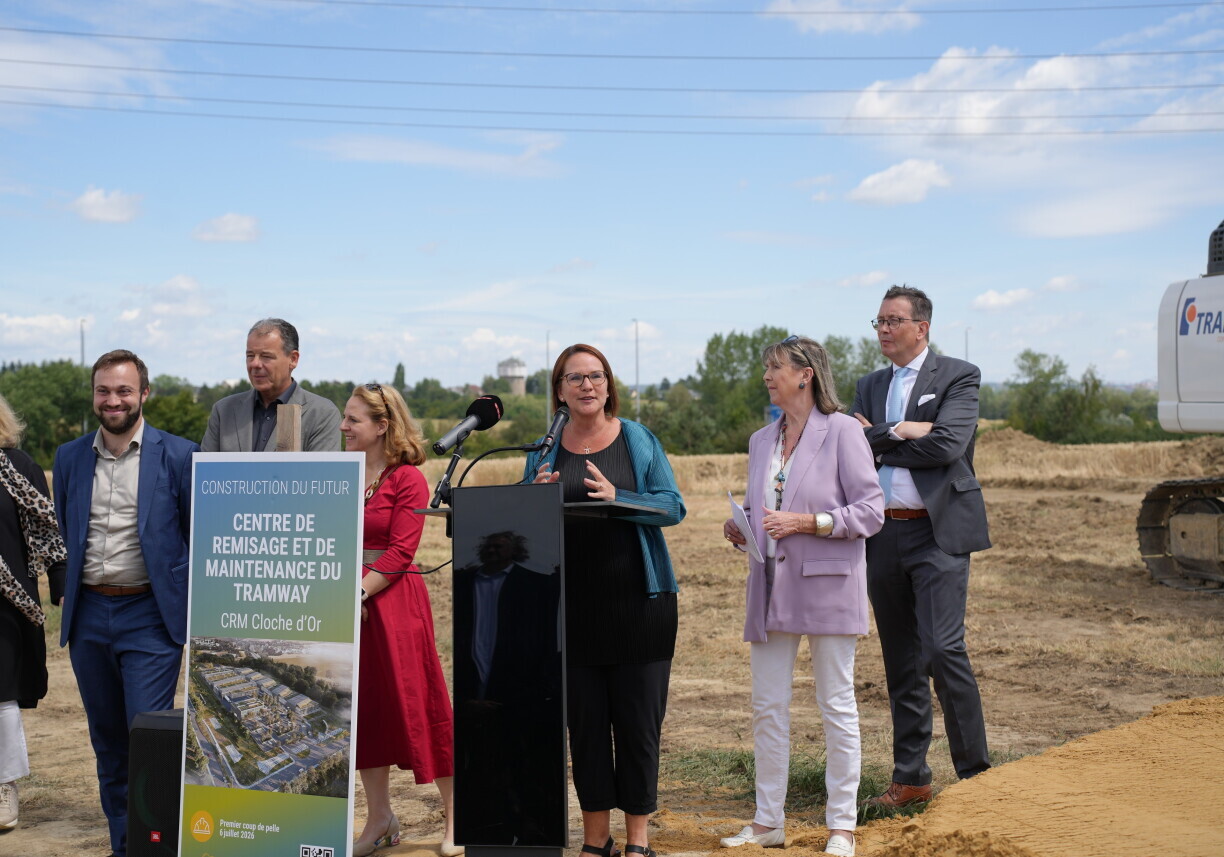
Luxembourg’s tram network is set for another significant expansion, with construction now underway on a major new depot at Cloche d’Or, near Stade de Luxembourg.
The project was launched on Monday afternoon with the symbolic ‘first spade’ ceremony attended by officials.
The new facility will occupy an 8-hectare site and comprise three main buildings: a maintenance workshop, a storage hall for trams, and a separate area for administrative offices. This expansion comes as part of the continuing modernisation of the capital’s public transport infrastructure.
Alongside the new depot, the next generation of trams will also be longer due to the increasing passenger demand.
According to Anthony Mopty, Director of New Lines at Luxtram, the current trams are 45 metres long, but future models will stretch to 56 metres, thus accommodating more passengers per journey. The new depot will be able to house 41 of these longer vehicles.
Construction of the depot is expected to be completed by 2030, with an estimated cost of €150 million. The Luxembourg State is set to cover €130 million of the cost, while Luxembourg City will fund the remaining amount.
In parallel, work is progressing on several other tram extensions across the city, as Minister for Mobility Yuriko Backes explained.
She also highlighted that the legislative proposal for the Arelerstrooss project has already been submitted, and work will begin gradually once all preparations are in place.
A similar proposal for the Escher Strooss extension is anticipated later this year, with a separate legislative project planned to obtain new rolling stock.
Efforts are also focused on further extensions to the south, first to Foetz, then to Metzeschmelz, and ultimately to Belval, which require additional legislative steps.
Minister Backes emphasised the strategic importance of expanding and modernising the tram network, particularly for the benefit of future generations.
Investment in future mobility is "not only essential, but is absolutely indispensable”, she said. If there is one area where one should not be cutting corners, it is in mobility infrastructure, according to Backes.
With the new Kirchberg line scheduled to open in time for the new school year in September next year, progress remains on track.
Minister Backes also expressed openness to extending the tram to other regions in Luxembourg, but stressed that priorities must be set given the scale of current projects.
Today, the tram serves around 120,000 passengers each day, and forecasts suggest this number could exceed 300,000 daily by 2035.





