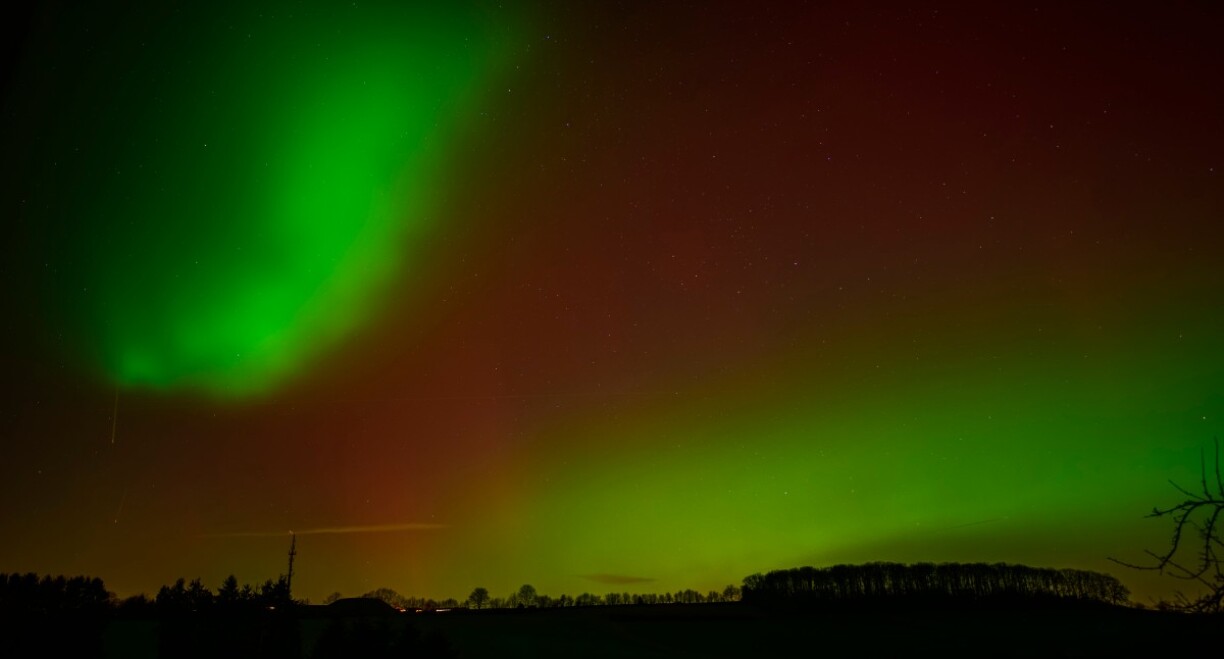
A powerful geomagnetic storm generated a rare and vivid display of the northern lights over parts of Europe on the night of 19–20 January, with some visibility reported in Luxembourg.
The aurora borealis, typically a spectacle reserved for higher latitudes, was observed across a wide area. Its colours were visible to the naked eye not only in neighbouring Germany but also as far south as the Alps and eastward into Poland.
An observer described the event as a dynamic show, with a strong red glow appearing in the mid-sky directly beneath dancing green bands. Each vibrant sequence lasted four to five seconds, repeating over nearly an hour.
Julien Laigle, a passionate amateur astronomer who spoke to RTL, confirmed that the cause was an extreme solar storm. While widespread low fog in Luxembourg limited viewing, clearer conditions in elevated areas like the region near St. Vith offered a better chance to witness the phenomenon. It remains uncertain whether another such display will occur in the coming nights.


When asked to explain the phenomenon, Meteolux meteorologist Luca Mathias detailed the process for RTL. He stated that an aurora occurs when high-energy particles from a solar flare – an eruption on the sun's surface – travel through space and collide with Earth's magnetic field. These particles then excite oxygen and nitrogen molecules in the atmosphere, causing them to emit the characteristic coloured light.
Mathias noted that seeing the aurora borealis in Luxembourg and surrounding regions is relatively rare, as it requires not only a strong solar storm but also favourable local weather conditions.
When asked if Monday's aurora was stronger than the event observed in May 2024, Mathias explained that strength is measured by several parameters. While last night's geomagnetic storm reached a maximum KP index of 8–9 – values that have occurred more frequently recently – the May 2024 event was ultimately classified as more powerful. That storm, rated as an extreme G5 event, exhibited stronger overall conditions despite similarly high KP values. In contrast, Monday's storm was classified as severe (G4).
Mathias confirmed that intense solar storms can have tangible effects on infrastructure. Depending on how much they disturb Earth's magnetic field, they can disrupt telecommunications, GPS systems, and power grids, potentially leading to outages. He cited the 1989 blackout in Quebec as a classic historical example of such an impact.
Regarding Meteolux's role, Mathias noted that the state weather service handles space weather advisories for commercial aviation. These advisories are integrated into meteorological flight plans and passed on to pilots.
As for prediction, Mathias stated that while an approaching solar storm can typically be detected one to three days in advance, forecasting the precise intensity of the resulting auroras is only possible about 30 to 90 minutes beforehand. This short-term forecast relies on real-time solar wind data from satellites.
He added that the sun is currently in the active phase of its 25th solar cycle, which is expected to continue throughout the year. Therefore, the possibility of further strong solar storms – and potentially more visible auroras – remains.





