Through maps of the numerous camps across Luxembourg, artefacts preserved from them and the personal stories of individual forced labourers, the exhibition highlights the fate of the thousands of people from the Soviet Union who were forced into labour during the German occupation, many of them young women.
The mother of Kati Hoor was one of them.
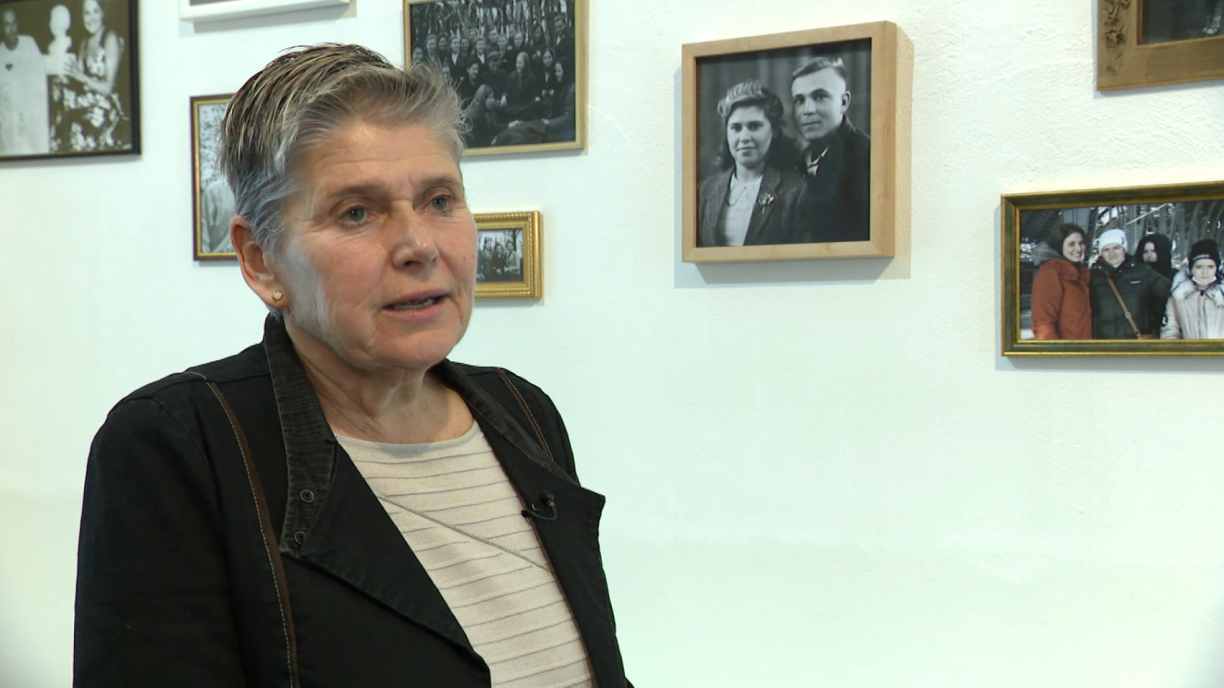
Abducted from Ukraine during the Nazi era as a young woman, Kati Hoor's mother was sent to a labour camp in Thionville, where she met her future husband. After the war, the two came to Luxembourg together and tried to build a new life here.
"My mother is from Petrivka. She met my father during the war. After the labour camp, they came here together. They had been married for 13 years, and then I was born", says Kati Hoor.
For many forced labourers, life after the war was far from normal. Hunger, loss of homeland and the trauma of the camp also shaped their daily lives in Luxembourg. The experience was hardly talked about.
"When my mother talked about it, she often cried", says Kati Hoor. She continued: "[Her mother] had three other siblings – a sister and two brothers. Because of the whole situation, she barely heard anything from her family back home".
Around 4,000 forced labourers from the Soviet Union were working in Luxembourg during the German occupation. They were partly prisoners of war, partly civilians, who came mainly from Ukraine, Russia or Belarus. They replaced the 11,000 Luxembourgish men who were forcibly recruited and had to fight in the Wehrmacht.
The forced labourers were employed in the steel and arms industry, in agriculture or on the railways, sometimes under extreme conditions. The camps were spread over around 12 sites, mainly in the south of the country, including Pétange, Differdange, Dudelange, and Bonnevoie.
Historian Inna Ganschow from the University of Luxembourg distinguishes between two main groups. She explains: "The prisoners of war were mostly adult men. The civilian Eastern workers were mostly young people and women. There was a deliberate policy with the prisoners of war: they were to remain malnourished so that they could not fight, could not escape and could not resist".
Despite the system of oppression, there were also signs of solidarity. The exhibition in Dudelange shows how parts of Luxembourg's population secretly helped the forced labourers, despite strict prohibitions.
"Many Luxembourgers placed food, clothes or shoes on their windowsills", explains Inna Ganschow. According to her, when the forced labourers were marched through the streets, they would seize the opportunity to take the items left for them. Others smuggled small wooden toys out of the camps and exchanged them for food with women and children, she adds.
For decades, however, the fate of many of those affected went unrecognised. Some remained stateless in Luxembourg, while others were deported back to the Soviet Union after the war. Their stories were largely forgotten. To date, around 2,600 of these forced labourers have been identified, and many more personal histories are likely to remain unknown forever.
The exhibition OST. The vanished traces of the forced labourers from Ukraine, Russia and Belarus in Luxembourg 1942–1944 can be visited for free at the documentation center in Dudelange until 22 February. It is open from Thursday to Sunday from 3pm to 6pm.





