Schools in Luxembourg resumed with a semblance of normality on Monday, with many pupils returning to in-person classes after a week of home learning.
Overview of measures in Luxembourg's schools
Masks are mandatory in almost all cases, whether primary or secondary. Carbon dioxide detectors are also in use to help staff with ventilating classrooms, while the mobile testing teams have been reinforced.
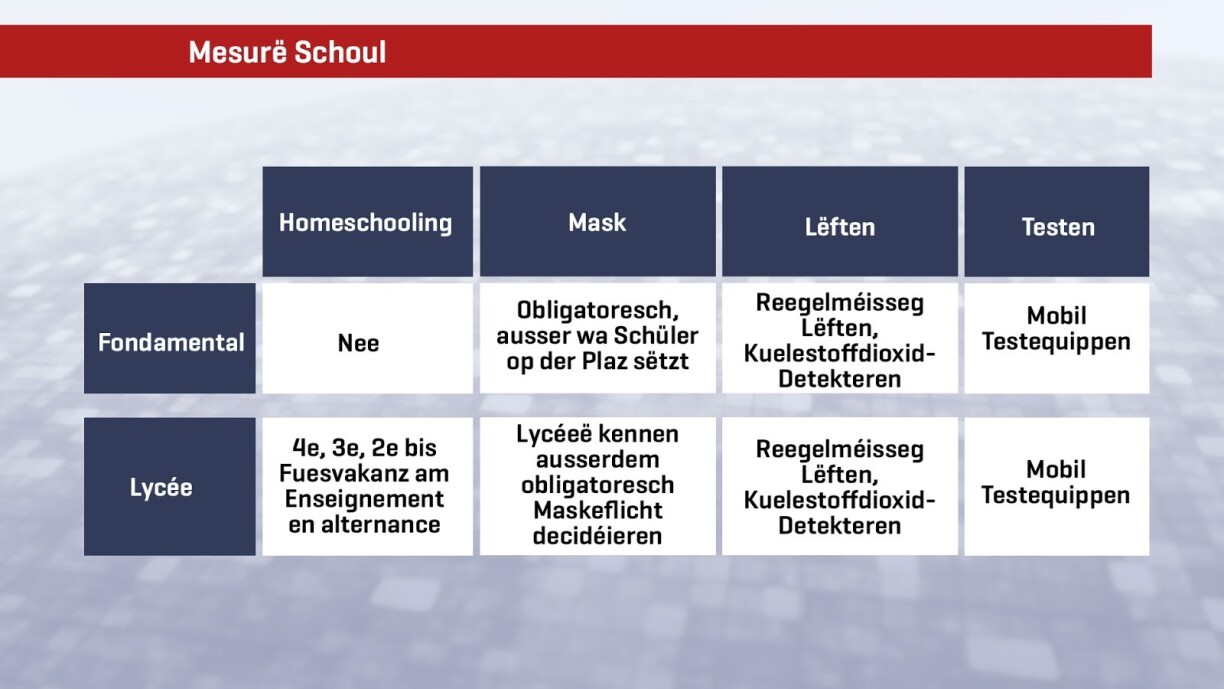
The above graphic states that primary schools will not undergo alternate weeks of homeschool, while masks are obligatory unless pupils are seated.
Secondary schools may decide whether they wish to instate a mandatory mask policy. The upper classes, with the exception of students in their final year of school, will continue to alternate weeks at home and at school until half term.
The phase model deployed before the winter break will be used, should infections be discovered among pupils.
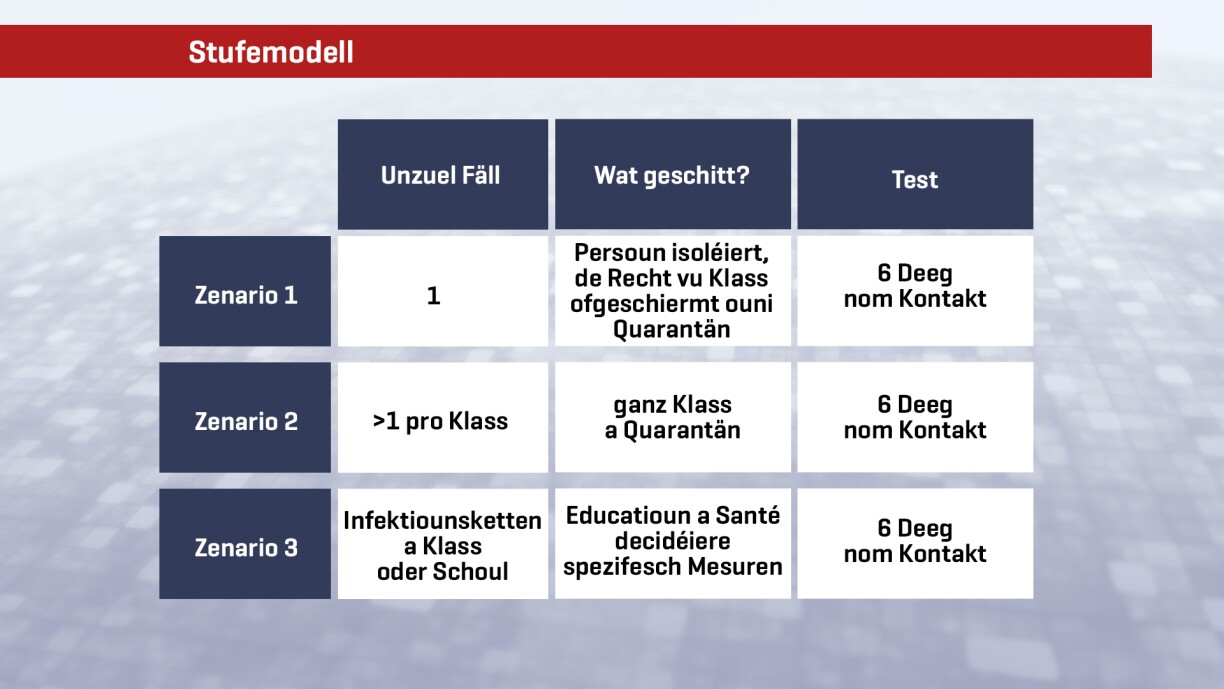
Scenario 1, in which a single case of Covid is identified in a class, will result in the infected student being isolated, while the rest of the class is distanced from the rest of the school without going into quarantine.
Scenario 2, in which more than one case of Covid is discovered in a class, results in the whole class going into quarantine.
In scenario 3, if multiple infections or clusters are identified in a school, will be decided by the Ministry of Education and the Ministry of Health.
All scenarios will have tests carried out six days after first contact.
Further details can be found on the Ministry of Education website.
Schools: Hotspot or not?
A study conducted by ETH Zürich, which analysed some 1.5 billion movements in Swiss telecommunication data between 10 February and 26 April 2020, showed that closing schools was one of the most efficient anti-Covid measures, resulting in 21.6% less mobility. The biggest impact was observed in banning gatherings of more than 5 people, which slashed mobility by 24.9 percent, while shutting restaurants and non-essential shops yielded a reduction of 22.3%.
An Austrian study reported that school-age pupils were just as likely to be infected as adults.
German virologist Christian Drosten tweeted that the United Kingdom saw around 1% of adults infected with Covid prior to the Christmas holidays, with 2% of primary school pupils and 3% of older students. The prevalence of the virus dropped among pupils during the holidays, while it increased among adults. Drosten concluded with a question: "Are there still doubts about the role of schools in spreading SARS-CoV-2?”"
Potential impact of the British variant
During a German Science Media Centre Webinar on 8 January, virologist Isabella Eckerle said it was difficult to say at the moment whether the UK strain played a major role among children or not.
Eckerle said:
"You can't really comment on whether this variant plays a bigger role in children or whether we're just seeing what has been there the whole time. Because of this idea that children don't get the virus and schools don't play a role, I think most of the science is shelved at the moment. The virus can infect children, the virus can also circulate in children. I think we have had the problem for a long time that it went unnoticed because the children did not meet the test criteria, and are often asymptomatic."





