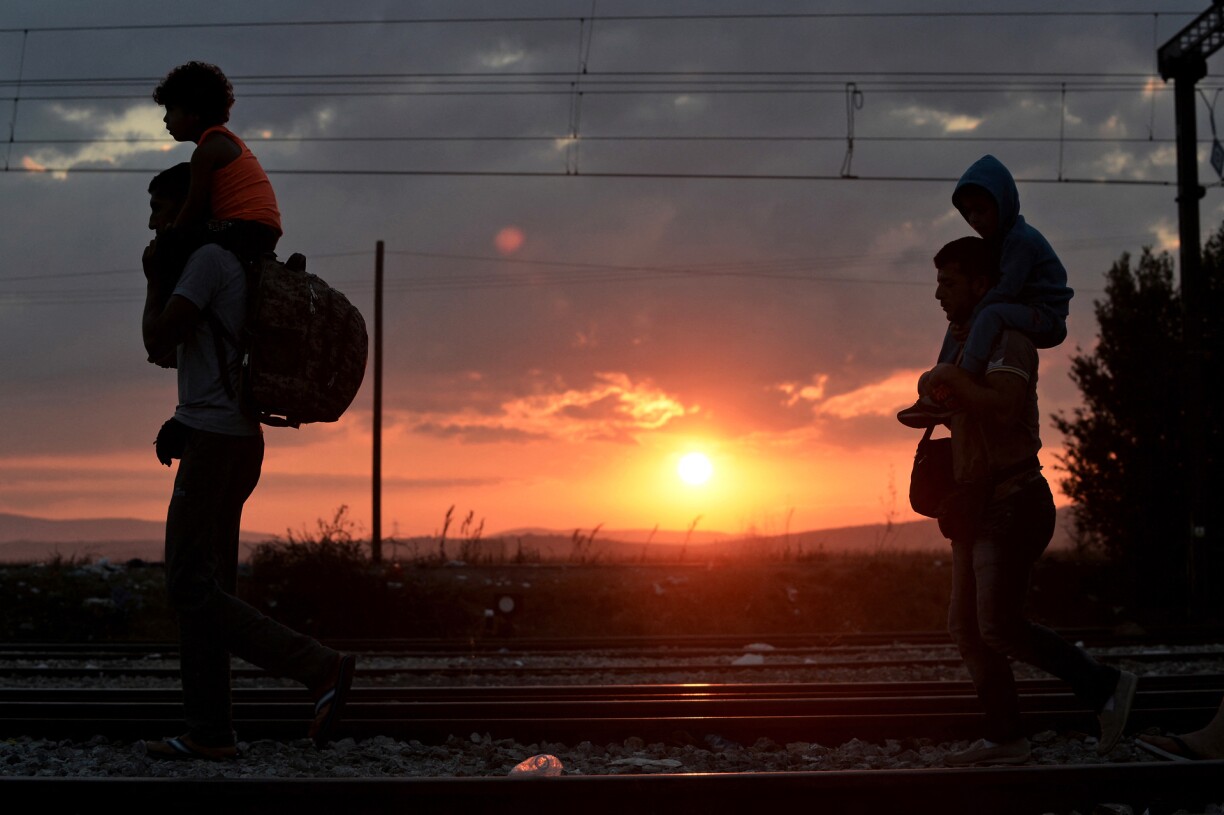
In August 2017, Bushra and Mahmood decided to flee their country, Yemen, which has been in a civil war since 2014. The couple left behind all the convenience of the life they had built with their children. "My life was in danger", explains Bushra, who was working for the American embassy in Sana'a, the Yemeni capital, at the time. "Several of my colleagues were kidnapped, I don't know what happened to them", she tells us. With utter dismay, her husband adds that "they disappeared."
Faced with the threats of the Houthi rebels, Bushra was convinced that fleeing was their only option. "We left everything behind", she laments. The couple abandoned their home with three young children, taking only the essentials with them. "We knew we couldn't travel with several suitcases", explains Mahmood. And so began the family's agonising journey, which took them through no fewer than seven countries before arriving in Luxembourg. First, they had to cross Yemen to reach the border with the Sultanate of Oman.
"It was very difficult to move around Yemen, there were checkpoints everywhere", recalls Bushra. It was only through her illness that the family were able to justify their movement – Bushra has a heart condition that requires regular medical check-ups. "The rebels we met weren't necessarily educated [on the complexities of the condition], so they relied mainly on the names of the hospitals and doctors who had treated me", she says. This enabled Mahmood and Bushra to leave the country without any real knowledge of where they were going. "We were just looking for a safe place to continue our lives", she added.
Their time in Oman was short-lived. "We rested for a few days and then left", says Mahmood. The family headed for Malaysia, this time by plane. However, they only managed to stay four months in the country, as they lacked the necessary visas. Their journey then led them to Iran. "We'd heard about the routes taken by migrants to reach Europe", Mahmood tells us. He had no idea of the hardships that awaited them there. From the interminable walks, to the night-time crossings, to the makeshift shelters, and the fear of being arrested and imprisoned by a particularly repressive regime: Bushra's family lived through a veritable nightmare.
Bushra and Mahmood will never forget the freezing nights they spent with their children in garbage-filled sheds. They tell of their terrifying trek across the mountains separating Iran from Turkey. "We had to wait until nightfall to move and we couldn't light torches", she says, for fear of being spotted by the border guards. Their youngest child was three years old at the time, and it was vital to prevent him from crying. "I carried him all night, and in the morning I couldn't do it any more", an emotional Mahmood adds. Visibly exhausted, a man who was travelling with them kindly offered to take over and carry their son over final stretch as they reached Turkish territory.
Yet the march was far from over. "We walked for so long that we ran out of food and water. The children kept asking us where we were going and why we had to walk so much. We couldn't see the end, it was hopeless", Mahmood tells us. They finally reached a place where they were asked to change clothes so that the authorities would think they had arrived in Turkey by normal means. There then followed a night's wait at a railway station, where staff refused to sell them bus tickets to Ankara. Finally, a bus driver who was leaving without any passengers offered to take them to the capital. Once there, they approached smugglers to try to make their way to Greece.
It was a perilous journey that cost them $1,000 and left them waiting for three days in the forest of Izmir. When they finally set sail, it was in the middle of the night on a boat that could carry twenty people. However, the smugglers had rounded up around sixty migrants. "We'd bought life jackets for the whole family", says Bushra, who was very reluctant to get on the boat. According to Mahmood, the boat was not manned by a captain. "They told us, 'you sail straight and you'll get to Kos’", and so they attempted to do so. After getting lost for hours at sea, they finally arrived on the Greek coast in the early hours of the morning.
It was July 2018. The Yemeni family had been travelling for almost a year under extreme conditions. The overcrowded Kos camp was not going to offer them any better prospects. There was no space. "All the containers were occupied. So we had to put up a makeshift tent... A few metres from the sewage drains", they said. With a shy smile, Bushra tells us that her family built the first makeshift tent in the Kos camp. It was an initiative that was quickly taken up by the many families that flocked in over the following months. As the camp filled up, however, living conditions became increasingly bleak. Both parents remember the stench and, above all, the omnipresence of rubbish and flies.
After spending several months in Kos, Bushra decided it was time to leave. The family managed to board a ferry to Athens, and then benefited from the help of a friend who made his flat available to them in the Greek capital. This was a stroke of luck while they tried to work out where their long journey would take them. "I'd heard all about Luxembourg, the culture, and the kindness of the locals. All good things that told us it would be a good destination (...) we were looking for security, stability and peace", explains the couple. Bushra added: "I was told that they really believed in human rights in Luxembourg."
And so the plan to join the Grand Duchy was born. Bushra tried for months to get plane tickets for her whole family, but was systematically turned down. The couple finally decided that she would travel with her youngest son and Mahmood would stay in Athens with the two eldest. Bushra finally succeeded, travelling first via Spain and then Belgium. From Brussels, she then managed to organise her journey to Luxembourg. On 16 December 2019, Bushra finally arrived at her destination – a journey that took her two years, four months, and 11 days.
As soon as she arrived, Bushra applied for international protection, which was granted very quickly, according to her. She expresses her gratitude to the authorities for allowing her to stay in Luxembourg and to bring her husband and sons here in November 2020. Since then, Bushra has given birth to her fourth child. She confirms that being pregnant in a refugee camp was complicated, especially since she was diagnosed with diabetes during her pregnancy.
In total, Bushra has been in five refugee centress in the Grand Duchy. In Strassen, Mersch, Differdange, Diekirch, and Mühlenbach. While each move has presented its own challenges, she has no complaints. She simply aspires to a normal life, a life away from refugee centres, in a home that her children could call their own. At present, her children attend school in Clervaux, while the family has been transferred to Mühlenbach. This means a journey of almost four hours for the children and their father, who accompanies them on public transport.
In January, Bushra thought there was light at the end of the tunnel when she landed a job with JP Morgan. However, the National Reception Office (ONA) quickly sent them a letter asking them to leave their accommodation – a process that had been initiated quite some time ago, if the documents submitted to us by the family are to be believed. Bushra explained that she desires the same things as the ONA: to find accommodation and leave. However, her applications for affordable housing sent to the Housing Fund, the National Company of Affordable Housing, and a number of municipalities have not yet borne fruit.
She has also tried her luck on the private market, but the responses have often been equally disappointing: "insufficient salary", “too large a family”, “accommodation not suited to your needs”. Understandably, the family is desperate to find a solution. Bushra and Mahmood are looking for accommodation that will enable their children to spend less time commuting to school. "They're exhausted when they arrive from Clervaux (...) I don't mind a long commute to work if it saves them the journey", says the Bushra. Changing schools is no longer an option. "They have never had any stability in their lives, and I want to try to help them keep what they have at school", she explains.
After nearly eight years of an extreme ordeal, Bushra simply wishes for a home of her own, where her family will no longer have to share the kitchen and sanitary facilities with five other families. She insists that she loves Luxembourg and wants to build her life here. The missing piece of the jigsaw is, as it is for many other families, housing. A problem she needs to resolve as quickly as possible if they wish to avoid ending up on the streets.
Lisa Burke and journalist Gaël Arellano welcomed Bushra and Mahmood for an in-depth conversation: available here.
See also:
Relocation challenges faced by refugees in Luxembourg
LSAP calls for new regularisation channels, Minister Gloden disagrees
Opposition calls for halt to expulsions of vulnerable asylum seekers
Luxembourg seeks to fast-track refugees into labour market amid staff shortages





