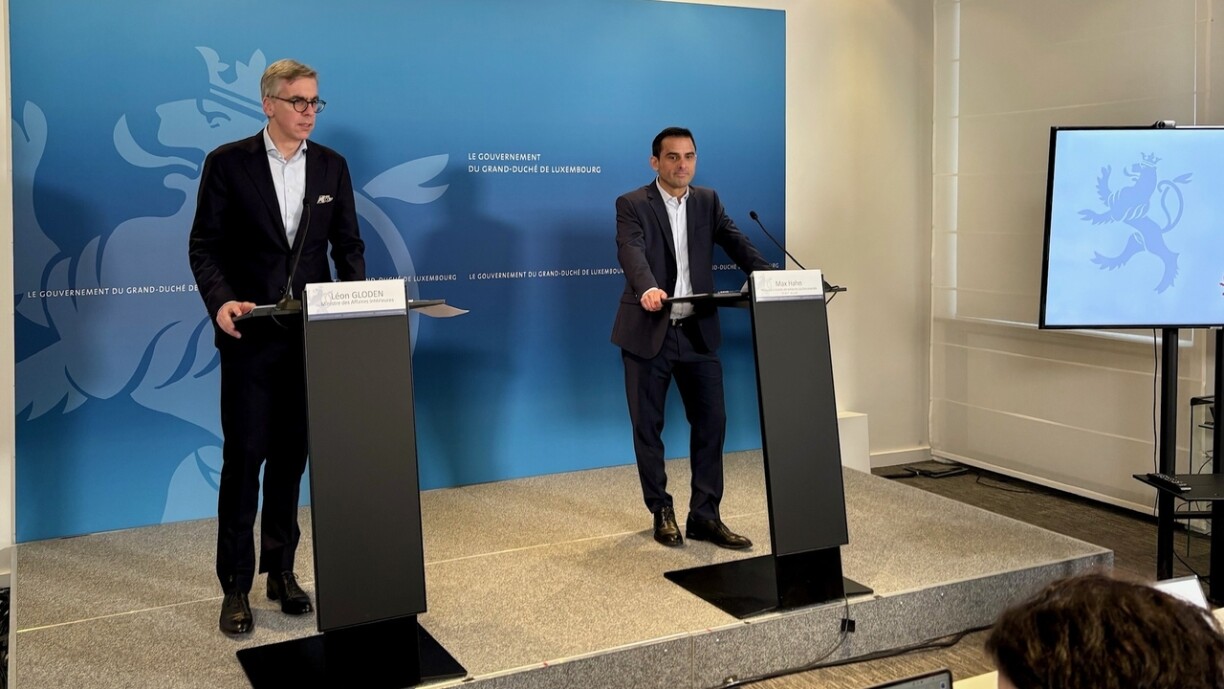
On Monday, Minister for Home Affairs Léon Gloden and Minister for the Reception of Refugees Max Hahn presented the 2024 report on immigration and asylum policy.
In 2023, Luxembourg ranked fifth in Europe for the number of asylum applications per capita. Minister Hahn described the situation as "difficult" and noted that it has grown more serious over time. Last year, 70% of applicants were granted refugee status, while 30% of applications were rejected.
In 2024, Luxembourg processed 1,018 international protection cases, marking a 6% increase compared to 2023. However, the total number of applications filed dropped by 18%, with 2,018 submissions recorded. Rejections rose significantly, with 502 applications denied – a 26% increase from the 402 rejections in 2023. Additionally, 438 individuals returned to their home countries, representing a 56% increase from the previous year. Of these returns, 308 were voluntary.
As of 1 December 2024, 3,873 individuals held temporary protection status, the majority of whom were Ukrainian nationals, according to Minister Gloden. Regarding refugee status, Syrian nationals topped the list with 370 grants, followed by Eritrean (216) and Afghan nationals (83). The ministers also addressed the high number of applications from Venezuelan nationals, nearly all of which are rejected due to being primarily economically motivated. Minister Gloden emphasised the need to review the European visa policy, as Venezuelan nationals currently benefit from visa-free travel to Europe, which some use to file asylum claims after arrival.
Minister Hahn highlighted Luxembourg's efforts to expand accommodation for asylum seekers, contrasting the country's approach with that of other EU nations. Currently, Luxembourg provides 8,200 beds for individuals seeking international protection.
The report also highlighted a significant increase in the number of individuals entering the network of structures managed by the National Reception Office (ONA). This figure surged from 2,100 in 2021 to 7,200 in 2022 before declining to 3,900 in 2023 and 2,800 in 2024. However, only 2,150 people exited the ONA network during this period, leaving a surplus of 650 individuals in ONA facilities. On average, 53 more people entered the network each month than left it over the course of 12 months. Despite this growing demand, only 400 additional beds were added in municipalities across the Grand Duchy in 2024.
Minister Hahn detailed his efforts to address the shortage, which include meetings with local municipalities to explore options for increasing bed capacity, even on a temporary basis. He also emphasised the need for European-level solutions, noting that Luxembourg alone cannot manage the situation in the long term.
The ministers further acknowledged that a significant number of individuals already granted refugee status continue to reside in ONA structures. Currently, 2,300 people fall into this category, with 1,500 having lived in ONA facilities for over a year. The government is actively working to reduce this number.
Minister Gloden reiterated the government's commitment to integrating international protection applicants into the labour market as quickly as possible. He noted that the process now typically takes six months. Employment figures among refugees have shown steady growth, rising from 70 in 2022 to 139 in 2023 and 371 in 2024. Plans are underway to collaborate with Minister of Labour Georges Mischo to explore opportunities for integrating applicants into sectors facing severe staff shortages, such as hospitality. This initiative aims to prepare applicants for employment by the time their protection status is granted, Minister Hahn explained.
Minister Gloden emphasised that "Luxembourg, like Europe, needs legal immigrants. We face a shortage of manpower and have practically exhausted all options within the Greater Region and other countries." To address this, the government has simplified the conditions for foreign workers to come and work in the Grand Duchy.
The ministers also discussed the new Maison de retour, which opened in 2024. Located in the former Emergency Accommodation Facility in Kirchberg (SHUK), this institution aims to assist individuals who wish to return to their home countries voluntarily. It provides financial and psychological support, as well as help in developing reintegration projects in their countries of origin. The facility can accommodate up to 170 individuals, with an average occupancy ranging between 50 and 70 at any given time.
Both ministers reiterated the government's commitment to pursuing "a reasonable asylum and migration policy" grounded in the principle of "equal treatment for everyone." Gloden and Hahn assured that every case is assessed individually, with no preferential treatment given to any applicant.





