Ewen questions why housing is often viewed solely as a functional investment rather than a cultural asset.
Many historic buildings are either altered in ways that disregard their historical value or demolished entirely. These actions are often justified by the need to simplify construction processes and address housing demands, overshadowing the cultural significance of these structures.
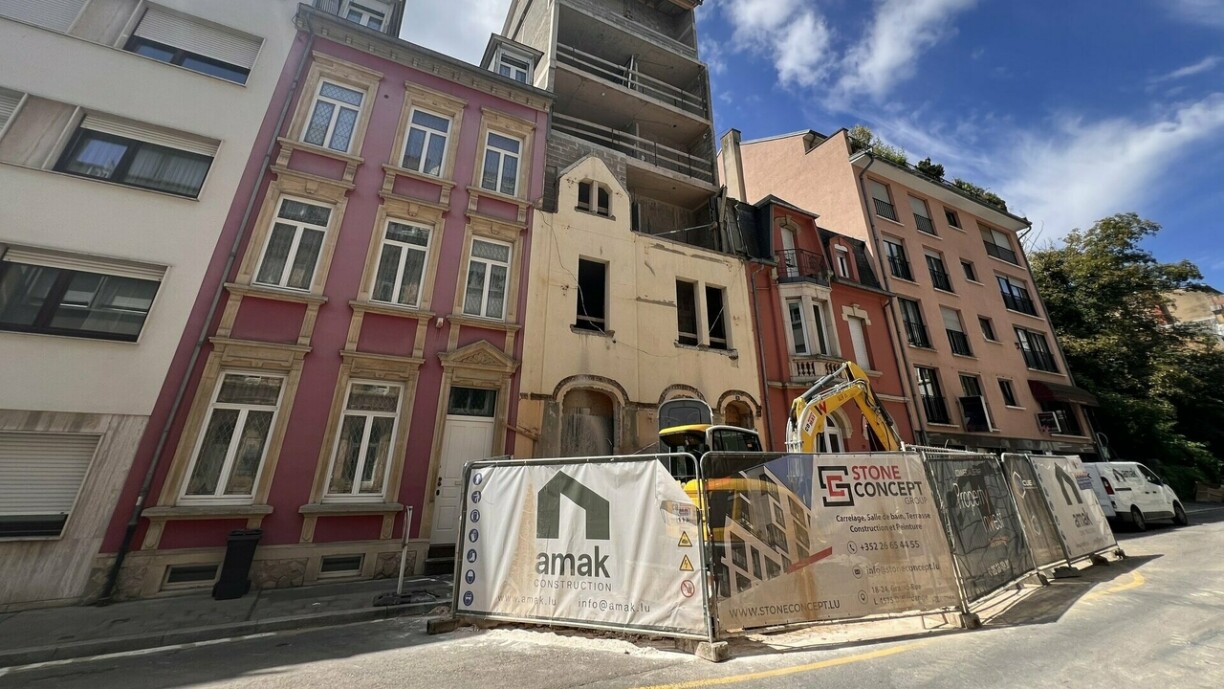
A case in point is a building in Limpertsberg, whose deteriorating façade has become a symbol of "professional vandalism," according to Ewen. Although the building was under consideration for classification as a historic monument, the Ministry of Culture had planned to shelve the application. By the time the decision was reviewed, the building’s façade was already being demolished.
Ewen argues, "We don't understand why housing is seen only as a function or investment […] rather than a cultural element. Preserving the 'culture of the built environment' while pursuing growth is crucial, yet it seems this aspect is often neglected. Culture is what ultimately binds society together."
Ewen also criticises Prime Minister Luc Frieden's State of the Nation address for its lack of focus on cultural issues. He believes that a shift in the approach to protecting buildings is necessary to better honour Luxembourg's heritage.
Ewen advocates for an approach in which "everything" would be protected, followed by lifting most of these protections "very, very, very rapidly" again, since "we can all agree that 95% of things that would be protected in this case are not worth protecting." Ewen argues that this approach would promote having control at the authorisation level for demolition or conversion, which he believes is crucial. By involving the Ministry of Culture early in the process, the ministry would be informed of any proposed changes or demolitions, allowing for proactive rather than reactive measures.
The issue extends beyond the Limpertsberg building. For example, in Kehlen, there is a house with a troubling history: it was home to a Jewish family during World War II, who were deported, and the house later became the headquarters of the "Volksdeutsche Bewegung," a Nazi movement in German-occupied Luxembourg. The Heritage Movement has applied to preserve the house's cultural and historical significance. However, according to Ewen, the association has not received any updates on the status of their application.
Full report by RTL Télé (in Luxembourgish)





