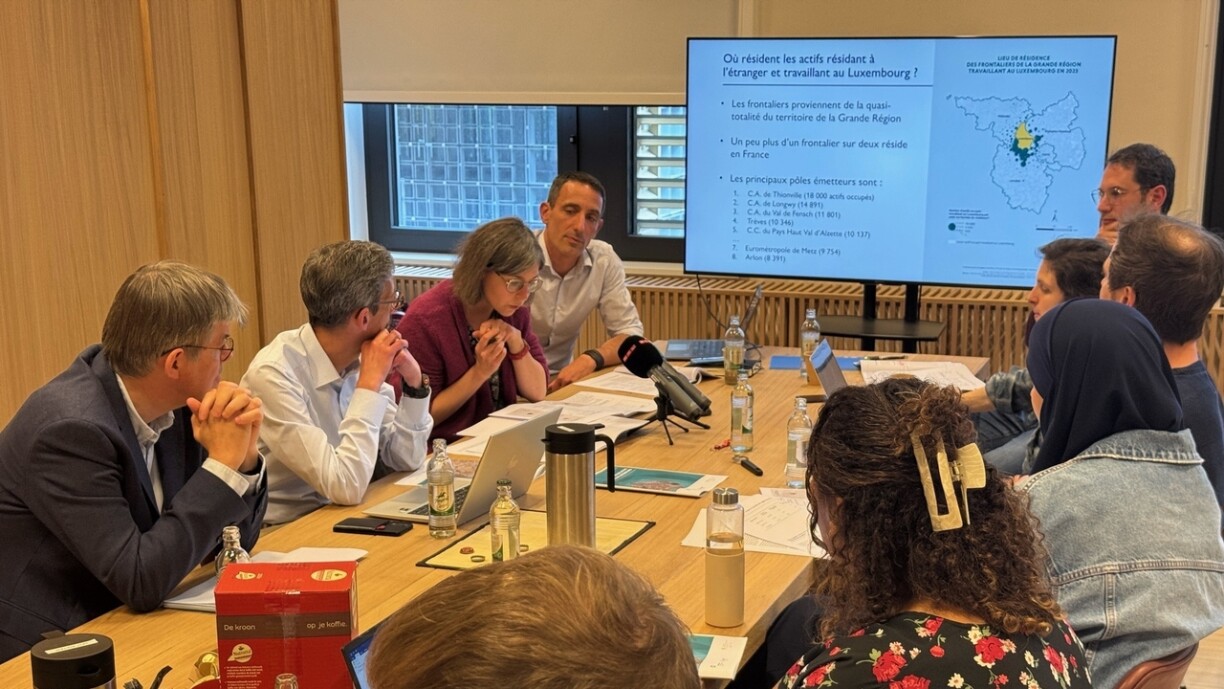
Employees in Luxembourg commute an average of 30.6 kilometres from their homes to their workplaces, as presented in the study on Monday by the Luxembourg Institute of Socio-Economic Research (LISER) and the Department of Spatial Planning. This figure is notably influenced by cross-border commuters:
Researchers were especially struck by how far Luxembourg’s labour market now reaches. According to LISER researcher Valérie Feltgen, while most commuters still live near the border, the commuting zones have clearly expanded since the last study in 2014. She notes that although the increase is not dramatic, this trend will inevitably reach a limit, as the time people are willing to spend commuting eventually becomes too great.
The study’s map shows that almost every municipality in the neighbouring regions has at least one resident who works in Luxembourg – a striking illustration of the Grand Duchy’s pull on the regional labour force.
LISER researcher Antoine Decoville notes that the national employment-to-resident ratio is 0.76, which he describes as “enormous.” In other words, there are 76 jobs for every 100 residents across the country—a far higher rate than in most EU countries.
Luxembourg City stands out even more. According to Decoville, the ratio of 1.22 means there are 122 jobs for every 100 residents – a remarkable concentration of employment in the capital.
Despite this, only 35,000 of the 136,000 residents of Luxembourg City actually work in the capital. Of the 170,000 jobs based there, 60% are held by residents from other parts of the country, while 30% of employed residents work outside the city. The researchers link this to household dynamics, where, for instance, one partner may work in the city and the other elsewhere.
The study also confirms the widespread phenomenon of “commuter municipalities”: just one in four residents works in the municipality where they live. This pattern reflects broader spatial and economic imbalances.
To address the challenges posed by long commuting distances, such as traffic congestion and pollution, Bob Wealer of the Department of Spatial Planning delves into the several strategic recommendations of the study, namely improving infrastructure for walking and cycling, especially connections between transport modes; encouraging teleworking where possible; designing new neighbourhoods with a balanced mix of housing, jobs, and services; relocating certain services and workplaces closer to where people live; and strengthening cross-border cooperation on transport planning.
Interestingly, the study did not include building more housing near job hubs among its primary recommendations. When questioned, representatives from the Department of Spatial Planning responded that both the state and local municipalities are already actively pursuing this.
One LISER researcher added that denser construction will likely be necessary, particularly in light of growing pressure to reduce land consumption.





