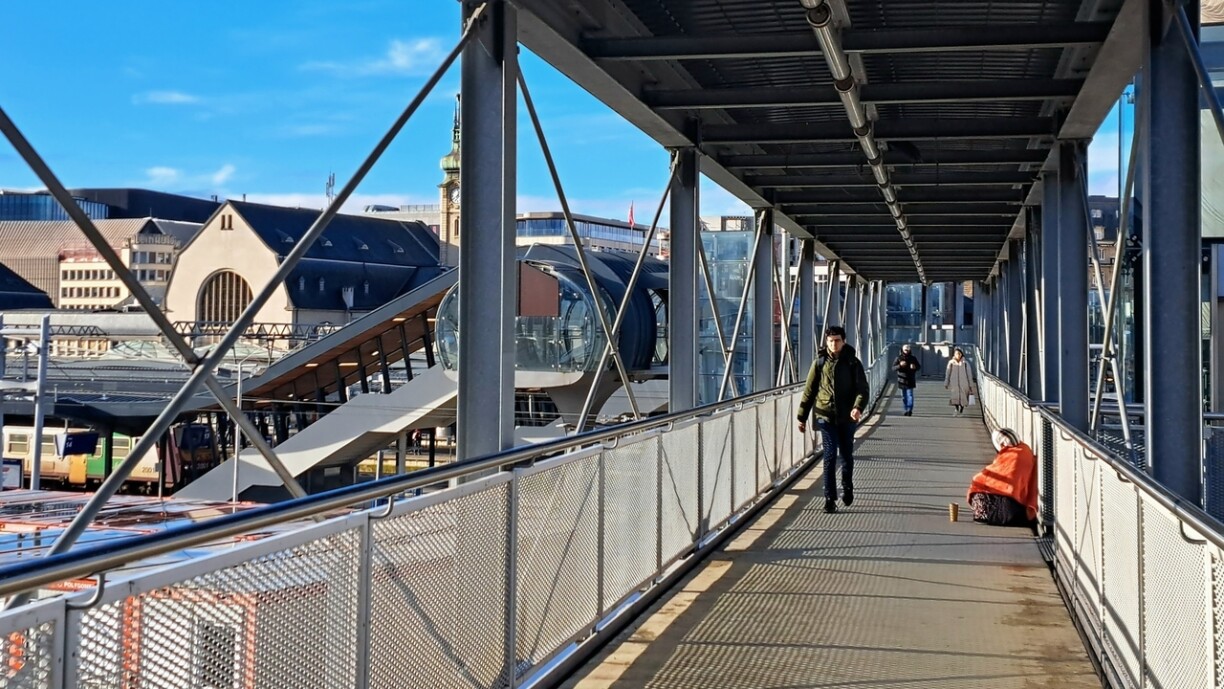
Minister for Home Affairs Léon Gloden defended the ban, stating that its primary focus is on curtailing aggressive behaviour and organised begging activities. Earlier this week, Gloden reversed his predecessor's decision to annul the corresponding police regulation, a move criticised by some members of the parliamentary committee for internal security on Wednesday.
Minister Gloden briefed MPs during a Wednesday afternoon parliamentary committee meeting, outlining the next steps established in a meeting earlier that day with the police and the municipality of Luxembourg City.
The partial begging ban, effective from 7am to 10pm, will be implemented in specific locations, including major streets in the city centre, the Gare neighbourhood, and prominent public squares and parks. As an initial measure, the municipality of Luxembourg City aims to raise awareness through the distribution of flyers and an increased police presence, according to the minister's post-committee briefing. In the subsequent phase, individuals found begging during prohibited times and locations will face fines, with cases referred to the public prosecutor's office for further action. Minister Gloden reiterated that the ban is specifically targeted at "aggressive and organised" begging.
MP and mayor of Dudelange Dan Biancalana of the Luxembourg Socialist Workers' Party (LSAP) highlighted that existing laws already permit prosecution for aggressive behaviour. Minister Gloden responded, emphasising the importance of visibility and asserting that individuals may be more familiar with police regulations than the penal code. Gloden suggested that municipalities could request police enforcement of their regulations, emphasising this as a key aspect of the ban's implementation.
For the opposition, however, a number of questions remain unanswered. MP Marc Goergen from the Pirate Party wondered how people who cannot even afford to eat are supposed to pay fines. Additionally, Goergen pointed out that these people lack fixed addresses to which fines could be sent. Minister Gloden dismissed this argument, asserting that such reasoning would undermine the principles of a state governed by the rule of law, "otherwise people could commit any sort of offence and just claim that they don't have anything."
Fernand Kartheiser of the Alternative Democratic Reform Party (adr) acknowledged the government's intention to address organised begging but felt that the proposed measures fell short. Kartheiser argued that the focus on penalising individual beggars did not adequately target the organisations behind such activities. He advocated for more comprehensive measures against organised begging while expressing concern that socially vulnerable individuals in dire situations should receive assistance rather than punishment.
Both the LSAP and the Green Party (déi gréng) are exploring the possibility of challenging the government's decision in court. Meris Šehović of the Green Party criticised Minister Gloden's reliance on a decree from 1789, which stipulates that the mayor is responsible for guaranteeing safety, peace, and health: "It is phenomenal to see that the new minister, who was one of the rapporteurs of the new constitution, is basing today's decision on a decree from 1789." In doing so, the minister would be ignoring the new constitution, which emphasises that restrictions on personal freedoms must be limited by law rather than municipal regulations, Šehović said. Dan Biancalana echoed these concerns, stating that the geographical and temporal restrictions imposed by the ban constitute a clear limitation of freedoms.
The LSAP stressed the importance of prevention, a facet they believe has been overlooked in the government's approach. The Green Party expressed "disappointment across the board," the adr found the approach to "normal begging" lacking from a social standpoint, and the Pirate Party characterised the ban as a "cold wind" disproportionately affecting the most vulnerable members of society.
Full report by RTL Télé (in Luxembourgish)





