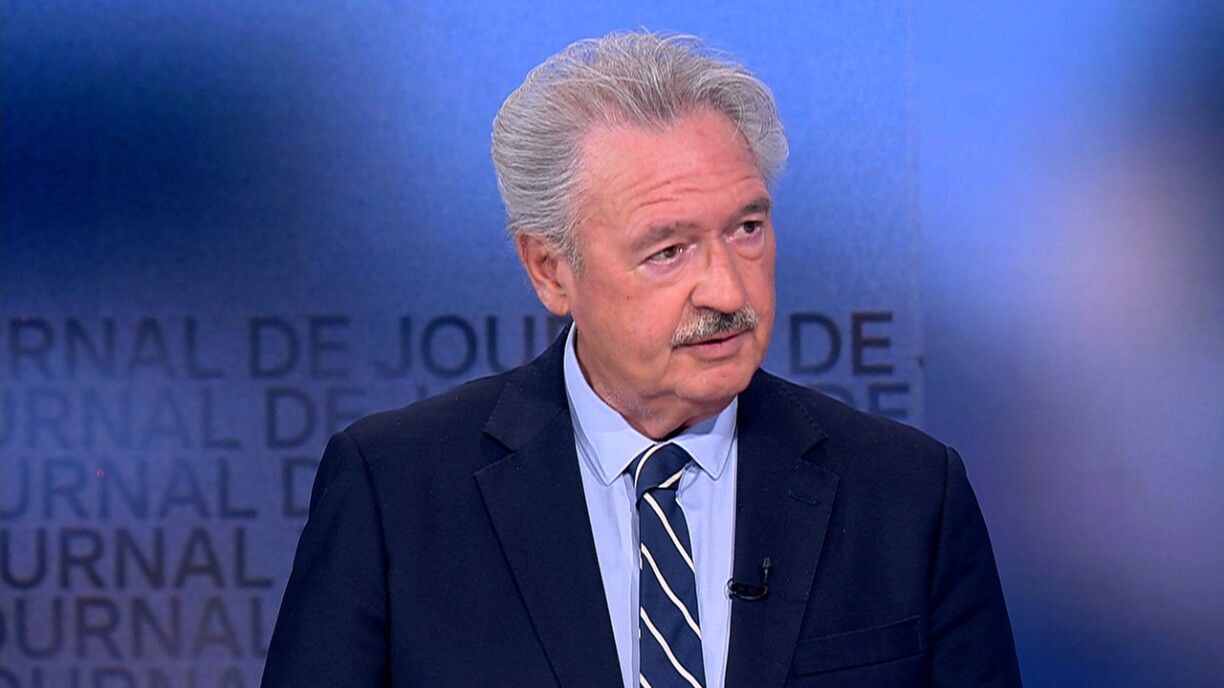
The first part of the discussion centred on recent changes in Luxembourg's refugee policy, particularly concerning male refugees who are alone and have already applied for asylum in another EU country.
For the past week, these refugees have not been accepted into Luxembourg's refugee facilities and have instead been placed on a waiting list, a practice similar to that in Belgium. This decision has faced criticism from the Refugee Council, as it raises concerns about the fate of these refugees, especially as the cold season sets in, potentially leaving them on the streets until suitable arrangements can be made.
When asked about the timing of these policy changes, Asselborn responded, "I realised that if we don't react, we'll run into a wall." He explained that the primary issue behind these changes is the limited capacity within Luxembourg's refugee structures.
Drawing a comparison to Belgium, which is 17 times larger, he noted that while Belgium has 34,000 beds, Luxembourg only has 8,000.
Asselborn further pointed out that an influx of people from Italy who were part of the Dublin procedure and chose to come to Luxembourg, coupled with the challenges of housing a diverse group of refugees in the same facilities, contributed to the problem.
Regarding security concerns within the facilities, Asselborn acknowledged, "Yes, concerning cohabitation, this issue has periodically arisen and, at times, quite severely. There are problems when it comes to living together in these structures. Among the Dublin cases – and it's essential not to generalise – there are individuals, primarily men, who may have attempted to seek asylum in three or four other countries before coming here. Their primary goal might not necessarily be to obtain asylum in Luxembourg, but rather to find accommodation. This has led to occasional clashes. As the situation worsened over time, we needed to find a solution to accommodate the Dublin cases separately, with different monitoring compared to other facilities."
When asked about the plan to provide shelter for those currently without it, Asselborn stated that measures have been taken to direct these individuals to a specific facility.
"We have now arranged for these people to be accommodated in a dedicated hall where differently trained staff can manage their needs more effectively," the minister explained. He emphasised that this approach contrasts with typical facilities staffed by security personnel with limited intervention capabilities.
Asselborn elaborated on the specific facility in question, located within Luxexpo, which exclusively houses Dublin cases – individuals who have previously undergone the asylum procedure in another EU country, such as Italy, and are awaiting the clarification of their status. He noted that the facility was initially at capacity, prompting a recent reassessment.
"We decided to establish priority lists and conduct case assessments with the involvement of social workers and medical personnel," Asselborn clarified. "The priority list categorises individuals based on factors like illness, vulnerability, age, and disability. Those in urgent need are placed at the top of the list, while others must wait their turn. Currently, we have 25 people on the list, and we will accommodate 15 of them tomorrow at Luxexpo, strictly adhering to the order."
Addressing the influx of asylum seekers from Italy, Asselborn revealed, "In October alone, we received 300 asylum applications, with over 120 coming from Italy as Dublin cases. These individuals are well aware that they must await the determination of their status and are not supposed to travel further within Europe."
The interviewer then pointed out that these individuals nevertheless also require assistance. Asselborn acknowledged this concern and explained the need for prioritisation, stating, "We are indeed providing assistance, but I had to establish priorities to ensure that we do not face a situation where women, children, and families are left without shelter. We can only use the spaces available. I'd like to highlight the role of municipalities in this matter: If they give us ten acres of land, we build a facility on that and we can house 35 refugees there. It wouldn't cost them a single cent."
However, the plan's viability depends on municipal participation. When asked about the government's course of action if municipalities do not take up the offer, Asselborn expressed concern over the current level of participation. He stated, "Some municipalities have agreed, but not enough. Approximately two-thirds have yet to commit. If this trend persists, we may need to explore alternative, potentially more mandatory, approaches. I've made efforts to persuade the municipalities, but there are limits to what I can achieve."
The Minister of Foreign Affairs was then questioned about the situation in the Middle East and the potential for the ongoing conflict to escalate into a major war. In response, Asselborn stressed the complex dynamics in the region, pointing out the involvement of multiple actors.
He noted, "At the moment, it's about who's taking charge in the Middle East. Is it Iran? With Hezbollah, with the Houthis, from Yemen? Is it Turkey? You heard Erdogan's speech, a nasty speech questioning Israel's right to exist. That's a struggle that's going on and that could become extremely explosive."
Asselborn further discussed his observations at the UN General Assembly, where he mentioned the Iranian Foreign Minister's speech. He highlighted the contentious nature of the discourse, saying, "Listening to this man, you wouldn't think you were in the UN, where the rule is supposed to be that one country respects the other and also one country works with the other. His rhetoric is extremely, extremely virulent. They don't recognise Israel's right to exist."
Regarding the humanitarian crisis in Gaza, Asselborn commended the U.S. Secretary of State, Antony Blinken, for his scheduled visit to the region. He acknowledged the difficult situation and the need to avoid further bloodshed.
He stated, "Israel has been through terrible things. Children have been shot in front of their parents. And the opposite, parents in front of their children. For Israel to stand up to that, to make sure that doesn't happen again, I think any reasonable person understands that."
Asselborn then outlined the key points Blinken is expected to address during his visit, including the importance of not seeking revenge, upholding international and humanitarian law, calling for a humanitarian pause, and focusing on the issue of hostages or prisoners. He emphasised the potential consequences of being accused of war crimes, both for Israel and the Western world.
In closing, Asselborn expressed hope for a resolution to the conflict, saying, "I hope that a moment will come when Israel will realise that this fear, this panic in which the Palestinians are now living, is similar, practically similar, to what they went through on 7 October. And that's why I hope that they will have a moment of insight and that this offensive will be over quickly. And I hope that Hamas will be defeated. Then, of course, the big question will be, what happens to Gaza? And that is a question that I think must interest not only the Americans but also the Europeans."
Full interview (in Luxembourgish)





