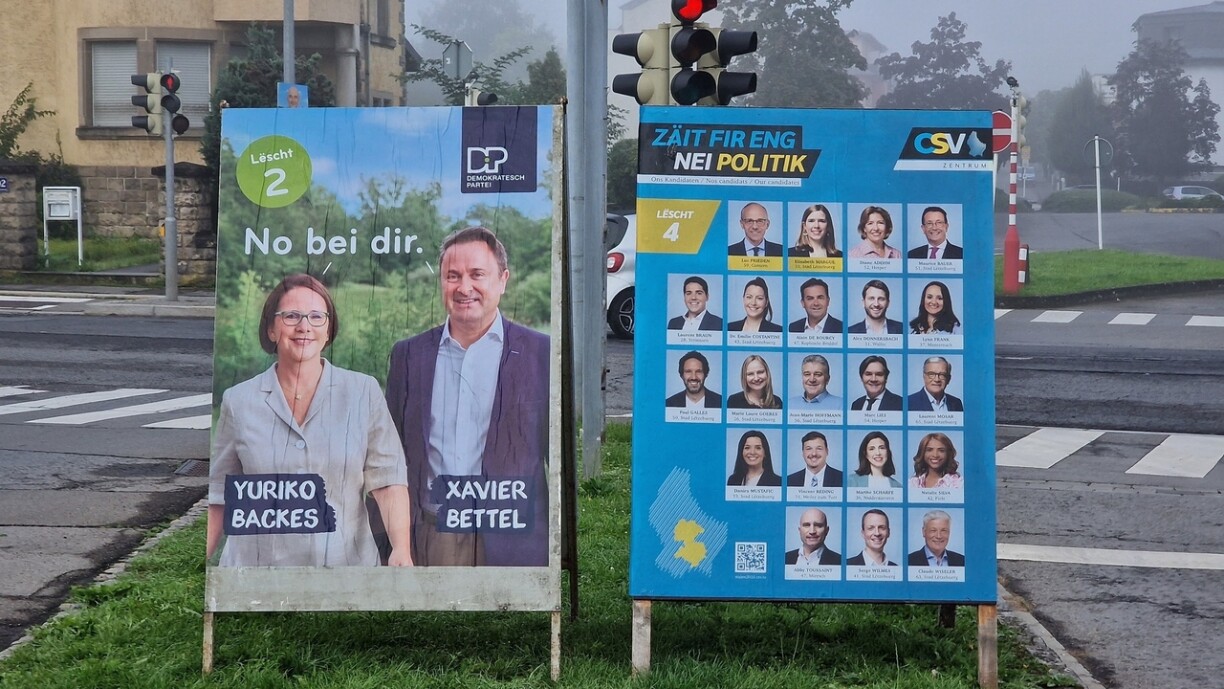
The countdown has officially started, only 36 days left until the national election takes place! Saturday thus marked the beginning of the unofficial campaign period, allowing Luxembourg's parties to hang up their election posters across the Grand Duchy.
But what are the rules for these electoral posters?
Nine of the parties running settled on a date for the launch back in January, which was then retained in the electoral agreement. Those included the seven parties already in the Chamber of Deputies with the addition of Fokus and Volt. They further agreed on the number and size of posters, as well as limiting media campaign spending to €100,000.
The Bridges and Roads Authority also has some rules the parties need to respect. According to spokesperson Gilles Didier, these are based on common sense, like ensuring that road signs remain visible and that roads are safe for drivers and pedestrians alike. Posters should therefore not be hanging next to pedestrian crossings as that might distract motorists.
According to Didier, often enough the Authority needs to take down posters that do not respect these rules.
Read also: Campaign kickoff marred by immediate vandalism of election posters
The official electoral campaign only starts on Monday 4 September and will go on for five weeks. The parties will have to remove their posters on 18 October at the latest.
Together with an advertising agency, our colleagues from RTL had a look at the different posters and there were big gaps in quality.
According to Dr Verena Landgraf-Freudenreich from the Ierace Dechmann + Partners (IDP) agency, the Green Party (déi gréng) is doing quite well as people who are voting for the first time might be intrigued by their posters: "They have created a visual language that combines the Luxembourgish context with aquarelle and they have followed through consistently. Their messages are short and concise, meaning onlookers have no difficulties deciphering them."
The marketing expert noted that the Luxembourg Socialist Workers' Party (LSAP) has a poorer image quality, which might impact lesser-known candidates.
In a multilingual country like Luxembourg, the language used is highly important. The posters are all written in Luxembourgish, but the more text is added, the greater the risk of losing potential votes.
Dr Landgraf-Freudenreich praised the aesthetics of the Democratic party (DP), but argued that there is too much text on their posters: "Too much text is the case if you drive past with a car or a bicycle and you don't catch the message. If, as a political party, you have to explain yourself on three different levels with a slogan, a title, and an explanation, then you are not far off from printing your whole manifesto on a poster."
These electoral posters might be a tradition in Luxembourg, but this year’s campaign will likely happen more through digital marketing and on social media platforms.
The majority of electoral campaign material was meanwhile manufactured abroad.





