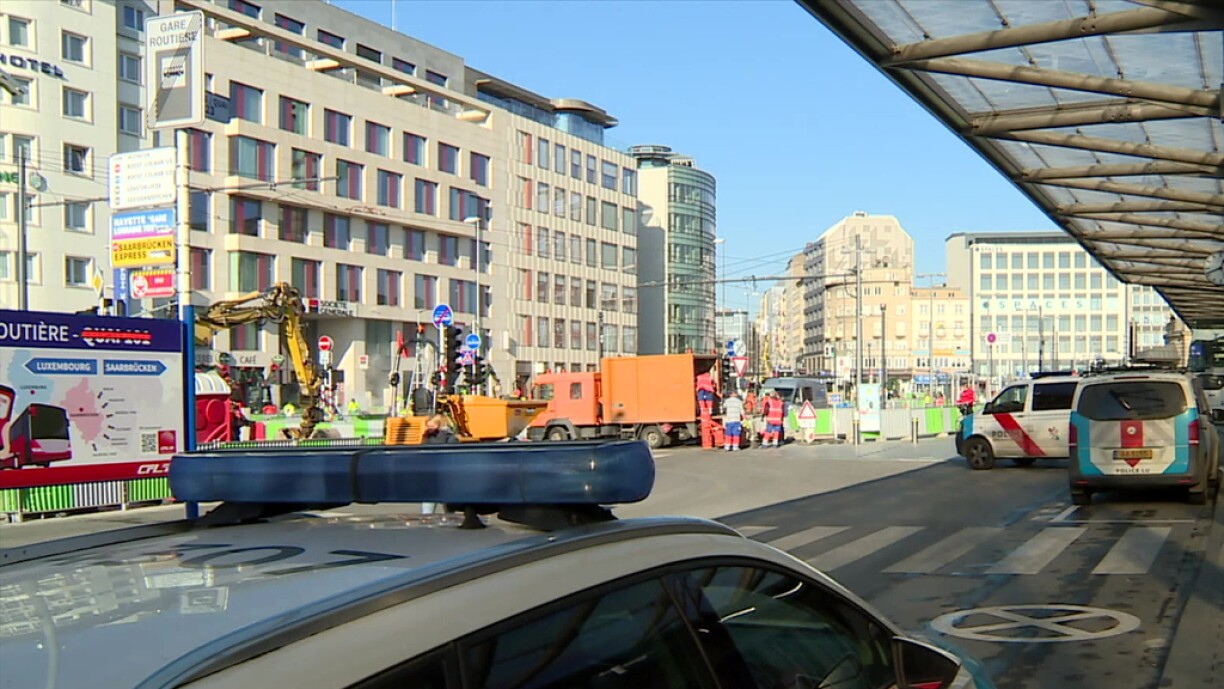
So far, political stances regarding the deployment of private security companies clash between Luxembourg City's municipal executive, a coalition between the Democratic Party (DP) and the Christian Social People's Party (CSV), and Minister of Internal Security Henri Kox.
A new document has now surfaced which is sure to fire up discussions once again – an until-now unpublished document written by the police and five ministries on the topic of drug-related crime.
This document is available to RTL.
The authors appear to be high-ranking civil servants, who point out where exactly the problems related to security and drug-related crime lie.
Regarding the current issues, which particularly affects Quartier de la Gare, the document assesses that Luxembourg City is an especially appealing place to sell illicit substances. In addition, the contact point for drug addicts, Abrigado, is completely overwhelmed with work, and police investigations often end without consequences, for instance because the expulsion of people who were found in possession of drugs is not possible due to a variety of obstacles.
The police point out that Luxembourg's hospitals do not have appropriate spaces to take in so-called "body packers", i.e. people who conceal drugs or plastic pouches containing illicit substances inside their bodies. At the moment, for instance, the area inside the Centre Hospitalier de Luxembourg (CHL) where these people are treated is on the same floor as the Covid-19 ward.
The interministerial note also harshly criticises Luxembourg City's municipal government. The authors state, for instance, that social contact points should be in different locations, and public places should be brighter and with less potential hiding spots for drug trafficking. The concept of "housing first" should also be prioritised, including the creation of small, decentralised structures for people suffering from drug addiction. According to the document, the Ministry of Health has been waiting for over a year for a reply by the capital's municipal authorities on these points.
One of the conclusions drawn by the note is that no single entity is solely to blame for the current situation.
The document points out the "complexity of the issue and the multitude of actors coming into play at different levels and stages of the process". The solutions, the authors continue, must include the prevention of drug addiction, care and guidance structures for vulnerable people, and the suppression of criminal offences. Making one actor solely responsible for coming up with a solution would be too short-sighted, with the document's authors stressing that "only a holistic approach involving the different actors in their respective areas of responsibility" could lead to a resolution of the issue.
The document's authors, including the police, stress the importance of working on a solution, with the end goal being the creation of a White Paper.
It should be noted that the document does not comment on, or for that matter even mention, the presence of private security companies around the capital's railway station and in Bonnevoie.
The president of the Parliamentary Commission for Judicial Affairs, Charel Margue, assured RTL that the note would be discussed and fleshed out. However, whether this will take place in the context of a public consultation is not yet known. The only thing that is safe to say is that the topic of law and order, including direct repercussions on the right for international protection and for the treatment of people under this status, is certain to be on the political agenda.





