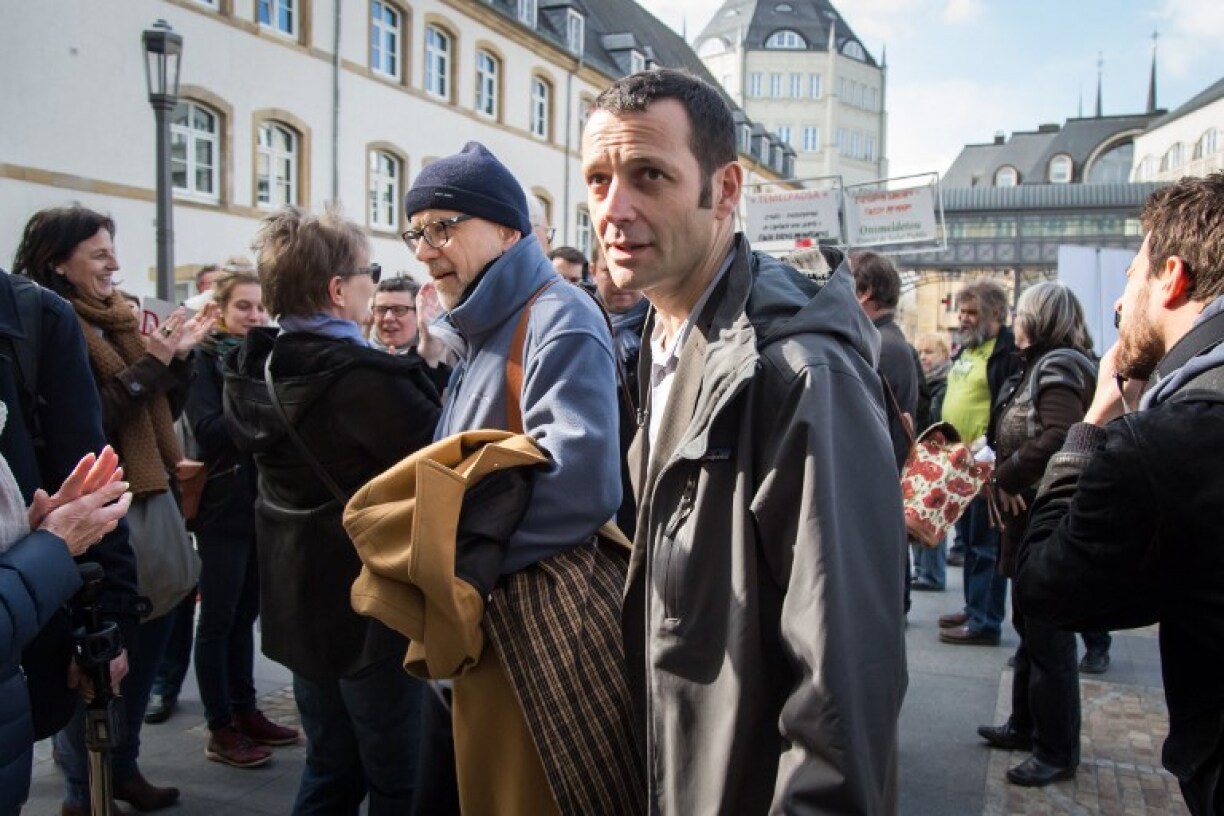
This hearing before the Court of Appeal, a consequence of the LuxLeaks case, was a “real issue on the freedom to inform”, according to Édouard Perrin, journalist for the French television show “Cash Investigation”.
Perrin is at the origin of the revelations in the tax evasion case which brought to light the practices of the Luxembourg audit firm PriceWaterhouseCoopers (PwC).
In November 2014, PwC had the computer equipment of the whistleblower Raphaël Halet seized at his home in France and proceeded to access his correspondence with Perrin. In order to carry out the seizure, PwC obtained an order signed by the Metz special court for interim measures to enter Halet’s home.
Perrin, who was accused and then acquitted during the LuxLeaks trial in Luxembourg, decided to take the audit firm to court in November 2017 for a clear breach of confidentiality of sources with the goal of having the order quashed.
The French journalist explained that this action had only one aim: that a judge could never again sign this kind of document. He also pointed out that the judge who did so in this case later admitted that she would not do it again.
Following Perrin’s action, the public prosecutor initially took the view that this was a clear violation of the secrecy of sources, enshrined in the 1881 bill since 2010, and essential for an investigation of this magnitude. However, to general bewilderment, the Metz district court, on the other hand, dismissed the journalist in February 2018 and fined him €3,000.
At the end of the hearing on Tuesday, Perrin was still asking himself many questions: Why did a judge sign an order allowing this seizure? Why was the violation of the confidentiality of sources recognised in the first instance, and above all why did the public prosecutor’s office subsequently decide to completely reverse its position? Perrin stated that, after Tuesday’s hearing, he was not at all confident. The same arguments were put forward by PwC’s lawyer, whose pleadings, Perrin pointed out, contained at least two lies. One concerning the initial application in which his name was allegedly not mentioned, which was not true, and the other concerning Halet’s status as a whistleblower, currently under consideration before the European Court of Human Rights, contrary to what PwC’s lawyer claimed, Perrin countered.
The National Union of Journalists (SNJ), which supports Perrin and is represented by Dominique Pradalié, declared that is ready and prepared to continue the fight, stating that it is “unbelievable” to be forced to go to court to have this order quashed.
The SNJ notes that what this affair showed is that a company can legitimately take the law into its own hands and “ensure that the secrecy of its business takes precedence over the secrecy of sources and the general interest”. This is, according to the union, opening up the path to a never-before-seen lack of transparency in terms of revealing dubious company practices.
The appeal process could lead to a disturbing jurisprudence for the practice of the journalist’s profession, and therefore for democracy as a whole.
The accounts of both parties’ lawyers and a few words from the prosecutor were on the agenda of Tuesday’s hearing.
The verdict will be handed down on 25 March.





